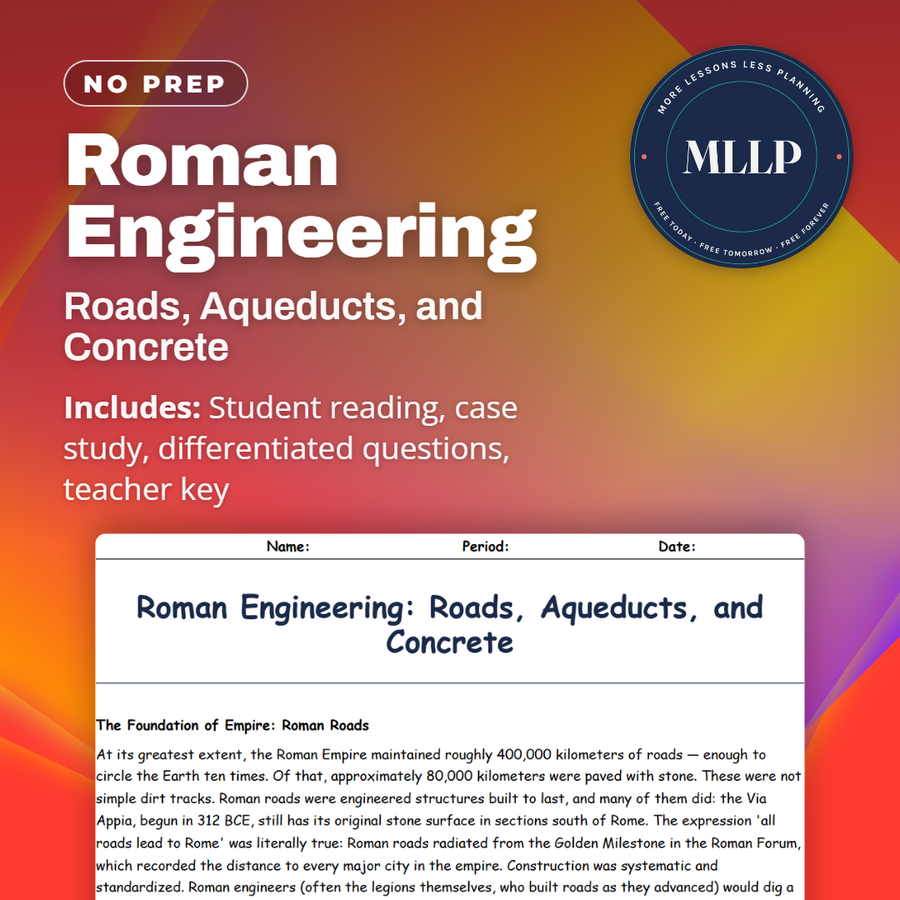
Roman Engineering: Roads, Aqueducts, and Concrete
Quality reviewed September 2026
Facts verified September 21, 2026
- Subject
- Social Studies
- Grades
- Grades 9-12
- Length
- 8-page student worksheet
- Time
- About one 50-minute class period
- Great for
- Sub plans and independent work
- Includes
- Reading passage, comprehension questions + full answer key
- Format
- Print-and-go PDF
What students do
- Titus the aquarius weighs four different repair options for a cracked aqueduct arch under deadline pressure
- Explain how Roman engineers moved water across fifty kilometers using nothing but gravity and slope
- Roman concrete's seawater reaction and why it grows stronger instead of weaker over time get worked through in detail
- Trace how a Roman road's layers of sand, gravel, and stone slabs were built to drain and last
What it covers
- How Roman aqueducts moved a billion liters of water a day using gravity and calculated slope alone
- Why Roman concrete grows stronger over centuries instead of degrading like modern concrete
- The Cloaca Maxima sewer system and its role in reducing disease in ancient Rome
Start reading this worksheet
The Foundation of Empire: Roman Roads
At its greatest extent, the Roman Empire maintained roughly 400,000 kilometers of roads. That is enough to circle the Earth ten times. Of that, approximately 80,000 kilometers were paved with stone. These were not simple dirt tracks. Roman roads were engineered structures built to last, and many of them did: the Via Appia, begun in 312 BCE, still has its original stone surface in sections south of Rome. The expression 'all roads lead to Rome' was literally true: Roman roads radiated from the Golden Milestone in the Roman Forum, which recorded the distance to every major city in the empire. Construction was systematic and standardized. Roman engineers (often the legions themselves, who built roads as they advanced) would dig a trench up to a meter deep, fill it with layers of sand, gravel, and rudus (a layer of rubble bound with lime mortar), and top it with fitted stone slabs, slightly curved to shed rainwater toward drainage ditches on either side. The roads were dead straight wherever terrain allowed: Roman surveyors used a groma, a simple instrument with hanging plumb lines, to maintain alignment across hundreds of kilometers. Speed of travel, troop movement, and message delivery all depended on road quality.
Moving Water: The Roman Aqueduct System
Rome the city had a water problem. The Tiber River that flows through it is slow, shallow, and historically brown with silt. By the late Republic, Rome's population had swollen past half a million people. By the imperial era, it may have reached a million. Supplying clean water to that many people without modern pumping technology required one of the most impressive engineering feats of the ancient world: the aqueduct system. At its peak, eleven major aqueducts supplied Rome with roughly one billion liters of water per day, more water per capita than many modern cities. The system worked entirely on gravity. Engineers surveyed the terrain and calculated the precise slope needed to keep water flowing steadily without losing pressure or stagnating. Where valleys interrupted the route, they built arched bridges, like the spectacular Pont du Gard in southern France, which carries an aqueduct 49 meters above the Gardon River on three tiers of arches. The engineering required to maintain a consistent slope across 50 kilometers of varying landscape, using only optical instruments, is astonishing by any standard. Once inside the city, water flowed into distribution tanks called castella that divided the supply. The wealthy had private connections piped directly into their homes. Public fountains supplied everyone else, typically within easy walking distance of any location in the city. Public baths, latrines, and the Colosseum's underground systems also required constant water supply.
Roman Concrete: The Ancient Material Science Still Puzzling Engineers
Perhaps Rome's most remarkable engineering achievement is one that most people walk past without noticing: concrete. Roman concrete (opus caementicium) was mixed from volcanic ash called pozzolana, seawater or freshwater, lime, and rubble aggregate. The result was a material that could be poured into forms of almost any shape, set underwater, and grow stronger over centuries rather than weaker. Modern Portland cement concrete is strong initially but degrades over decades. Roman concrete structures like the Pantheon's dome (built 125 CE, still the world's largest unreinforced concrete dome), the harbor at Caesarea Maritima, and the Baths of Caracalla have stood for nearly two thousand years with minimal maintenance. Scientists analyzing Roman marine concrete discovered that seawater reacting with the volcanic ash created mineral crystals that actually reinforced the concrete's structure over time: the reverse of what happens in modern concrete, which is attacked by seawater. This discovery has significant implications for sustainable construction today.
Like what you read? The full reading, the case study, and every question set are in the free download below, along with the answer key.
Why this matters
Titus's decision about the cracked arch is really a decision about tradeoffs, cheap fixes versus reliable ones, and that is a conversation every city still has about aging infrastructure, whether it's a bridge, a water main, or a road. The detail about Roman concrete growing stronger from seawater exposure is not only a neat fact either. Engineers today are studying that same chemical reaction to design longer-lasting coastal construction, which means a two-thousand-year-old recipe might end up shaping how the next generation of seawalls gets built.
From one teacher to another
Four hundred thousand kilometers of road, eleven aqueducts moving a billion liters of water a day, and concrete that gets stronger with age: the reading treats Roman infrastructure as proof that engineering, not conquest alone, held the empire together. Students read how Roman roads were built in layers with drainage ditches and kept straight using a simple plumb-line tool called a groma, then follow the gravity-only aqueduct system down to castella that distributed water across a city. A passage on Roman concrete explains how seawater reacting with volcanic ash actually reinforces the material over centuries, the opposite of what happens to modern concrete. Titus the aquarius, staring at a cracked aqueduct arch and a foreman demanding a decision, is where the case study lands.
What you get
Download
Where should I send the next one?
Everything here is free and it stays that way. Leave your email and I'll send you the new lessons as they go up. You can unsubscribe from any one of them.
Related resources


Every lesson on this site is free to download and use. If one of them saved you a prep period, you can chip in a few bucks toward my three kids' daycare fund. That's genuinely where tips go.