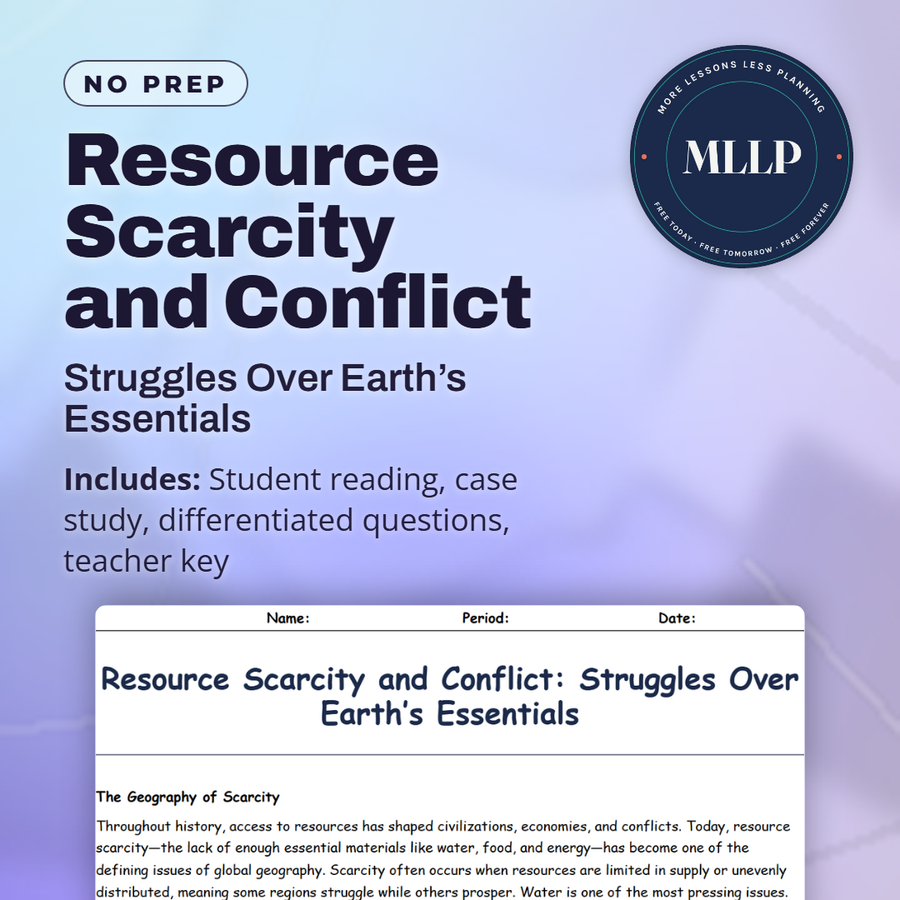
Resource Scarcity and Conflict: Struggles Over Earth’s Essentials
Quality reviewed September 2026
Facts verified September 14, 2026
- Subject
- Social Studies
- Grades
- Grades 9-12
- Length
- 7-page student worksheet
- Time
- About one 50-minute class period
- Great for
- Sub plans and independent work
- Includes
- Reading passage, comprehension questions + full answer key
- Format
- Print-and-go PDF
What students do
- Match terms like the Nile River, Darfur, and desalination to their correct definitions
- Fill in the blank sentences on the Darfur region, melting glaciers in the Himalayas, and how scarcity can lead to cooperation
- Answer multiple choice questions on why water scarcity is such a global concern, which conflict combined scarcity and politics, and what desalination technology does
- Write short answers on how climate change intensifies resource scarcity, why scarcity can cause migration, and what solutions countries use to manage water shortages
What it covers
- How resource scarcity in water, farmland, and energy is unevenly distributed and can fuel tension between nations and communities
- Shared rivers like the Nile and treaties like the Indus Waters Treaty as examples of how scarcity leads to both conflict and cooperation
- A case study on the Darfur conflict, where competition for farmland and water combined with ethnic and political divisions to spark violence
Start reading this worksheet
The Geography of Scarcity
Throughout history, access to resources has shaped civilizations, economies, and conflicts. Today, resource scarcity (the lack of enough essential materials like water, food, and energy) has become one of the defining issues of global geography. Scarcity often occurs when resources are limited in supply or unevenly distributed, meaning some regions struggle while others prosper. Water is one of the most pressing issues. Although about 70% of the Earth’s surface is covered in water, only a tiny fraction is fresh and accessible for human use. Regions such as the Middle East and North Africa experience extreme water shortages, leading to disputes between countries and within communities. Similarly, fertile farmland is under pressure due to overuse, population growth, and climate change. These challenges make survival more difficult and can push nations toward conflict and competition. Energy resources such as oil, natural gas, and coal are also unevenly spread across the globe. Countries rich in fossil fuels, like Saudi Arabia or Russia, hold significant economic and political power, while others must import to meet their needs. Renewable resources like solar and wind power are growing, but not all regions have equal access to the technology or infrastructure to use them effectively. Geography thus plays a crucial role in determining who has resources, and who does not.
How Scarcity Leads to Conflict
Resource scarcity often increases tensions between communities, nations, or even global powers. In some cases, competition for resources sparks “resource wars.” For example, control over oil fields has played a role in conflicts in the Middle East. In Africa, disputes over access to water and grazing lands have fueled clashes between farmers and herders. Scarcity does not always directly cause wars, but it can worsen existing tensions, especially in regions already facing poverty or political instability. Migration is another outcome of scarcity. When people cannot access farmland, clean water, or jobs, they often move elsewhere, sometimes triggering disputes with local populations. For example, drought in the Sahel region of Africa has forced thousands to migrate southward, creating competition over land. Geography magnifies these struggles. Rivers that cross borders, like the Nile or the Mekong, become flashpoints as countries debate who has the right to use the water. Melting glaciers in the Himalayas threaten water supplies for billions in Asia. Meanwhile, climate change worsens scarcity by altering rainfall patterns, drying lakes, and damaging cropland. Without cooperation, the struggle for resources could escalate into greater global instability.
Like what you read? The full reading, the case study, and every question set are in the free download below, along with the answer key.
Why this matters
Drought and shrinking farmland in Darfur combined with ethnic and political divisions to spark a conflict that scarcity alone did not cause and politics alone did not cause either, it took both. The same pressure shows up over shared water: the Nile River and the Indus Waters Treaty exist because scarcity can push nations toward cooperation instead of war.
I pair Darfur with the treaty examples on purpose, because students default to assuming scarcity always ends in violence. Walking through the key info table, which maps resources from water to lithium onto the regions where they cause tension, lets them see cooperation and conflict as two outcomes of the same pressure.
From one teacher to another
This reading ties resource scarcity directly to real conflicts instead of leaving it abstract. The key info table maps five resources, from water to lithium, to the regions where they cause tension. The Darfur case study is the strongest piece, showing how drought and shrinking farmland escalated into a humanitarian crisis. I like that the reading also covers cooperative solutions like the Indus Waters Treaty and desalination alongside the conflict side. This pairs well with a unit on human-environment interaction.
What you get
Download
Where should I send the next one?
Everything here is free and it stays that way. Leave your email and I'll send you the new lessons as they go up. You can unsubscribe from any one of them.
Related resources
Changing Political Boundaries: Shaping the World Map
Climate Change Impacts and Adaptation: Facing a Warming World
Disease and Global Health: Geography of Epidemics and Recovery
Globalization and Interdependence: How the World is Connected
International Cooperation and Sustainability: Working Together for a Better Future
Migration Crises: Movement in a Changing World
Every lesson on this site is free to download and use. If one of them saved you a prep period, you can chip in a few bucks toward my three kids' daycare fund. That's genuinely where tips go.