Resolving Conflict at Home
Quality reviewed September 2026
Facts verified September 23, 2026
- Subject
- Career & Life Skills
- Grades
- Grades 9-12
- Length
- 9-page student worksheet
- Time
- About one 50-minute class period
- Great for
- Sub plans and independent work
- Includes
- Reading passage, comprehension questions + full answer key
- Format
- Print-and-go PDF
What students do
- Identify why a cool down break during conflict is maintenance rather than avoidance
- The Ortega family discovers their kitchen fight was never about fairness, it was about a definition
- Constructive conflict, accommodating, collaborating, repair attempt, and definition of done get matched to their real definitions
- Decide whether a plan without a scheduled check in date counts as a real plan at all
What it covers
- Where household conflict actually comes from, and the five ways people typically handle it
- The six step process for working through a conflict, from cooling down to a scheduled check in
- The Ortega family's Sunday meeting, called after a fight over the definition of a clean kitchen
Start reading this worksheet
Conflict Is Not the Problem
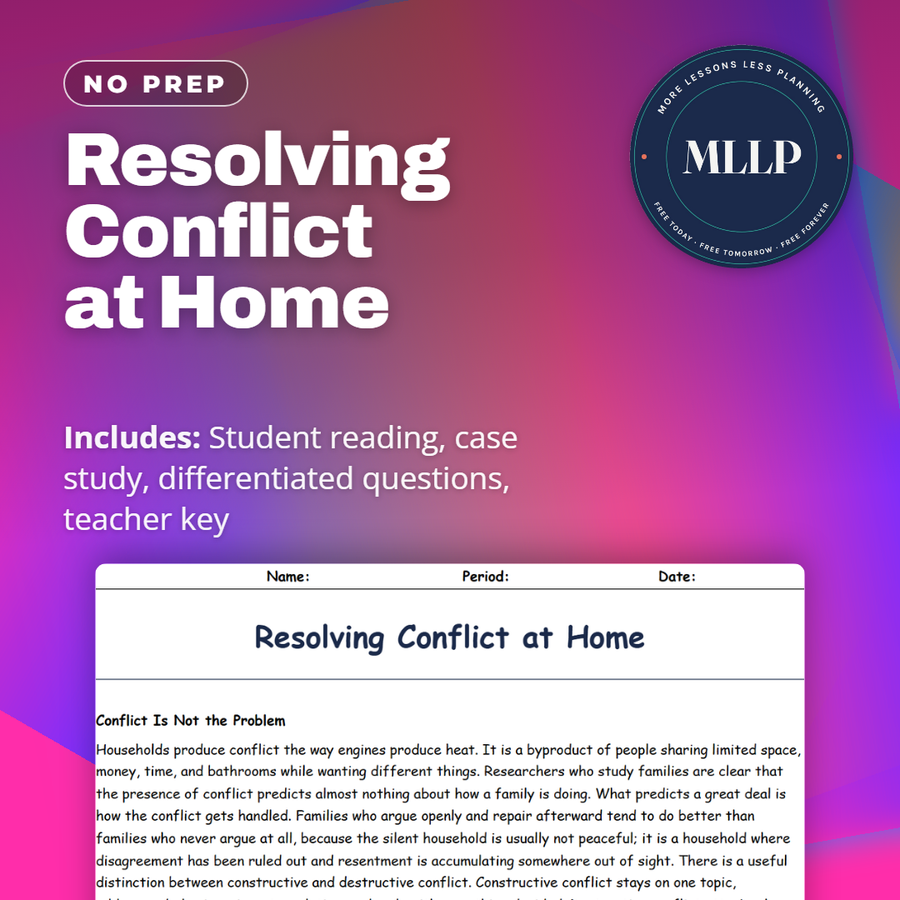
Households produce conflict the way engines produce heat. It is a byproduct of people sharing limited space, money, time, and bathrooms while wanting different things. Researchers who study families are clear that the presence of conflict predicts almost nothing about how a family is doing. What predicts a great deal is how the conflict gets handled. Families who argue openly and repair afterward tend to do better than families who never argue at all, because the silent household is usually not peaceful; it is a household where disagreement has been ruled out and resentment is accumulating somewhere out of sight. There is a useful distinction between constructive and destructive conflict. Constructive conflict stays on one topic, addresses behavior, aims at a solution, and ends with something decided. Destructive conflict attacks the person, expands to cover history, aims at winning, and ends with someone leaving the room. Both feel unpleasant while they happen, which is why people often cannot tell them apart in the moment and have to judge by the aftermath instead. A second point matters especially for teenagers. Conflict between a parent and a teen frequently increases in early adolescence and then declines, and the arguments cluster around autonomy: schedules, privacy, and who decides. That pattern is developmentally normal rather than a sign the relationship is failing. Knowing it is normal makes it easier to argue about curfew without concluding the whole relationship is broken.
Where Household Conflict Actually Comes From
If you survey what families fight about, the same short list appears everywhere: chores, money, screens and phones, curfew, privacy, tone of voice, and siblings. Underneath those surface topics sit a smaller number of real drivers. Unspoken expectations cause an enormous share, because each person is running a private rulebook and assumes it is obvious. One person believes clean means the counters are wiped, another believes it means the floor is mopped, and both feel wronged. Scarce resources drive another share, since one bathroom, one car, and one budget force real tradeoffs that cannot be resolved by everyone being nicer. Competing needs matter as well: a parent working an early shift needs quiet at ten, and a teenager finally has free time at ten. Neither is wrong. Role imbalance shows up when one person is carrying visibly more of the household load, and stress from outside the home reliably raises the temperature inside it, which is why job loss, illness, or a hard week at school so often surfaces as an argument about dishes. Family systems thinking adds that arguments frequently attach themselves to the wrong topic. A fight about a phone charger at eleven at night is rarely about a charger. Getting to the actual driver is most of the work, and the fastest route there is usually asking what is really bothering you about this, and then waiting.
Five Ways People Handle It
Conflict researchers commonly describe five styles, and most people have one they reach for automatically. Avoiding means sidestepping the issue entirely by changing the subject, leaving, or agreeing to talk later and never doing it. It is genuinely appropriate when the issue is trivial or when everyone is too heated to be useful, and it is a disaster as a permanent strategy because the problem waits. Accommodating means giving in to keep the peace, which works when the issue matters far more to the other person, and which becomes corrosive when the same person always accommodates. Competing means pushing for your own outcome, appropriate in an emergency or when a safety line is involved, and destructive as a default because it produces winners and losers inside a family. Compromising means each side gives up part of what they wanted, which is fast, fair-feeling, and often leaves both people partly unsatisfied. Collaborating means working the problem until a solution meets both sets of underlying needs, which takes the most time and produces the most durable result. The point of learning the list is not that collaborating is always correct. It is that most people use one style regardless of the situation and have never noticed. A teenager who always accommodates and a parent who always competes will produce the same fight for six years without either one choosing it.
Like what you read? The full reading, the case study, and every question set are in the free download below, along with the answer key.
Why this matters
Chores, screens, curfew, and money are exactly the fights this reading lists as universal, and most students are already having at least one of them at home right now, which makes the six step process considerably more useful than an abstract conflict resolution unit would be. I particularly like the reframe that a silent household is not automatically a peaceful one, since a lot of students assume the families that never argue are doing better than families like their own. The distinction between constructive conflict and destructive conflict gives students a real way to judge their own arguments by the aftermath instead of by how loud they got. Learning that a fight about a phone charger is rarely about the charger is the kind of insight that changes how a student reads their very next argument at home.
From one teacher to another
Households produce conflict for the most ordinary reason there is, people sharing limited space, time, money, and bathrooms while wanting different things, and the reading is upfront that the presence of conflict predicts almost nothing about how a family is actually doing. What predicts more is the pattern underneath it, and the reading sorts five common styles, avoiding, accommodating, competing, compromising, and collaborating, noting that most people default to one without ever choosing it. A full passage lays out a six step process for actually working through a disagreement, cooling down, defining the problem as a behavior rather than a character flaw, stating and reflecting each view, brainstorming, picking a plan, and setting a check in date. The Ortega family case study follows three people who agree completely about fairness and disagree entirely about what the word clean means, and the questions ask students to trace how that gap had been driving a fight that looked like it was about chores. A short closing section covers repair attempts and the four patterns, criticism, contempt, defensiveness, and stonewalling, worth avoiding.
What you get
Download
Where should I send the next one?
Everything here is free and it stays that way. Leave your email and I'll send you the new lessons as they go up. You can unsubscribe from any one of them.
Related resources

Aging Parents and the Sandwich Generation

Building Your Support Network
Communication Skills That Actually Work

Dating, Boundaries, and Consent

Divorce, Blended Families, and Change
Family Roles and Shared Responsibilities
Every lesson on this site is free to download and use. If one of them saved you a prep period, you can chip in a few bucks toward my three kids' daycare fund. That's genuinely where tips go.