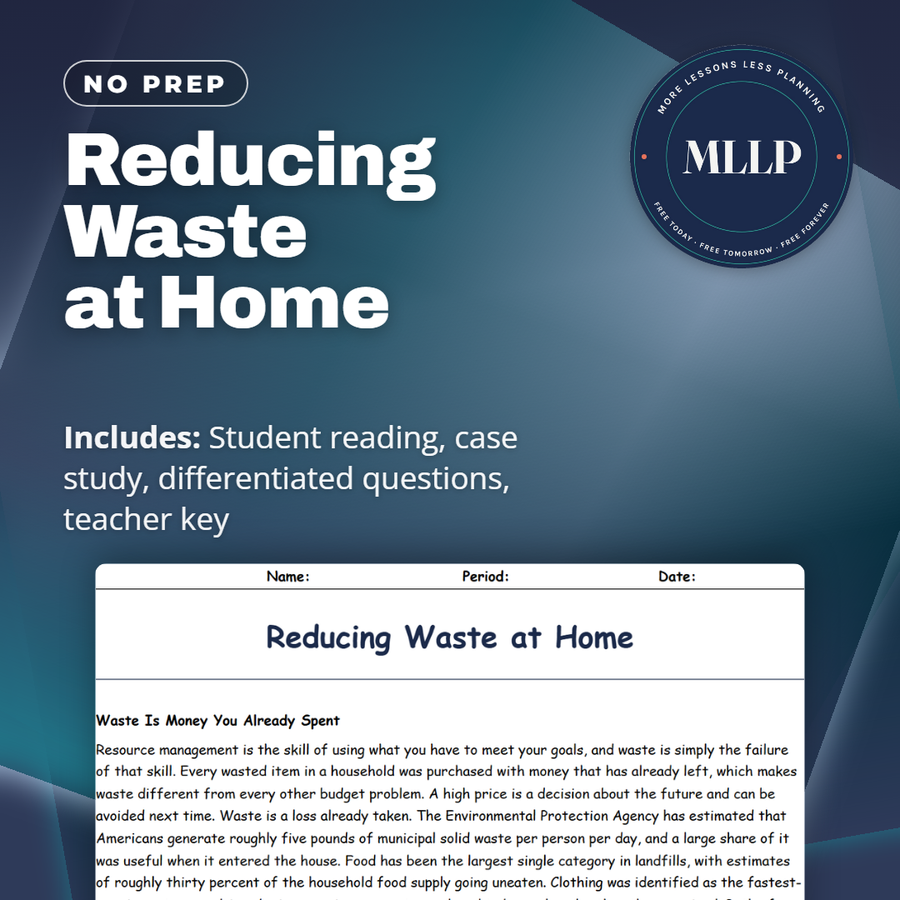
Reducing Waste at Home
Quality reviewed September 2026
Facts verified September 23, 2026
- Subject
- Career & Life Skills
- Grades
- Grades 9-12
- Length
- 8-page student worksheet
- Time
- About one 50-minute class period
- Great for
- Sub plans and independent work
- Includes
- Reading passage, comprehension questions + full answer key
- Format
- Print-and-go PDF
What students do
- The gap under Ngozi's back door and the incandescent bulbs get explained as two of the highest return fixes on her list
- Ngozi's household audit findings get matched to the money each one is actually costing
- Explain why one contaminated item can send an entire recycling load to a landfill
- Phantom load and an EnergyGuide label get used to compare two appliance choices
What it covers
- The reduce, reuse, recycle hierarchy and why the order is a ranking, not a list
- Planned obsolescence, right to repair, and wishcycling in household recycling
- Ngozi's audit of the Okafor household's energy and water waste
Start reading this worksheet
Waste Is Money You Already Spent
Resource management is the skill of using what you have to meet your goals, and waste is simply the failure of that skill. Every wasted item in a household was purchased with money that has already left, which makes waste different from every other budget problem. A high price is a decision about the future and can be avoided next time. Waste is a loss already taken. The Environmental Protection Agency has estimated that Americans generate roughly five pounds of municipal solid waste per person per day, and a large share of it was useful when it entered the house. Food has been the largest single category in landfills, with estimates of roughly thirty percent of the household food supply going uneaten. Clothing was identified as the fastest-growing category, driven by inexpensive garments produced to be replaced rather than repaired. Both of those numbers describe money, not just trash. The familiar phrase reduce, reuse, recycle is a ranking rather than a list, and that ordering is the part everyone forgets. Reduce comes first because the cheapest and cleanest resource is the one never purchased. Reuse comes second because extending an item's life requires no new manufacturing. Recycle comes last because it still consumes energy, water, and transportation to break something down and remake it. Recycling is genuinely valuable, but treating it as the primary answer inverts the hierarchy and lets the first two steps, which save far more money, go unused.
Buying Less and Buying Better
Reduction starts before the purchase, which is why it belongs in a consumer skills course rather than a science one. Buying only what will be used sounds trivial and is the largest single lever available, because unused purchases are pure loss. Choosing durability over disposability is close behind. A twenty dollar item that lasts a decade beats a four dollar item replaced every year, and the comparison only becomes visible if you calculate cost per use rather than cost per purchase. Reusable versions of disposable products, including water bottles, food containers, cloth napkins, and shopping bags, pay for themselves at a predictable point that is easy to calculate. Packaging is worth attention as well, since concentrated products, refill pouches, and bulk bins reduce both cost and volume. Planned obsolescence complicates all of this. Some products are deliberately designed for a short service life, with sealed batteries, proprietary screws, glued assemblies, or software updates that slow older devices. A growing right-to-repair movement has produced laws in several states requiring manufacturers to make parts, tools, and repair documentation available to owners and independent shops. As a consumer the practical response is to check repairability before buying anything expensive, since a device with available parts and a replaceable battery may last three times as long as a sealed competitor at the same price. Buying used converts someone else's disposal into your acquisition at a fraction of the price, and for furniture, tools, textbooks, and children's clothing it is frequently the obviously correct choice.
Getting a Second Life Out of What You Own
Reuse is where household skill turns directly into money, and it is the strand of consumer science with the deepest roots in home economics. Basic repair pays immediately. Sewing a button, patching a seam, replacing a zipper, tightening a chair, unclogging a drain, or swapping a phone battery each costs a few dollars and a short amount of time against replacement prices many times higher. Those skills have thinned out over two generations, which is precisely why they are valuable again now. Maintenance is the invisible half of reuse and generates a larger return than repair, because it prevents the failure entirely. Cleaning a dryer's lint trap and vent improves efficiency and prevents fires. Changing filters on furnaces and vacuums extends equipment life. Washing clothes in cold water on shorter cycles and air drying when possible reduces both utility costs and fabric wear, since the lint in a dryer is the garment slowly disappearing. Rotating and properly storing seasonal items prevents the damage that quietly retires them. Beyond repair sits repurposing, which finds a second function for something that has failed its first, such as glass jars becoming storage or worn towels becoming cleaning rags. When a household genuinely cannot use an item, giving it away through donation, resale, or a local exchange group keeps it in service somewhere else, which is a better outcome than a landfill and often a tax deduction or a small return.
Like what you read? The full reading, the case study, and every question set are in the free download below, along with the answer key.
Why this matters
A household's electric bill, water bill, and pile of half used products are all places where a teenager can see resource management working or failing in real time, usually without anyone framing it that way. The reading's point that waste is money already spent, unlike a high price which can still be avoided next time, reframes a running toilet or a drawer of unused chargers as a loss that already happened rather than a minor annoyance. Ngozi's own conclusion, that none of her fixes required sacrifice, only attention, is the kind of finding a student can act on the same week this reading is assigned.
From one teacher to another
The Okafor family's electric bill has climbed for four months straight before their daughter Ngozi runs a household audit and finds a daylight gap under the back door, eleven incandescent bulbs, and a toilet that has been running quietly for weeks. The reading ranks reduce, reuse, and recycle in that order on purpose, explaining why the cheapest fix is the purchase never made and why recycling, genuinely useful as it is, comes last because it still consumes energy to process. Students see repair and maintenance treated as real money, from a lint trap that prevents a fire to a replaceable phone battery that can triple a device's life, and learn why one greasy pizza box can send an entire load of recycling to a landfill. Ngozi's finished list costs under thirty dollars per item and fixes nothing with a new appliance.
What you get
Download
Where should I send the next one?
Everything here is free and it stays that way. Leave your email and I'll send you the new lessons as they go up. You can unsubscribe from any one of them.
Related resources
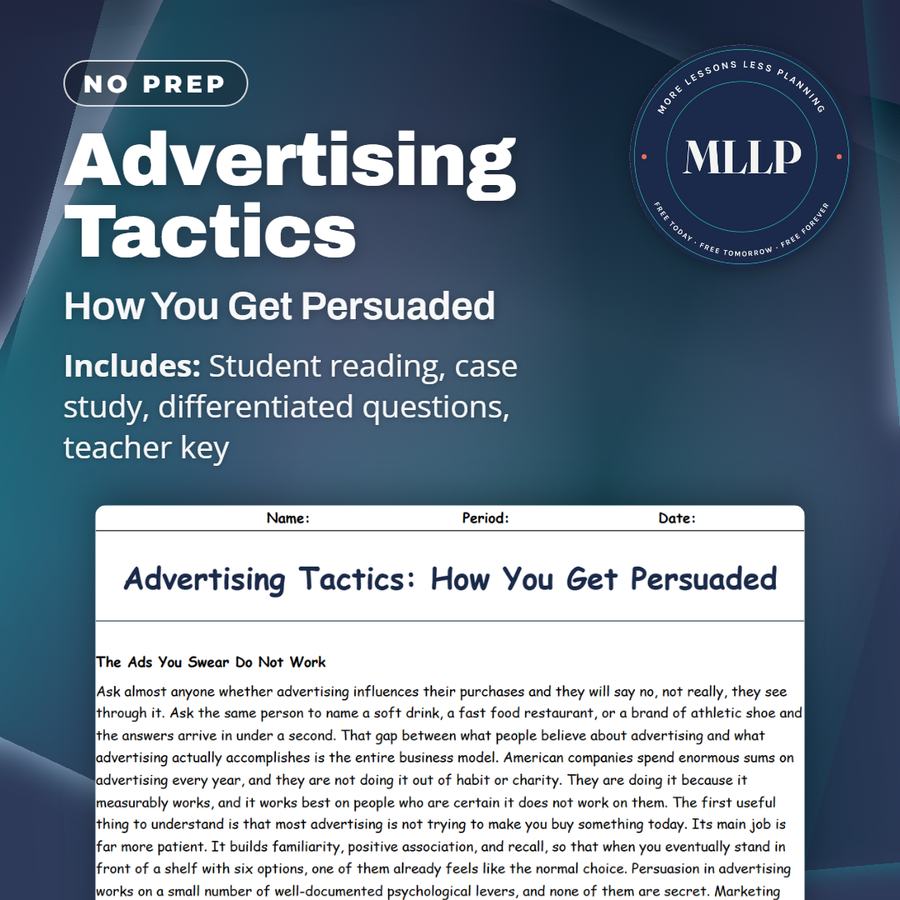
Advertising Tactics: How You Get Persuaded
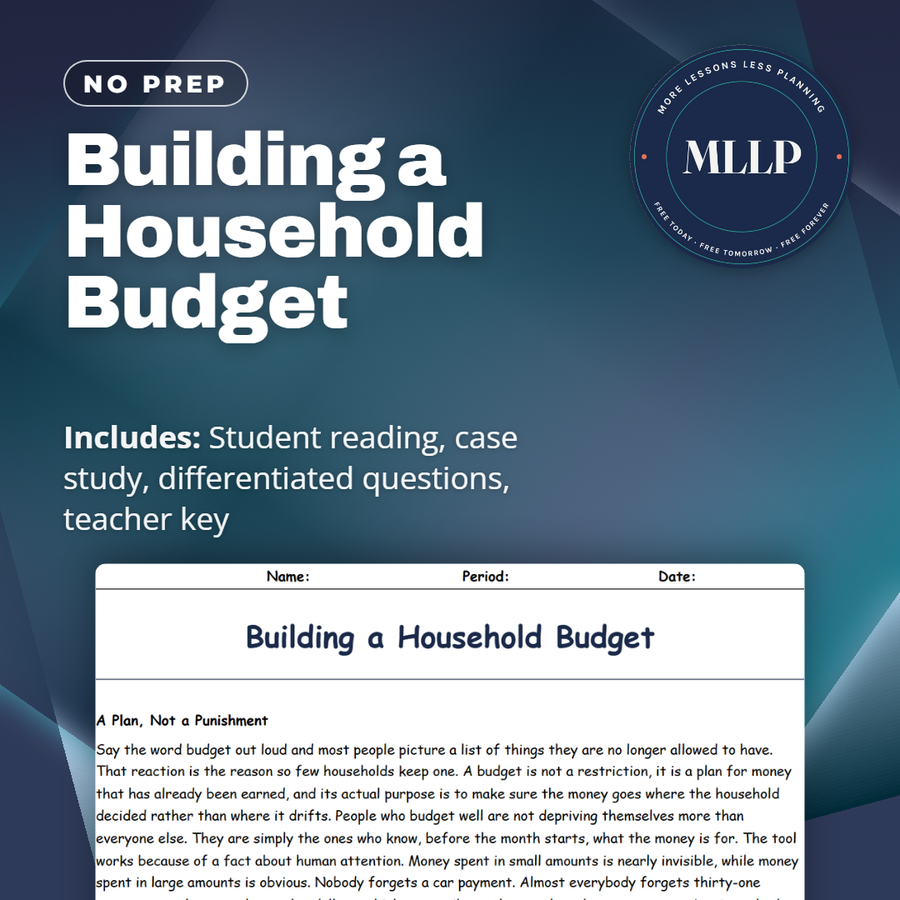
Building a Household Budget
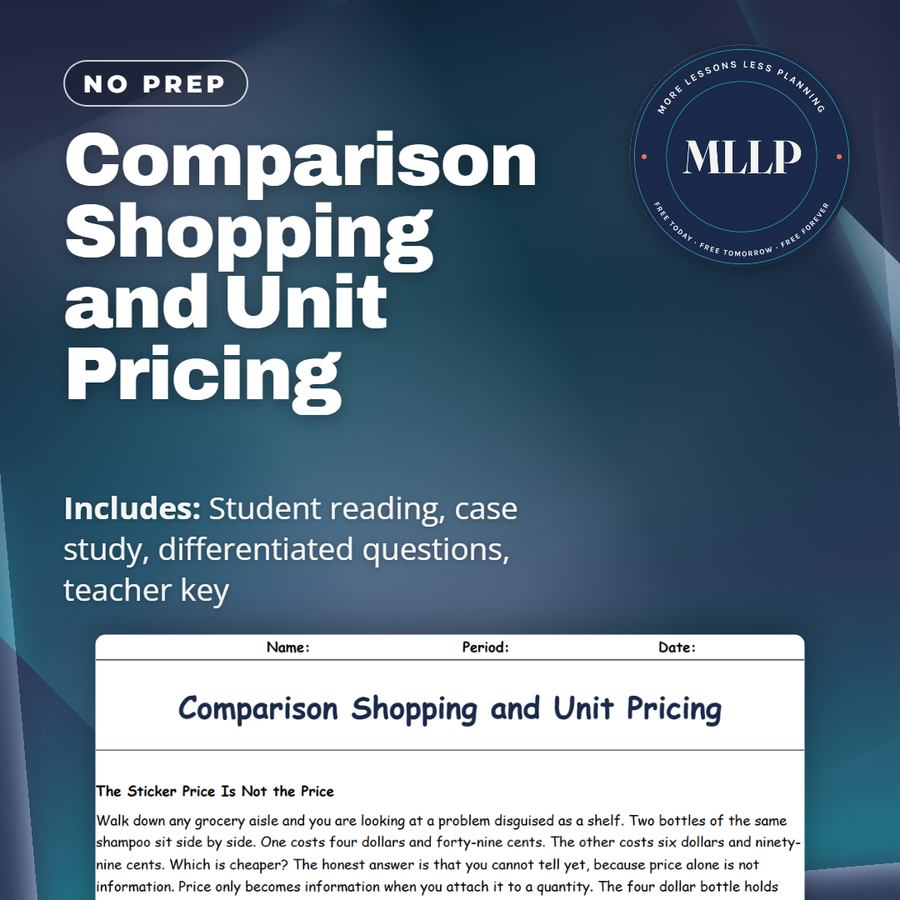
Comparison Shopping and Unit Pricing
Consumer Rights and Responsibilities
Grocery Shopping on a Budget
Making a Major Purchase
Every lesson on this site is free to download and use. If one of them saved you a prep period, you can chip in a few bucks toward my three kids' daycare fund. That's genuinely where tips go.