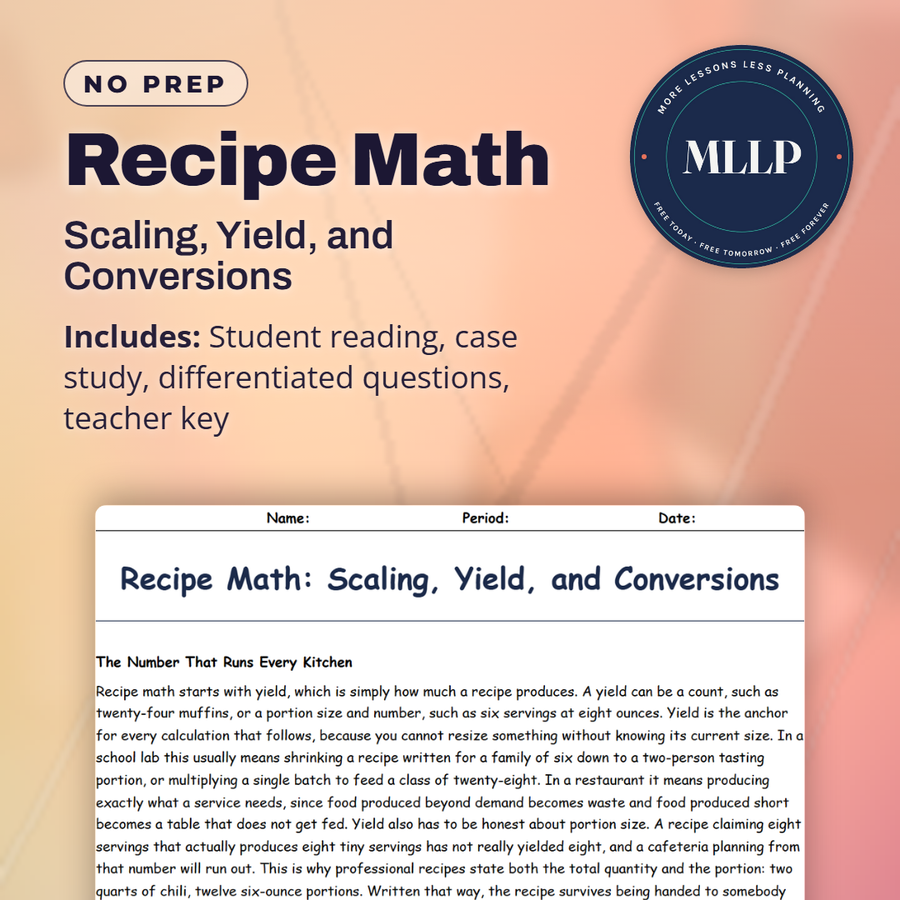
Recipe Math: Scaling, Yield, and Conversions
Quality reviewed September 2026
Facts verified September 23, 2026
- Subject
- Career & Life Skills
- Grades
- Grades 9-12
- Length
- 9-page student worksheet
- Time
- About one 50-minute class period
- Great for
- Sub plans and independent work
- Includes
- Reading passage, comprehension questions + full answer key
- Format
- Print-and-go PDF
What students do
- Yield anchors every scaling decision in the reading, since nothing can be resized without knowing its starting size
- Explain how dividing desired yield by original yield produces the single conversion factor
- Bianca triples her cornbread correctly and still pulls out a pan that is raw in the middle
- Decide what a conversion factor cannot fix on its own, like cooking time, pan size, and strong spices
What it covers
- How to find and use a conversion factor to scale a recipe up or down
- Why cooking time, pan size, and strong spices do not scale the same way ingredients do
- The difference between as purchased weight and edible portion weight, and why it changes a grocery list
Start reading this worksheet
The Number That Runs Every Kitchen
Recipe math starts with yield, which is simply how much a recipe produces. A yield can be a count, such as twenty-four muffins, or a portion size and number, such as six servings at eight ounces. Yield is the anchor for every calculation that follows, because you cannot resize something without knowing its current size. In a school lab this usually means shrinking a recipe written for a family of six down to a two-person tasting portion, or multiplying a single batch to feed a class of twenty-eight. In a restaurant it means producing exactly what a service needs, since food produced beyond demand becomes waste and food produced short becomes a table that does not get fed. Yield also has to be honest about portion size. A recipe claiming eight servings that actually produces eight tiny servings has not really yielded eight, and a cafeteria planning from that number will run out. This is why professional recipes state both the total quantity and the portion: two quarts of chili, twelve six-ounce portions. Written that way, the recipe survives being handed to somebody who has never made it. Everything else in this reading is arithmetic performed on the yield number, so getting it stated clearly is the first and most important step. Recipes written this carefully are called standardized recipes, and food service operations depend on them. A standardized recipe has been tested in that specific kitchen with that specific equipment, and it states yield, portion size, and procedure precisely enough that any trained employee reproduces the same result. Consistency, not creativity, is the point.
The Conversion Factor Does the Whole Job
Scaling a recipe up or down uses one tool, and it is a single number called the conversion factor. Divide the yield you want by the yield you have, then multiply every ingredient in the recipe by that number. A recipe yields four servings and you need six, so the factor is six divided by four, which is 1.5. Every quantity gets multiplied by 1.5: two cups of rice becomes three cups, one pound of chicken becomes a pound and a half, one teaspoon of salt becomes a teaspoon and a half. Scaling down works identically. A recipe yields twenty-four cookies but the lab needs twelve, so the factor is twelve divided by twenty-four, which is 0.5, and every ingredient is halved. The method never changes and it does not care whether the factor is a whole number. The one thing that trips students is fractions, since three quarters of a cup multiplied by 1.5 is not obvious in cup form. The fix is to convert awkward volumes into the smallest unit before multiplying. Three quarters of a cup is twelve tablespoons, and twelve times 1.5 is eighteen tablespoons, which converts back to one cup plus two tablespoons. Working in tablespoons or grams turns fraction problems into ordinary multiplication. There is one sanity check worth running after any scaling. Multiply your finished amounts back down by the reciprocal of the factor and see whether you land on the original recipe. It takes about ten seconds and it catches the single most common error, which is scaling most of the ingredients and forgetting one of them.
The Conversions Worth Memorizing
Scaling requires moving between units constantly, so a small set of equivalents is worth knowing cold rather than looking up. Three teaspoons make one tablespoon. Four tablespoons make a quarter cup. Eight tablespoons make a half cup, and sixteen make a full cup. One cup is eight fluid ounces. Two cups make a pint, two pints make a quart, and four quarts make a gallon. For weight, sixteen ounces make a pound. On the metric side, one thousand grams make a kilogram and one thousand milliliters make a liter, and because metric units move by powers of ten, scaling in metric is far less error-prone than scaling in cups. The trap that catches even careful students is the word ounce, which names both a volume and a weight. A fluid ounce measures space and an ounce measures mass, and they are only close for water. Eight fluid ounces of honey weighs about twelve ounces because honey is denser than water. This is why a recipe that says eight ounces of chocolate wants a scale, while eight fluid ounces of milk wants a liquid measuring cup. When a recipe is ambiguous, the ingredient itself usually settles it: solids are almost always specified by weight and liquids by volume. Rounding deserves a rule of its own. Scaled amounts rarely land on numbers a kitchen can actually measure, so cooks round to the nearest practical unit, and the smaller the quantity the more careful that rounding has to be. Rounding two and a third cups of flour to two and a half is fine; rounding leavening or salt is not.
Like what you read? The full reading, the case study, and every question set are in the free download below, along with the answer key.
Why this matters
The math in this reading shows up the first time a student cooks for more people than a recipe was written for, doubling a recipe for a sleepover or scaling one down to cook for just themselves, and getting the conversion factor right is only half of what the reading teaches. The other half, that pan size and cooking time need their own separate judgment call, is the part that actually explains why a doubled batch so often comes out wrong even when the arithmetic was correct.
From one teacher to another
Scaling a recipe starts with yield, and the reading is precise about what that word means, a stated quantity and portion size that every later calculation depends on. It walks through the conversion factor, desired yield divided by original yield, multiplied across every ingredient, and it spends real time on what that single number cannot fix by itself, cooking time, pan size, and strong spices like chile or clove, which behave differently in a large batch than a small one. Bianca's case study triples a cornbread recipe correctly and still pulls a raw center out of the oven, because she never recalculated pan size along with the ingredients. The last passage covers as purchased and edible portion weight, the reason a recipe asking for two cups of chopped onion means buying more than two cups of onion. I hand this out before any lab where students are scaling a recipe for the whole class.
What you get
Download
Where should I send the next one?
Everything here is free and it stays that way. Leave your email and I'll send you the new lessons as they go up. You can unsubscribe from any one of them.
Related resources
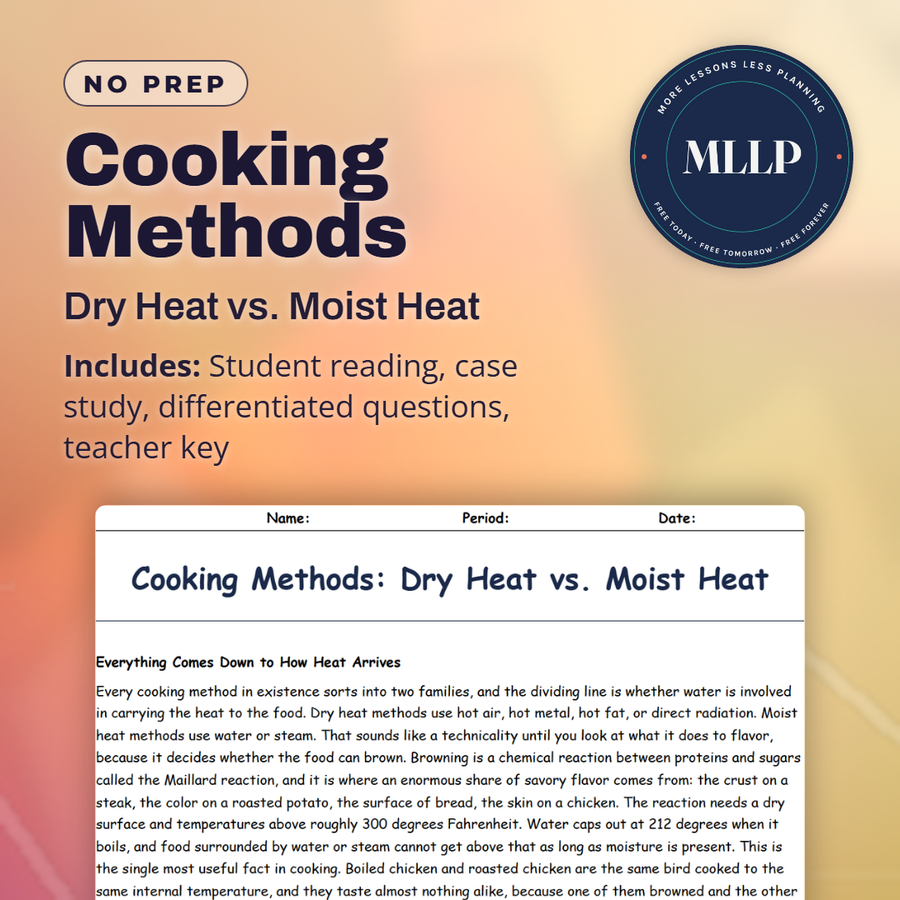
Cooking Methods: Dry Heat vs. Moist Heat
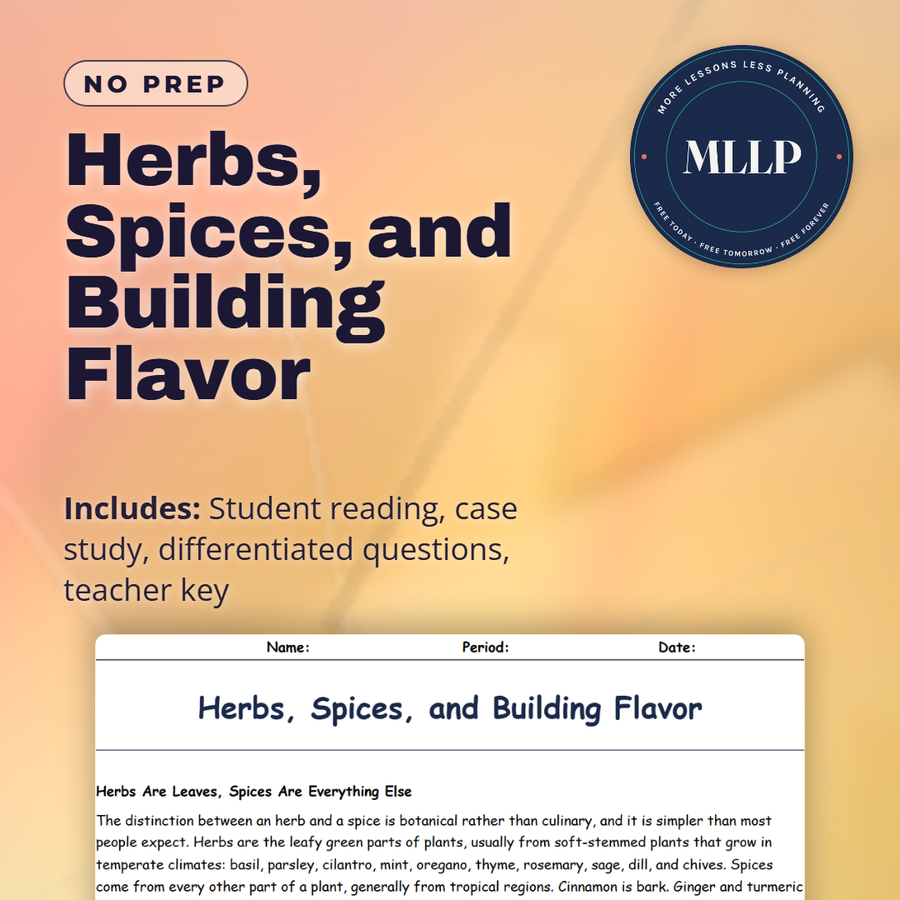
Herbs, Spices, and Building Flavor
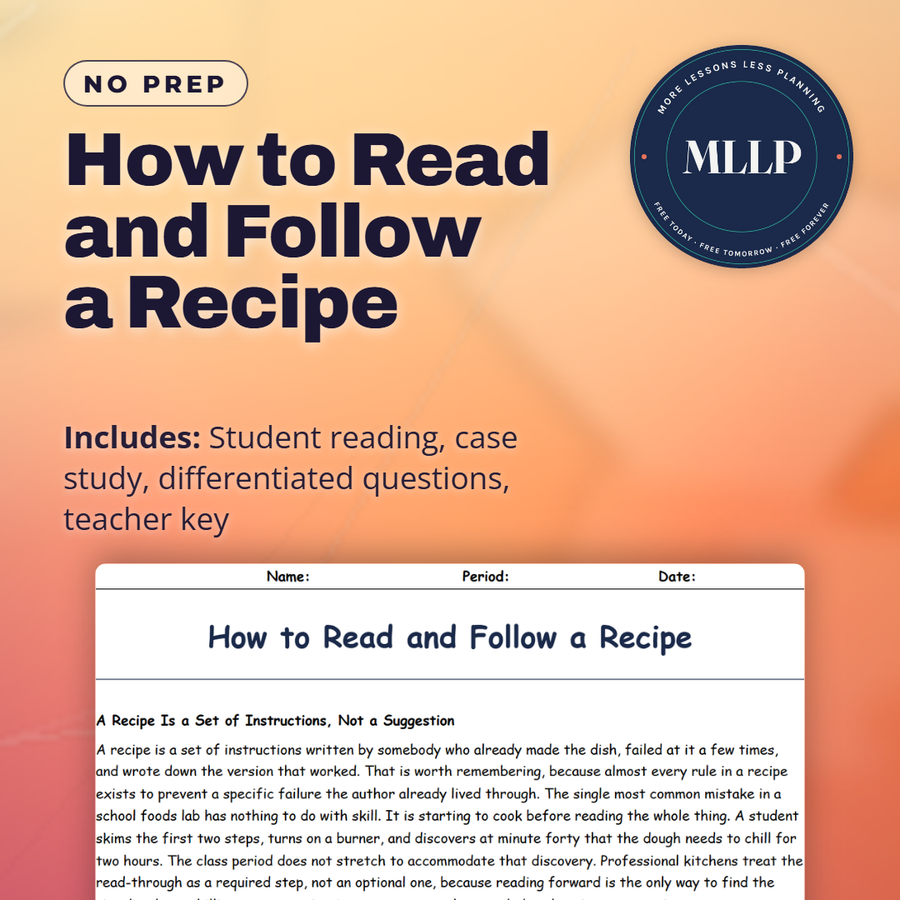
How to Read and Follow a Recipe
Kitchen Tools and Equipment
Knife Skills and the Basic Cuts
Measuring Techniques: Dry, Liquid, and Weight
Every lesson on this site is free to download and use. If one of them saved you a prep period, you can chip in a few bucks toward my three kids' daycare fund. That's genuinely where tips go.