
Real vs Nominal GDP: Why It Matters
Quality reviewed September 2026
- Grades
- Grades 9-12
- Time
- About two 50-minute class periods
- Includes
- 10 ready-to-teach files
- Format
- Word (.docx) · PowerPoint (.pptx)
- Slide deck
- Guided notes
- Guided notes teacher key
- Activity + answer key
- Quiz + answer key
- Exit ticket + answer key
- Teacher guide
What students do
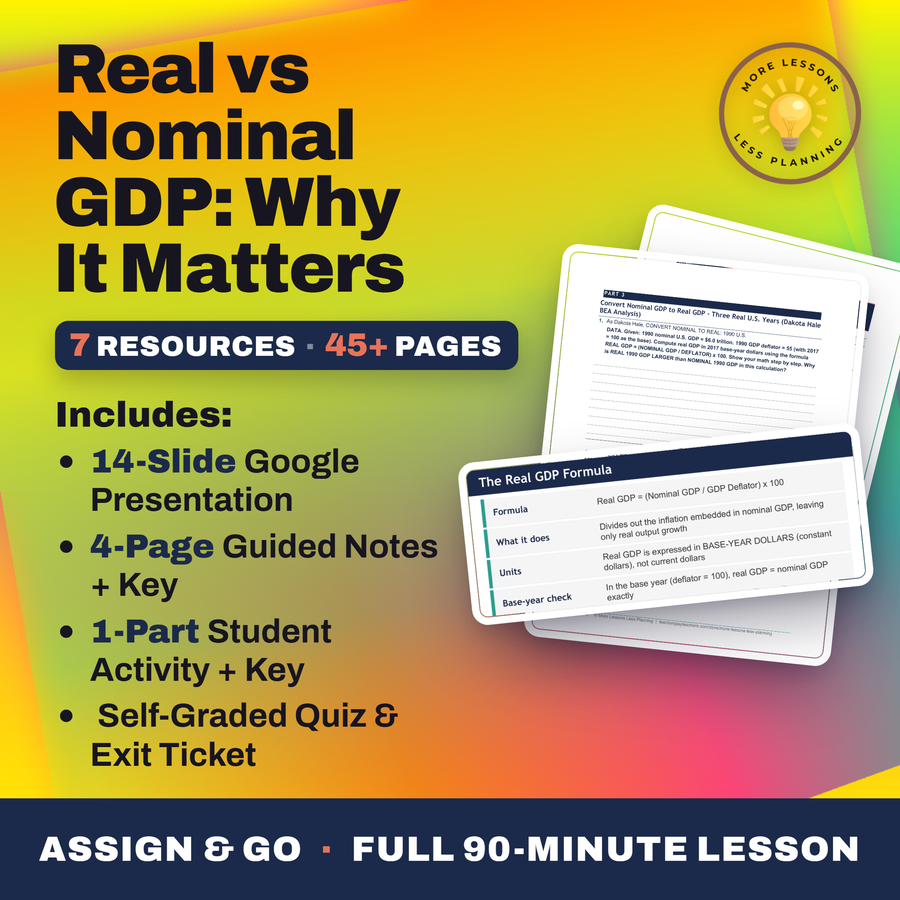
- Convert nominal GDP to real GDP using Real GDP = (Nominal GDP / GDP Deflator) x 100 for 1990, 2010, and 2026
- Verify that real and nominal GDP must be equal in the base year, where the deflator equals exactly 100
- Read a real-vs-nominal GDP chart to find the year the two lines cross and compute both growth factors
- Write a policy memo to the BEA evaluating a politician's claim that nominal GDP growth proves their policies worked
What it covers
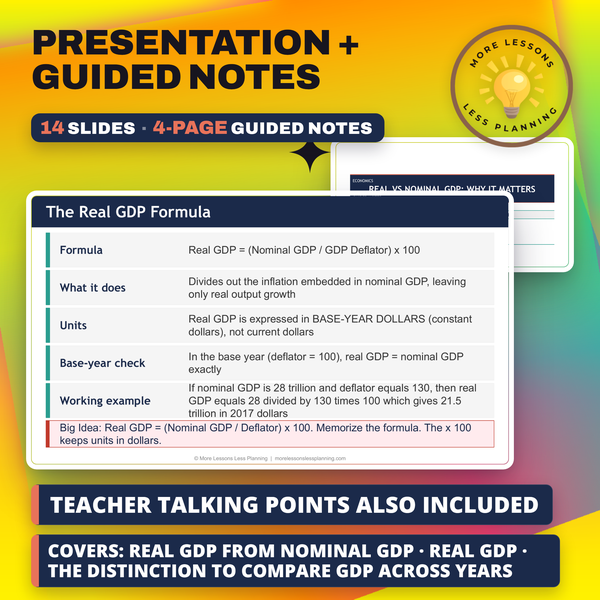
- The Real GDP = (Nominal GDP / GDP Deflator) x 100 formula, applied to real U.S. data from 1990, 2010, and 2026
- The base-year check, where the deflator equals exactly 100 and real and nominal GDP must match
- Reading a real-vs-nominal GDP chart to find where the two lines cross and diverge
- Evaluating a politician's nominal-growth claim in a policy memo to a BEA economist
Learning targets
- Distinguish real GDP from nominal GDP
- Calculate real GDP using a price deflator
- Apply the distinction to compare GDP across years
Peek inside
Nominal GDP
Measured in THIS YEAR'S prices
Rises with output AND with inflation
1980 U.S. GDP: ~$2.9 trillion
2026 U.S. GDP: ~$28 trillion
Nominal GDP vs the Real Story
Nominal GDP is measured in THIS YEAR'S .
Nominal GDP rises with output AND with .
1980 U.S. GDP was about $2.9 trillion; 2026 U.S. GDP is about $ trillion.
The headline says GDP grew 10x since 1980, but most of that is rising , not output.
Real growth from 1980 to 2026 was only about x, not 10x.
1. GDP measured in current-year prices - the headline figure that rises with both real output growth AND rising prices - is .
Why this matters
A politician bragging the economy grew 27% under their policies makes a claim students cannot check until they learn nominal GDP from real. This lesson has them apply Real GDP = (Nominal GDP / Deflator) x 100 to actual U.S. figures from 1990, 2010, and 2026, then find the base year where both numbers match.
The moment that lands hardest is asking whether Americans got ten times richer between 1980 and 2026, since that is how far nominal GDP grew, and letting students discover the real figure is nowhere close. After that, a memo to a BEA economist stops being an abstract exercise and starts feeling like fact-checking someone live.
From one teacher to another
Students walk in assuming a bigger GDP number always means a richer country, so I open by asking whether the average American actually got 10 times richer between 1980 and 2026, since that's how much nominal GDP grew, and let them find the real growth figure for themselves instead of handing it to them. Getting there means drilling the formula, Real GDP = (Nominal GDP / Deflator) x 100, on actual U.S. data from 1990, 2010, and 2026, including the base-year check where the deflator equals exactly 100 and real and nominal have to match. Once they can read the chart where the two lines cross at the base year and diverge afterward, I hand them a politician's claim that "GDP grew 27% under my policies" and make them write a memo to a BEA economist explaining exactly what that number is hiding.
Every file in this toolkit
-
Activity (Student)
Dakota Hale works at the BEA, and you apply the deflator formula to convert 1990, 2010, and 2026 nominal GDP into real dollars, confirm the base-year check, read a real-vs-nominal chart for the crossover year, then fact-check a politician's claim of 27 percent growth in a memo.
-
Activity (Answer Key)
All three GDP conversions get solved step by step, from 1990's $10.9 trillion real figure to the 2026 flip where nominal outruns real, plus the exact base-year match at $19.5 trillion. A memo debunks the politician's 27 percent growth claim with the worked figures.
-
Exit Ticket (Student)
Short questions explain why real GDP differs from nominal GDP, calculate real GDP from a $25 trillion nominal figure with a deflator of 125, and identify why U.S. nominal GDP tends to outpace real GDP over the long run. One real-versus-nominal situation from everyday life fits in the write-up.
-
Exit Ticket (Answer Key)
Base-year prices against current-year prices mark the real-versus-nominal split, $20.0 trillion answers the deflator calculation, and inflation baked into the nominal figure explains why it grows faster over time. A teacher reads this response for content instead of grading it against a fixed scale.
-
Guided Notes (Student)
Nominal GDP jumps from $6.0 trillion in 1990 to $28.0 trillion in 2026, and students apply the Real GDP formula across four deflator values to land on a true growth factor near 2x instead of 4.7x. A FRED-series check, GDP against GDPC1, catches any claim that confuses the two.
-
Guided Notes (Teacher Key)
$6.0 trillion at a deflator of 55 equals $10.9 trillion real in 1990, up through $28.0 trillion at 130 equals $21.5 trillion real in 2026, each worked step by step. The FRED series names, GDP for nominal and GDPC1 for real, and the full deflator formula come answered for direct use.
-
Quiz (Student)
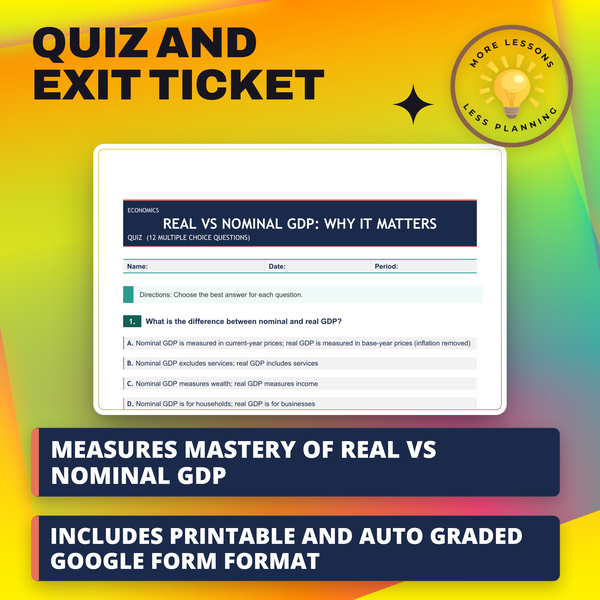
A deflator problem asks students to convert a $28 trillion nominal figure at a deflator of 130, a second item asks how far real GDP grew since 1980, and a third defines the deflator itself.
-
Quiz (Answer Key)
That $28 trillion nominal figure works down to $21.5 trillion once the deflator applies, nominal and real GDP match only in the base year, and real growth since 1980 lands near 3 times over.
-
Slides
FRED's GDPC1 series gets a callout before the deflator formula runs on 1990 and 2026 figures, nominal climbing from $6.0 to $28 trillion while real GDP moves only from $10.9 to $21.5 trillion, and 2017 sits where the two curves meet.
-
Teacher Guide
Forgetting to multiply by 100 is flagged as the single most common student error on the deflator formula, and the script has the class chorus the equation three times before the first practice problem. An extension sends students to pull the GDP and GDPC1 series themselves.
Download
Where should I send the next one?
Everything here is free and it stays that way. Leave your email and I'll send you the new lessons as they go up. You can unsubscribe from any one of them.
Related resources

Consumer Confidence Why It Predicts the Future
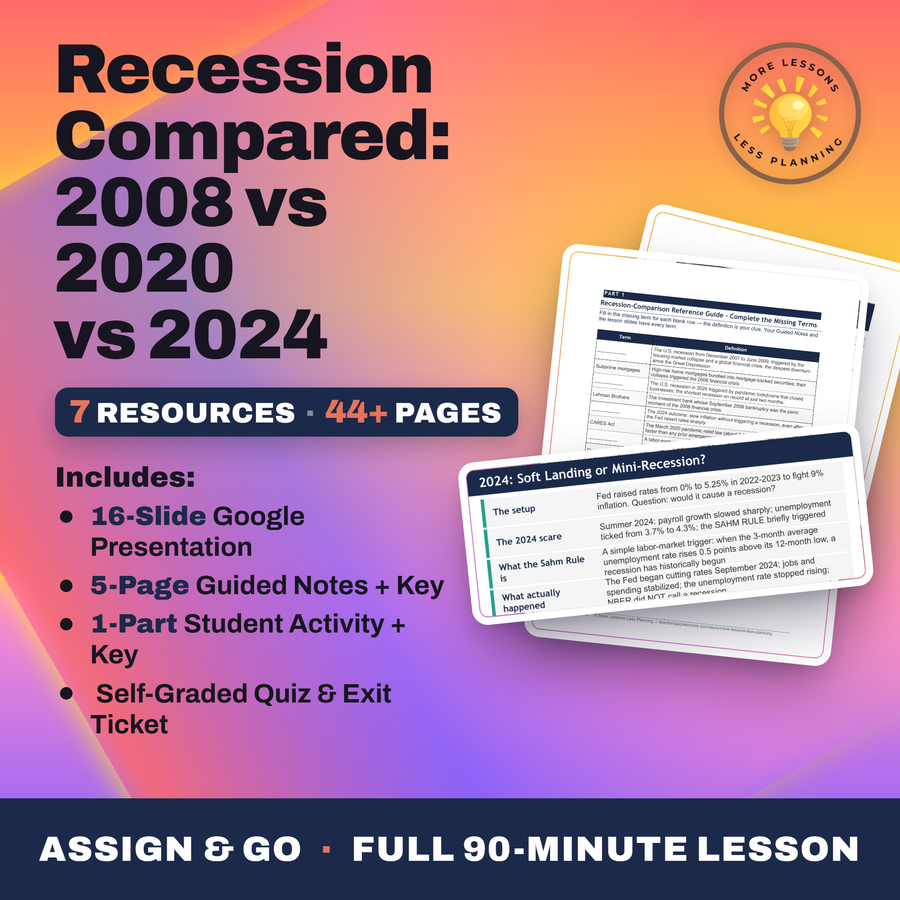
Recession Compared 2008 vs 2020 vs 2024

The Business Cycle Boom, Bust, Recovery
Unemployment Rate: How It's Calculated

Amazon Warehouses: Working Conditions Investigation

Anti-Trust Laws and Regulation: Promoting Fair Competition
Every lesson on this site is free to download and use. If one of them saved you a prep period, you can chip in a few bucks toward my three kids' daycare fund. That's genuinely where tips go.