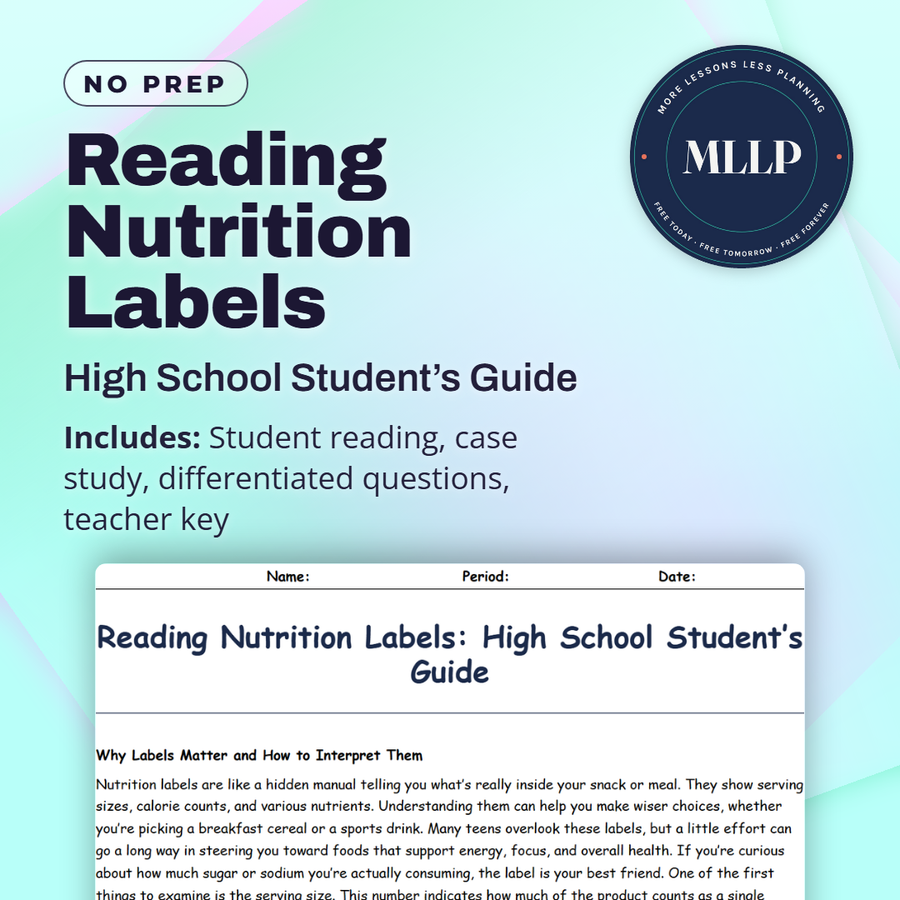
Reading Nutrition Labels: High School Student’s Guide
Quality reviewed September 2026
Facts verified September 21, 2026
- Subject
- Career & Life Skills
- Grades
- Grades 9-12
- Length
- 7-page student worksheet
- Time
- About one 50-minute class period
- Great for
- Sub plans and independent work
- Includes
- Reading passage, comprehension questions + full answer key
- Format
- Print-and-go PDF
What students do
- Line up five label terms, including Serving Size, % Daily Value, and Ingredient List, with their definitions
- Fill in three blanks about hidden sugar, % Daily Value, and sodium using clues from the passages
- Tackle three multiple-choice questions on reading serving sizes, added sugars, and % Daily Value
- Give short-answer responses on why "low fat" products can still be unhealthy and how to apply label-reading to snack choices
What it covers
- How to read a nutrition label section by section, from serving size to % Daily Value
- Why marketing terms like "natural" or "low fat" can be misleading without checking the actual numbers
- Carla's discovery that her "healthy" cereal and yogurt were both loaded with added sugar, and how switching brands fixed her energy crash
Start reading this worksheet
Why Labels Matter and How to Interpret Them
Nutrition labels are like a hidden manual telling you what’s really inside your snack or meal. They show serving sizes, calorie counts, and various nutrients. Understanding them can help you make wiser choices, whether you’re picking a breakfast cereal or a sports drink. Many teens overlook these labels, but a little effort can go a long way in steering you toward foods that support energy, focus, and overall health. If you’re curious about how much sugar or sodium you’re actually consuming, the label is your best friend. One of the first things to examine is the serving size. This number indicates how much of the product counts as a single serving, and all the nutritional details listed (calories, protein, fat, etc.) are based on that serving. If you double the serving size, you double the listed numbers. Next, look at the total calories. While calorie needs vary by individual, understanding this figure helps you gauge if a product might be too high or too low in calories for your goals. Remember: not all calories are the same in terms of nutritional value. Below the calorie count, you’ll find macronutrients (fat, carbohydrates, and protein) listed in grams. Each of these categories can have sub-listings, such as saturated fat or added sugars. These sub-listings signal which types of nutrients might need extra attention. For example, if you see a food is high in saturated fat, you might want to eat a smaller portion or choose it less frequently.
Decoding Sugars, Sodium, and Daily Values
Hidden sugars are particularly tricky. A product can claim to be “healthy” while containing a surprising amount of added sugar listed under names like fructose, dextrose, or cane syrup. Checking the “Added Sugars” line can reveal how much sugar is pumped into a product beyond what naturally occurs in foods like fruits or dairy. Too much added sugar can lead to energy spikes followed by crashes, making it harder to concentrate or perform well in sports. Sodium is another element to watch. It helps regulate fluid balance but is easily overconsumed when you rely heavily on processed foods. High sodium intake can contribute to issues like high blood pressure over time. Teens often need around 2,300 milligrams or fewer per day, but some frozen meals or snacks can exceed half of that in just one serving. Awareness is key. If you see a label with 800 milligrams of sodium in one portion, consider how that factors into your overall daily intake. Next, you might notice % Daily Value percentages on the label. These figures are based on a 2,000-calorie diet and give you a quick snapshot: 5% or less is considered low for a nutrient, while 20% or more is high. Use these percentages to decide if a food is offering a lot of a beneficial nutrient (like fiber) or too much of something you want to limit, like saturated fat.
Comparing Labels for Smarter Shopping
One of the best habits you can adopt is label comparison. If you’re choosing between two types of granola bars, look at the sugar, protein, and fiber content. This allows you to spot which bar offers more of what you need and less of what you don’t. Maybe one bar has 8 grams of protein and 5 grams of sugar, while another has 2 grams of protein and 12 grams of sugar. Even though both might be marketed as “wholesome,” the label clarifies which is truly better for your goals. When you’re in the grocery store, try to scan the label of at least one new product each trip. Over time, you’ll build a mental library of healthier options: ones with lower sodium, fewer added sugars, and higher fiber or protein. Learning to compare labels also helps you see through buzzwords like “natural” or “fortified,” which can be misleading if you don’t check the facts. If you notice one cereal is loaded with vitamins but also comes with 20 grams of sugar per serving, you’ll know it’s not the best pick. Don’t forget to look at the ingredient list, usually located below or beside the Nutrition Facts panel. Ingredients are listed from highest to lowest quantity. If you see sugar or hydrogenated oils near the top, that’s a sign the product might not align with your health goals. By comparing labels, you can still enjoy convenience foods, just with a better grasp of their nutritional profile.
Like what you read? The full reading, the case study, and every question set are in the free download below, along with the answer key.
Why this matters
Reading a label is a skill a student uses at every grocery run for the rest of their life, long after they've forgotten the details of any single test, which is part of why I keep coming back to this one. It also doubles as a lesson in reading marketing skeptically: a package that says "natural" or "low fat" is designed to be read fast, and the label underneath is where the actual claim gets tested. Carla's story lands because her mistake wasn't laziness, it was trusting words on a box instead of the numbers next to them, and that's an easy trap for anyone to fall into.
From one teacher to another
Nutrition labels look intimidating until someone points out what each line actually means, and that's the job of this reading: serving size first, then added sugars and sodium, then the % Daily Value column most students skip entirely. Carla's case study comes early, showing how her "whole grain" cereal and "low-fat" yogurt were both hiding more added sugar than she expected, and how switching brands fixed her afternoon energy crash. Four passages build the skill in stages: why labels matter, how to decode sugar and sodium specifically, and how to compare labels as a grocery-store habit. The comparison exercise, two granola bars with different protein and sugar counts, is the part students remember longest.
What you get
Download
Where should I send the next one?
Everything here is free and it stays that way. Leave your email and I'll send you the new lessons as they go up. You can unsubscribe from any one of them.
Related resources
Body Image & Eating Disorders: A Student Wellness Guide
Exercise Safety & Guidelines: Teen Fitness Essentials
Healthy Sleep & Recovery: Boosting Teen Wellness
Macronutrients: Proteins, Carbs, and Fats for Teens
Master MyPlate: Dietary Guidelines for Teens
Nutrition’s Impact: Health Effects for High Schoolers
Every lesson on this site is free to download and use. If one of them saved you a prep period, you can chip in a few bucks toward my three kids' daycare fund. That's genuinely where tips go.