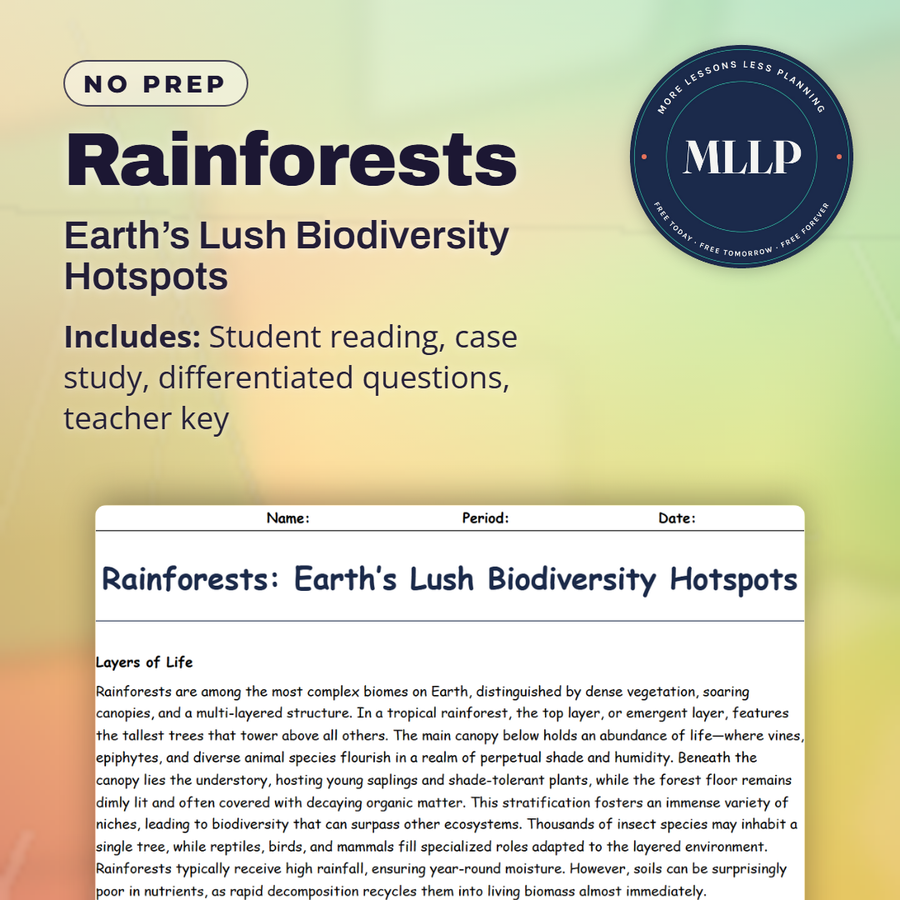
Rainforests: Earth’s Lush Biodiversity Hotspots
Quality reviewed September 2026
Facts verified September 14, 2026
- Subject
- Social Studies
- Grades
- Grades 9-12
- Length
- 7-page student worksheet
- Time
- About one 50-minute class period
- Great for
- Sub plans and independent work
- Includes
- Reading passage, comprehension questions + full answer key
- Format
- Print-and-go PDF
What students do
- Match terms like canopy, epiphyte, and shifting cultivation to their correct definitions
- Fill in the blank sentences on indigenous land stewardship, deforestation, and the forest floor
- Answer multiple choice questions on what the rainforest canopy is, what deforestation causes, and what shifting cultivation involves
- Write short answers on why rainforests are called the lungs of the planet, the role indigenous peoples play in conservation, and how eco-tourism can help or hurt rainforest ecosystems
What it covers
- The layered structure of a tropical rainforest, from the emergent layer and canopy down to the understory and forest floor
- Global rainforest regions like the Amazon and Congo Basin, and threats including logging, cattle ranching, and palm oil plantations
- A case study on indigenous stewardship and sustainable land management in the Amazon, plus a reference table of rainforest layers and species
Start reading this worksheet
Layers of Life
Rainforests are among the most complex biomes on Earth, distinguished by dense vegetation, soaring canopies, and a multi-layered structure. In a tropical rainforest, the top layer, or emergent layer, features the tallest trees that tower above all others. The main canopy below holds an abundance of life, where vines, epiphytes, and diverse animal species flourish in a realm of perpetual shade and humidity. Beneath the canopy lies the understory, hosting young saplings and shade-tolerant plants, while the forest floor remains dimly lit and often covered with decaying organic matter. This stratification fosters an immense variety of niches, leading to biodiversity that can surpass other ecosystems. Thousands of insect species may inhabit a single tree, while reptiles, birds, and mammals fill specialized roles adapted to the layered environment. Rainforests typically receive high rainfall, ensuring year-round moisture. However, soils can be surprisingly poor in nutrients, as rapid decomposition recycles them into living biomass almost immediately.
Global Distribution and Threats
Rainforests span regions near the equator, particularly in South America (the Amazon), Central Africa (the Congo Basin), and parts of Southeast Asia. These “lungs of the planet” store vast amounts of carbon, produce oxygen, and stabilize local and global climates. Indigenous communities rely on the forest for shelter, food, and medicines, passing down knowledge of plant uses across generations. Nonetheless, deforestation looms as a major threat. Logging, cattle ranching, palm oil plantations, and infrastructure projects eat away at rainforest acreage. Habitat loss leads to reduced biodiversity and disrupts carbon cycles, exacerbating climate change. Conservation efforts, like establishing protected areas, promoting sustainable forestry, and supporting community-managed reserves, aim to curb these declines.
Like what you read? The full reading, the case study, and every question set are in the free download below, along with the answer key.
Why this matters
This reading walks through the rainforest layer by layer, emergent, canopy, understory, forest floor, so a term like epiphyte has an actual place to attach to instead of floating as vocabulary. The Amazon and Congo Basin get called the lungs of the planet, but logging, cattle ranching, and palm oil plantations are cutting into those same layers.
I like that the Amazon case study features indigenous stewardship instead of only loss, since students need a working example of forest management alongside the threats. It also sets up a more honest conversation about eco-tourism, whether visiting a rainforest responsibly is possible or just a different kind of pressure on the land.
From one teacher to another
I like that this one walks through the rainforest layer by layer before getting into deforestation, so students have the structure in mind when they read about what is actually being lost. The Amazon stewardship case study gives a positive example of forest management led by local communities, which balances out the threats passage. It fits naturally alongside a unit on biomes or global regions.
What you get
Download
Where should I send the next one?
Everything here is free and it stays that way. Leave your email and I'll send you the new lessons as they go up. You can unsubscribe from any one of them.
Related resources
Biomes & Ecosystems: Life Across Earth’s Habitats
Climate vs. Weather: Understanding the Difference
Convergent Boundaries: Where Plates Collide
Deserts: Survival in the Harshest Climates

Divergent Boundaries: Where Plates Pull Apart
Earth’s Layers: From Crust to Core
Every lesson on this site is free to download and use. If one of them saved you a prep period, you can chip in a few bucks toward my three kids' daycare fund. That's genuinely where tips go.