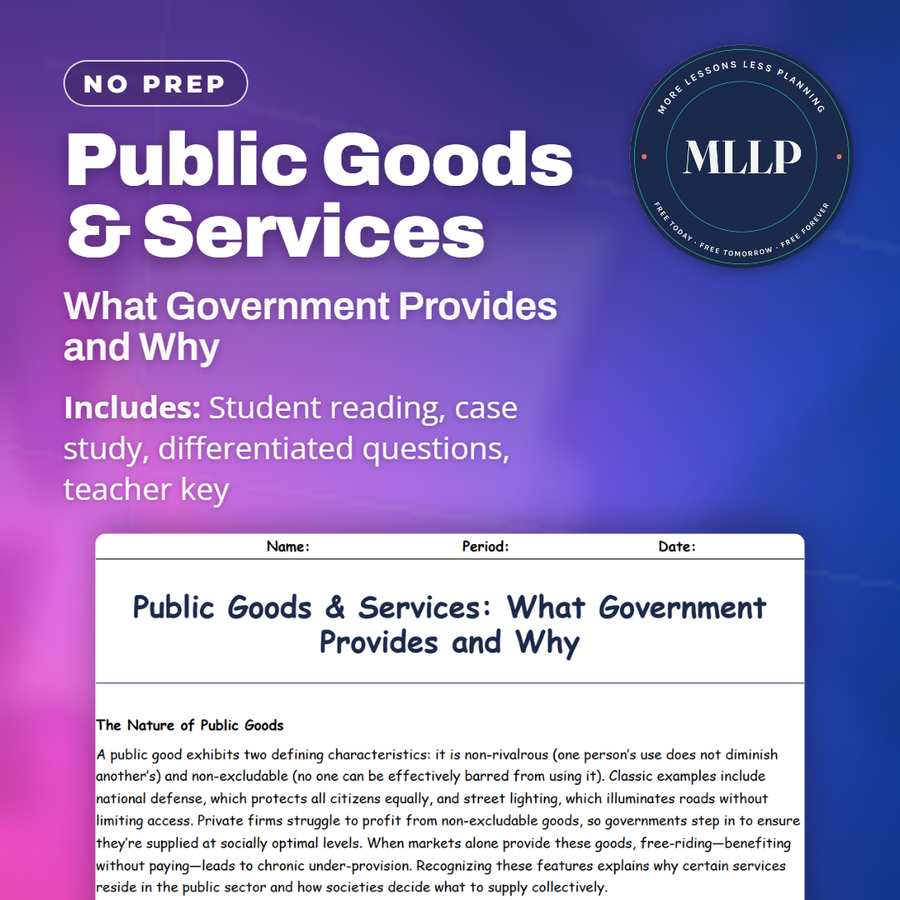
Public Goods & Services: What Government Provides and Why
Quality reviewed September 2026
Facts verified September 8, 2026
- Grades
- Grades 9-12
- Length
- 6-page student worksheet
- Time
- About one 50-minute class period
- Great for
- Sub plans and independent work
- Includes
- Reading passage, comprehension questions + full answer key
- Format
- Print-and-go PDF
What students do
- Identify characteristics of public goods (non-rivalrous, non-excludable) using examples like national defense, street lighting, and public parks
- Analyze City Z's Green Heart initiative to explain how property taxes, concession fees, and vouchers addressed the free-rider problem
- Match public finance terms like "voucher program," "congestion charge," and "free-rider problem" to their definitions
- Explain why direct government provision works better than private market provision for non-excludable goods
What it covers
- Defining public goods through non-rivalrous and non-excludable characteristics, with examples like defense and street lighting
- Types of government services and how different services require different provision methods (direct supply, vouchers, public-private partnerships)
- Financing mechanisms including taxation, user fees, congestion charges, and vouchers to address the free-rider problem
Start reading this worksheet
The Nature of Public Goods
A public good exhibits two defining characteristics: it is non-rivalrous (one person’s use does not diminish another’s) and non-excludable (no one can be effectively barred from using it). Classic examples include national defense, which protects all citizens equally, and street lighting, which illuminates roads without limiting access. Private firms struggle to profit from non-excludable goods, so governments step in to ensure they’re supplied at socially optimal levels. When markets alone provide these goods, free-riding (benefiting without paying) leads to chronic under-provision. Recognizing these features explains why certain services reside in the public sector and how societies decide what to supply collectively.
Types and Examples of Government Services
Governments also deliver services that blend public-good and private-good elements. Consider: By examining each service’s mix of non-rivalry and excludability, policymakers tailor funding and access rules. This strikes a balance between efficiency (getting the right amount) and equity (sharing costs fairly).
Provision Mechanisms: Direct Supply vs. Vouchers
Governments can supply services through: Direct supply, where agencies own assets and employ staff (e.g., border patrol, traffic control). Voucher/subsidy models, in which public funds follow the user to private providers (e.g., school or health-care vouchers). Vouchers introduce consumer choice and competition, potentially improving quality and containing costs, but require robust oversight to prevent cream-skimming and to guarantee universal access.
Like what you read? The full reading, the case study, and every question set are in the free download below, along with the answer key.
Why this matters
A streetlight doesn't stop working just because the person under it didn't pay. Something non-rivalrous and non-excludable, like street lighting or national defense, can't be sold like a sandwich, because there's no way to keep a non-payer from benefiting anyway.
City Z's Green Heart initiative solved the free-rider problem in practice: property taxes covered the base cost, concession fees added revenue, and vouchers kept the park open to families who couldn't afford user fees. That blend makes the trade-offs concrete instead of theoretical.
From one teacher to another
I use this reading to help students understand why some goods and services are government's job rather than the market's. My students learn the concept of non-rivalrous and non-excludable goods, using examples like national defense and street lighting to see why private firms cannot profit from providing them. The City Z case study shows how a city combined property taxes, concession fees, and targeted vouchers to finance a public park, addressing the free-rider problem while ensuring access for low-income families. They explore different financing approaches (direct supply, vouchers, and public-private partnerships), recognizing that different goods require different solutions. This helps them see the reasoning behind government involvement in parks, schools, defense, and infrastructure.
What you get
- Answer Key
-
Student Worksheet
City Z converted 200 acres of derelict land into a new park in 2018, paying for upkeep through property tax increases and concession fees charged to food stalls and bike rentals inside it. A voucher program gave seniors and low-income families $100 toward guided fitness classes, keeping access open despite the added fees. By 2021 visitor counts had risen 40 percent and nearby asthma hospitalizations had fallen 15 percent.
Download
Where should I send the next one?
Everything here is free and it stays that way. Leave your email and I'll send you the new lessons as they go up. You can unsubscribe from any one of them.
Related resources
Budget Deficits & Surpluses: Understanding Fiscal Balances
Federal Budget & Debt: Funding the Nation’s Priorities
Fiscal Policy Impact: Fueling or Hindering Economic Growth
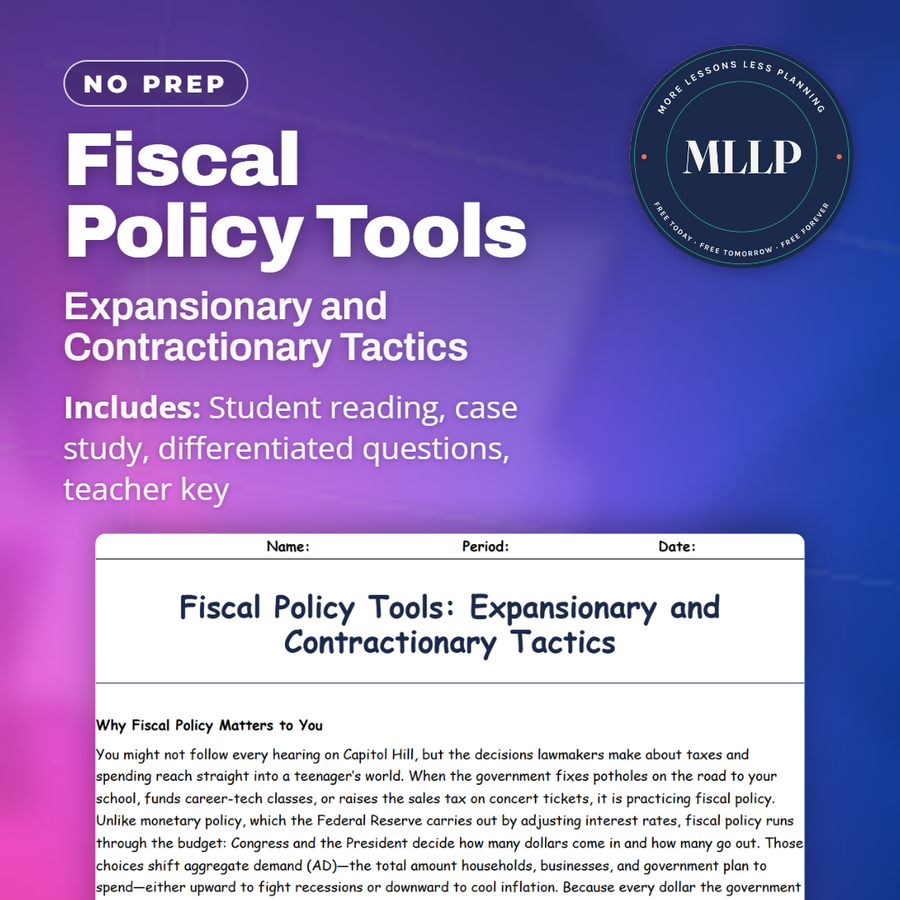
Fiscal Policy Tools: Expansionary and Contractionary Tactics
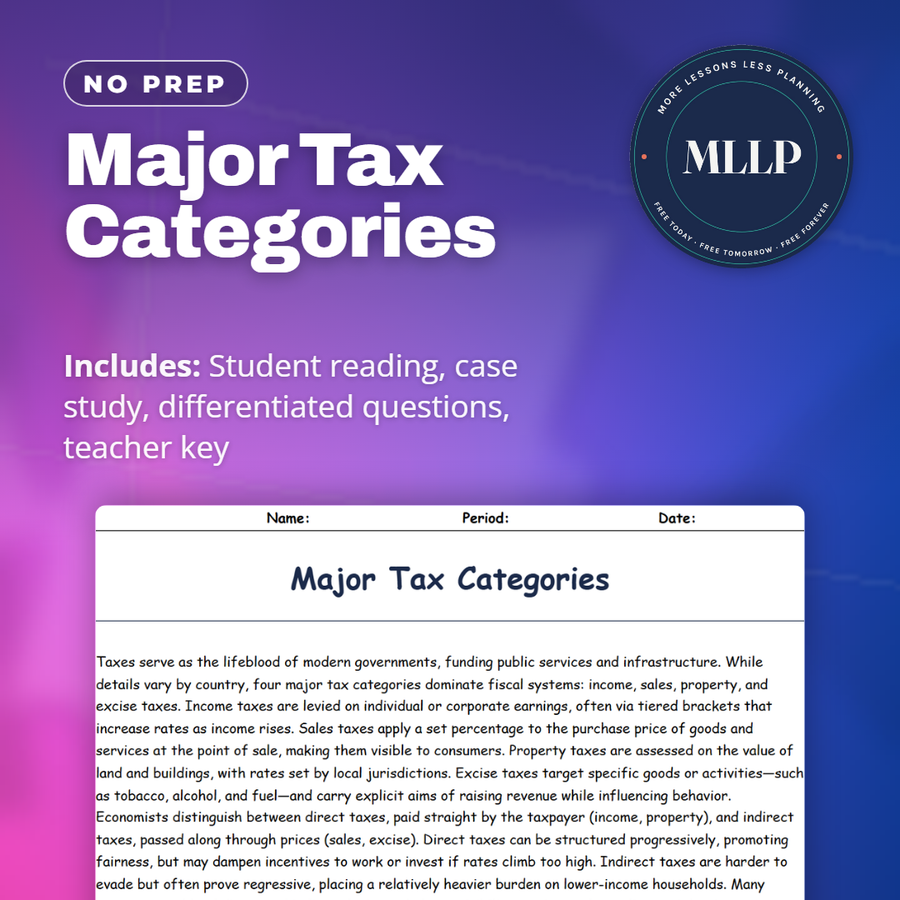
Major Tax Categories
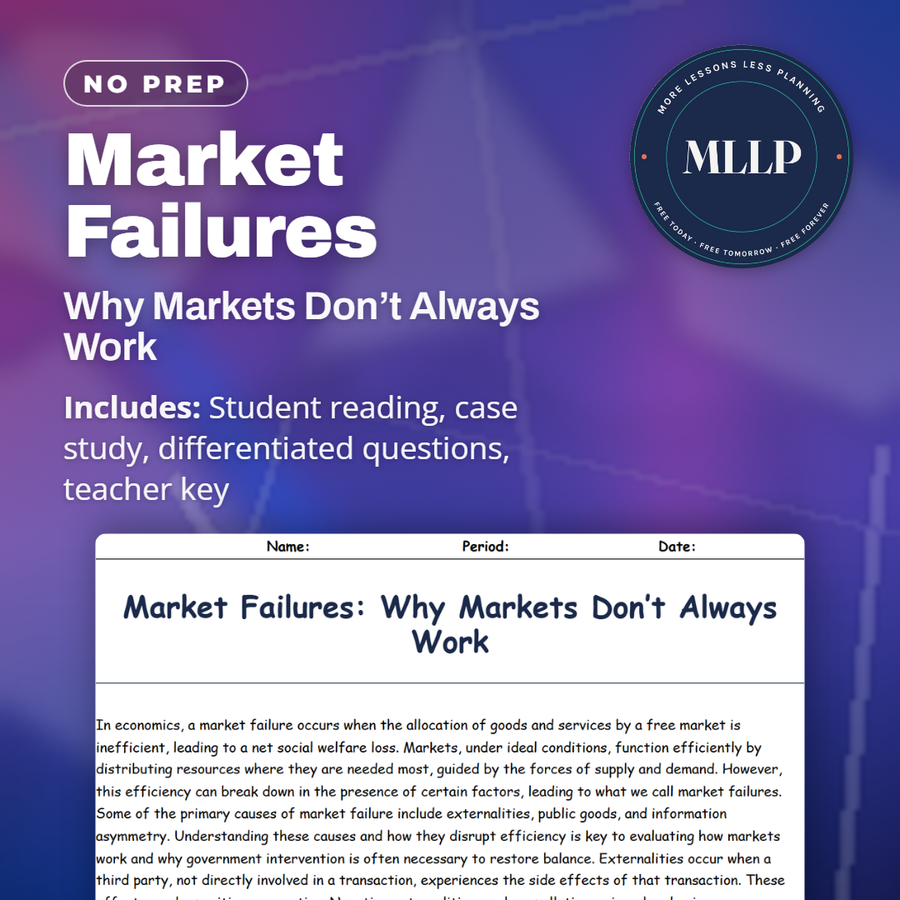
Market Failures: Why Markets Don’t Always Work
Every lesson on this site is free to download and use. If one of them saved you a prep period, you can chip in a few bucks toward my three kids' daycare fund. That's genuinely where tips go.