Major Tax Categories
Quality reviewed September 2026
Facts verified September 8, 2026
- Subject
- Civics · Economics · Government
- Grades
- Grades 9-12
- Length
- 6-page student worksheet
- Time
- About one 50-minute class period
- Great for
- Sub plans and independent work
- Includes
- Reading passage, comprehension questions + full answer key
- Format
- Print-and-go PDF
What students do
- Distinguish between the four major tax categories (income, sales, property, excise) using examples and the key-info table
- Analyze Country X's 2017 tax reform to evaluate how it balanced revenue generation, equity, and behavioral incentives
- Match tax structure terms like "progressive," "proportional," "regressive," and "deadweight loss" to their definitions
- Explain why progressive and regressive taxes have different distributional effects on lower-income households
What it covers
- Four major tax categories: income, sales, property, and excise taxes with their definitions and economic uses
- Tax structures (progressive, proportional, regressive) and their trade-offs between fairness, simplicity, and economic efficiency
- Economic impacts including deadweight loss, behavioral effects, and how taxation redistributes income
Start reading this worksheet
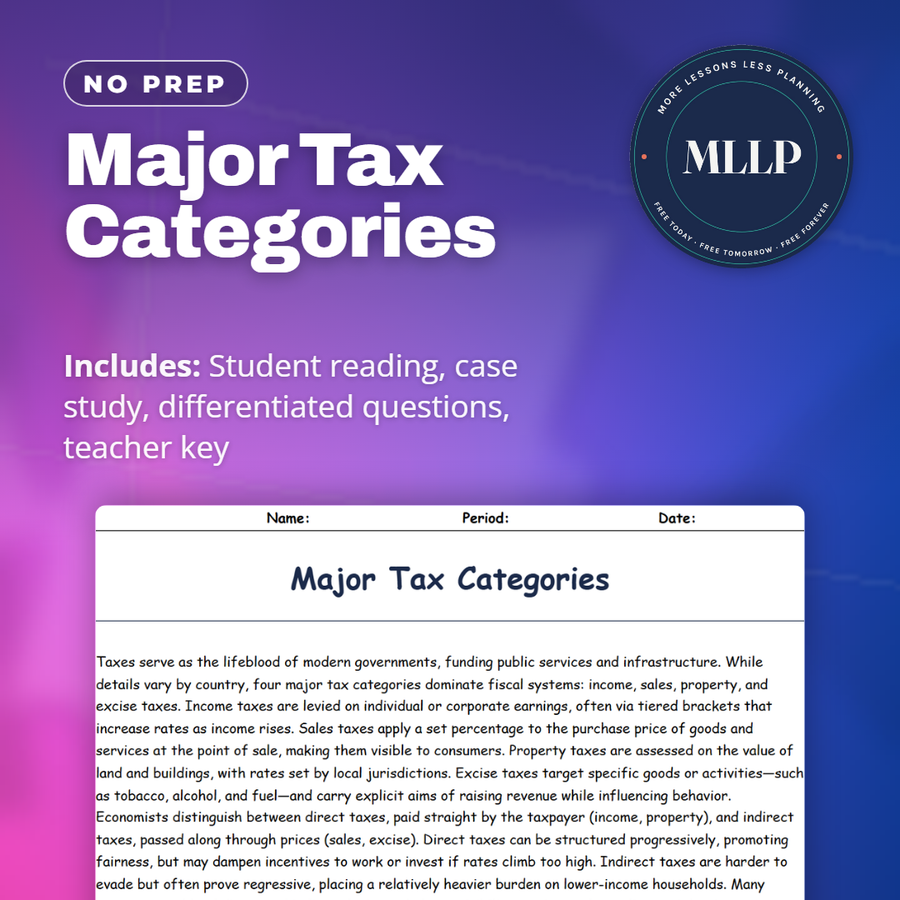
Taxes serve as the lifeblood of modern governments, funding public services and infrastructure. While details vary by country, four major tax categories dominate fiscal systems: income, sales, property, and excise taxes. Income taxes are levied on individual or corporate earnings, often via tiered brackets that increase rates as income rises. Sales taxes apply a set percentage to the purchase price of goods and services at the point of sale, making them visible to consumers. Property taxes are assessed on the value of land and buildings, with rates set by local jurisdictions. Excise taxes target specific goods or activities (such as tobacco, alcohol, and fuel) and carry explicit aims of raising revenue while influencing behavior. Economists distinguish between direct taxes, paid straight by the taxpayer (income, property), and indirect taxes, passed along through prices (sales, excise). Direct taxes can be structured progressively, promoting fairness, but may dampen incentives to work or invest if rates climb too high. Indirect taxes are harder to evade but often prove regressive, placing a relatively heavier burden on lower-income households. Many governments blend direct and indirect levies to balance visibility, equity, and compliance. Below is a quick reference table to help you master these categories: Understanding these four pillars sets the stage for exploring why governments levy taxes, and how those choices ripple through economies.
Purposes and Structures of Taxation
Taxes do more than fill the treasury. They advance multiple purposes. The foremost goal is revenue generation, financing schools, roads, and safety nets. Beyond revenue, taxes enable redistribution, shifting resources from higher-income groups into welfare benefits and public services to reduce inequality. Policymakers also wield taxes as behavioral incentives, discouraging harmful activities (for example, excise levies on cigarettes) or encouraging public-good investments (such as tax credits for renewable energy). Selecting an appropriate tax structure is critical to these aims: Progressive systems impose higher marginal rates on higher income brackets, promoting vertical equity. Proportional (flat) taxes apply the same rate to all earnings, prized for simplicity and predictability. Regressive taxes, by contrast, burden lower-income individuals with a larger share of their income, often arising through consumption levies on essentials. Each structure carries trade-offs. Progressive rates can bolster fairness but risk discouraging work at the margin; proportional systems minimize economic distortion yet lack redistributive power; regressive elements may deepen inequality unless offset by exemptions or rebates. Crafting a balanced tax code demands careful calibration of these competing considerations.
Like what you read? The full reading, the case study, and every question set are in the free download below, along with the answer key.
Why this matters
A sales tax and a property tax raise revenue in completely different ways for completely different households. The four categories give students a real question: who actually pays a tax, not just who writes the check. Country X's 2017 reform touched all four types at once.
Progressive versus regressive is what students get wrong most, assuming any tax applied equally is automatically fair. Comparing how a flat sales tax affects a low-income versus high-income household usually makes the distinction click, and deadweight loss stops being a term to memorize.
From one teacher to another
I use this reading to help students understand how governments fund public services through different taxes. My students learn about income, sales, property, and excise taxes, discovering that each has different trade-offs. They analyze the Country X case study, which shows how a nation reformed all four tax types simultaneously to raise revenue while improving equity and reducing unhealthy behaviors. The reading covers progressive versus regressive systems, helping them see why economists worry about fairness when designing taxes. By the end, students grasp that tax policy balances fairness, economic efficiency, and social goals alongside raising revenue.
What you get
- Answer Key
-
Student Worksheet
Country X's tax-to-GDP ratio had stalled near 15 percent when its 2017 reform added a 45 percent top bracket on incomes above 100,000 units while cutting rates for low and middle earners by two points. A patchwork of sales levies became one 10 percent value-added tax, with rebates for staple foods, and excise taxes on tobacco and sugary drinks followed. Within eighteen months, VAT compliance rose 5 percent and cigarette use fell 7 percent.
Download
Where should I send the next one?
Everything here is free and it stays that way. Leave your email and I'll send you the new lessons as they go up. You can unsubscribe from any one of them.
Related resources
Budget Deficits & Surpluses: Understanding Fiscal Balances
Federal Budget & Debt: Funding the Nation’s Priorities
Fiscal Policy Impact: Fueling or Hindering Economic Growth
Fiscal Policy Tools: Expansionary and Contractionary Tactics

Market Failures: Why Markets Don’t Always Work
National Debt Explained: Risks, Ratios, and Consequences
Every lesson on this site is free to download and use. If one of them saved you a prep period, you can chip in a few bucks toward my three kids' daycare fund. That's genuinely where tips go.