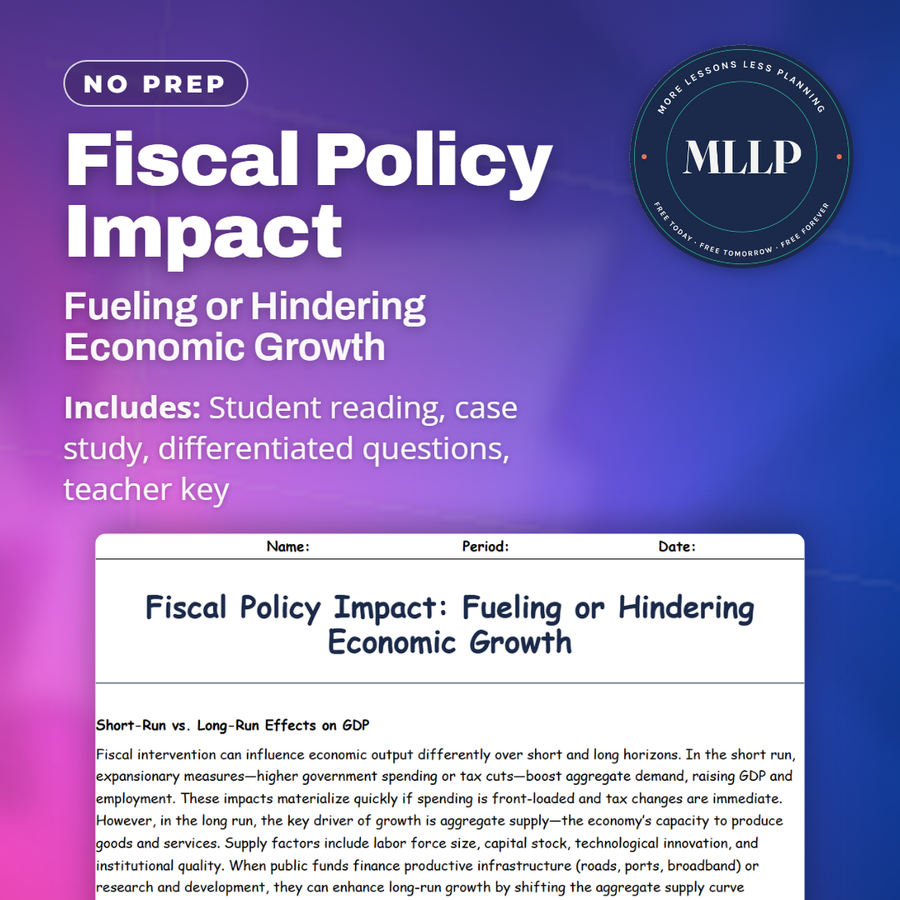
Fiscal Policy Impact: Fueling or Hindering Economic Growth
Quality reviewed September 2026
Facts verified September 8, 2026
- Grades
- Grades 9-12
- Length
- 6-page student worksheet
- Time
- About one 50-minute class period
- Great for
- Sub plans and independent work
- Includes
- Reading passage, comprehension questions + full answer key
- Format
- Print-and-go PDF
What students do
- Compare short-run demand effects vs. long-run supply effects of different public investments (highways, R&D, education, green energy)
- Analyze Germany's Investment and Growth package to explain how infrastructure addressed both immediate and structural economic needs
- Match fiscal concepts like "aggregate supply," "crowding out," and "debt-to-GDP ratio" to their definitions
- Explain why crowding out is minimal in deep recessions but severe when the economy nears full employment
What it covers
- Short-run vs. long-run effects of fiscal policy and the crucial role of productive investment
- How public infrastructure and research grants enhance aggregate supply and long-term growth potential
- Debt-to-GDP dynamics and the balance between fiscal stimulus and long-term sustainability
Start reading this worksheet
Short-Run vs. Long-Run Effects on GDP
Fiscal intervention can influence economic output differently over short and long horizons. In the short run, expansionary measures (higher government spending or tax cuts) boost aggregate demand, raising GDP and employment. These impacts materialize quickly if spending is front-loaded and tax changes are immediate. However, in the long run, the key driver of growth is aggregate supply, the economy’s capacity to produce goods and services. Supply factors include labor force size, capital stock, technological innovation, and institutional quality. When public funds finance productive infrastructure (roads, ports, broadband) or research and development, they can enhance long-run growth by shifting the aggregate supply curve rightward. Conversely, persistent deficits that finance consumption rather than investment can crowd out private capital formation and slow potential growth over time.
Role of Public Investment
Investment in infrastructure (transportation networks, energy grids) and R&D fosters higher productivity by reducing transaction costs, improving connectivity, and fueling technological breakthroughs. For instance, each dollar spent on highway expansion can yield multiple dollars in private-sector output through reduced shipping times and logistical efficiencies. Similarly, government grants to universities and research labs underwrite innovations that private firms later commercialize. Efficient public investment requires rigorous cost-benefit analysis, transparent procurement, and mechanisms to ensure maintenance. Without these, “white elephant” projects can squander resources and produce little growth benefit.
Crowding-Out: Interest Rates and Private Investment
When governments finance deficits by borrowing, they issue bonds that compete with private borrowers for funds. If bond sales push up interest rates, private firms face higher borrowing costs. That reduces capital investment. This phenomenon, known as crowding out, can blunt the stimulative effect of fiscal expansion, especially when the economy is near full employment and funds are scarce. However, in deep recessions, when private demand is weak, crowding out is minimal. Low interest rates and ample liquidity allow governments to borrow without significantly affecting private credit markets. Thus, the state’s fiscal stance and the stage of the business cycle jointly determine the net growth impact of deficit financing.
Like what you read? The full reading, the case study, and every question set are in the free download below, along with the answer key.
Why this matters
Germany's Investment and Growth package spent money on rail lines and broadband, doing two jobs at once: putting people to work immediately and raising the economy's capacity for years afterward. That is the whole argument for infrastructure spending over spending that only props up demand.
Crowding out looks like a fixed penalty until this reading ties it to context: minimal when the economy has slack in a recession, severe once it nears full employment. Once students see that, they can evaluate real infrastructure debates instead of reciting a rule.
From one teacher to another
I use this reading to help students grasp how fiscal policy affects economic growth over different time horizons. My students explore the key insight that government spending on productive infrastructure can shift aggregate supply as well as demand. The Germany case study shows how a well-designed investment package built rail and broadband networks that stimulated employment immediately and enhanced long-term productivity. They also learn why crowding out matters less during recessions but becomes critical at full employment. Understanding these dynamics prepares them to evaluate real policy debates about infrastructure, stimulus, and growth.
What you get
- Answer Key
-
Student Worksheet
Germany's investment push followed earlier Agenda 2010 reforms and funneled money into rail modernization, solar-panel grants, and broadband starting in 2009. Rail upgrades created construction jobs right away while electrified lines cut logistics costs for years afterward. Grants for solar panel installations boosted domestic manufacturing at the same time, pairing an immediate jobs effect with a payoff that only showed up over years.
Download
Where should I send the next one?
Everything here is free and it stays that way. Leave your email and I'll send you the new lessons as they go up. You can unsubscribe from any one of them.
Related resources
Budget Deficits & Surpluses: Understanding Fiscal Balances
Federal Budget & Debt: Funding the Nation’s Priorities

Fiscal Policy Tools: Expansionary and Contractionary Tactics

Major Tax Categories

Market Failures: Why Markets Don’t Always Work
National Debt Explained: Risks, Ratios, and Consequences
Every lesson on this site is free to download and use. If one of them saved you a prep period, you can chip in a few bucks toward my three kids' daycare fund. That's genuinely where tips go.