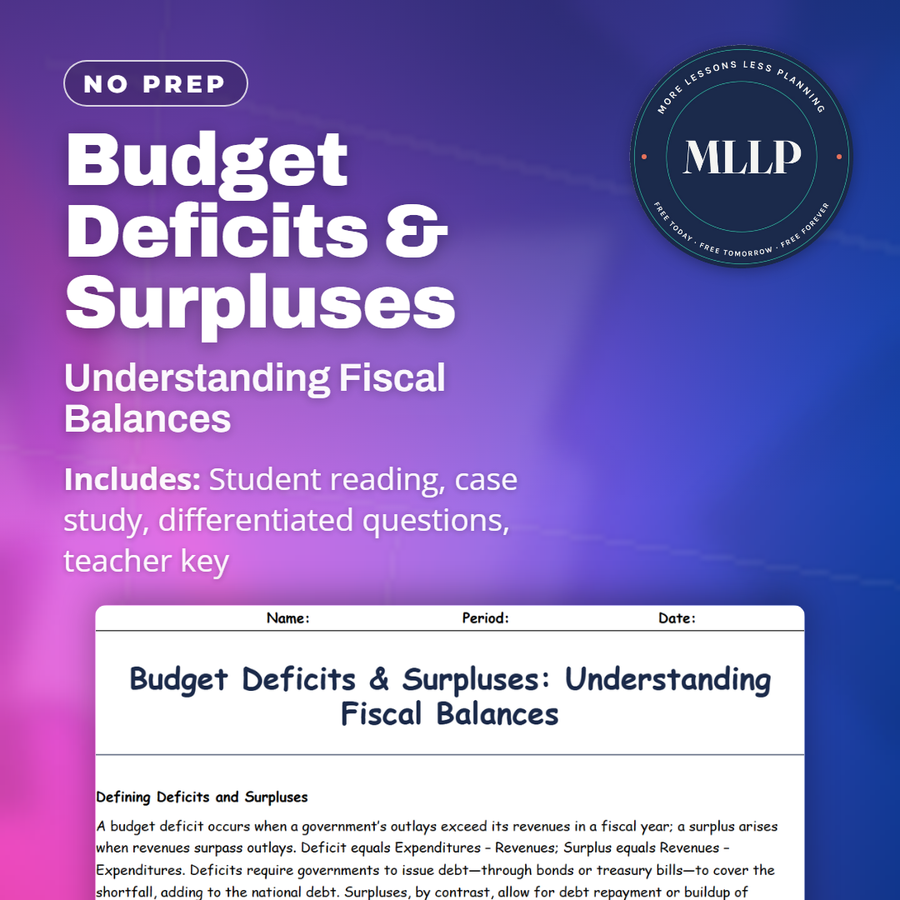
Budget Deficits & Surpluses: Understanding Fiscal Balances
Quality reviewed September 2026
Facts verified September 8, 2026
- Grades
- Grades 9-12
- Length
- 6-page student worksheet
- Time
- About one 50-minute class period
- Great for
- Sub plans and independent work
- Includes
- Reading passage, comprehension questions + full answer key
- Format
- Print-and-go PDF
What students do
- Distinguish between structural and cyclical deficits using the provided key-info table
- Analyze Ireland's post-crisis recovery strategy to evaluate how austerity and structural reforms combined
- Match fiscal terms like "cyclical deficit," "surplus," and "debt-to-GDP ratio" to their definitions
- Explain why crowding out occurs when governments run persistent deficits
What it covers
- Defining budget deficits and surpluses and how they relate to national debt accumulation
- Types of deficits: structural deficits driven by policy choices and cyclical deficits from business cycles
- Policy responses including spending cuts, tax increases, and growth strategies to address fiscal imbalances
Start reading this worksheet
Defining Deficits and Surpluses
A budget deficit occurs when a government’s outlays exceed its revenues in a fiscal year; a surplus arises when revenues surpass outlays. Deficit equals Expenditures – Revenues; Surplus equals Revenues – Expenditures. Deficits require governments to issue debt, usually through bonds or treasury bills, to cover the shortfall, adding to the national debt. Surpluses, by contrast, allow for debt repayment or buildup of reserves.
Structural vs. Cyclical Deficits
Not all deficits are created equal. A structural deficit reflects a fundamental imbalance in tax and spending policies, one that shows up even at full-employment output. By contrast, a cyclical deficit stems from the business cycle, widening automatically during recessions and narrowing during booms as tax revenues fall and safety-net spending rises. Understanding this distinction helps policymakers design countercyclical measures (stimulus during slumps and restraint during expansions) while recognizing the need to address underlying structural gaps for long-term fiscal health.
Common Causes of Fiscal Imbalances
Several factors can drive persistent deficits or surpluses: Economic Downturns: Lower GDP growth reduces tax revenues and raises unemployment benefits. Policy Choices: Tax cuts without spending offsets or entitlement expansions push deficits up. Demographics: Aging populations increase health and pension spending, widening structural deficits. Interest Costs: High debt levels raise interest payments, consuming an increasing share of budgets. While short-term deficits can support recovery, sustained imbalances risk eroding investor confidence and raising borrowing costs.
Like what you read? The full reading, the case study, and every question set are in the free download below, along with the answer key.
Why this matters
Why does a government run a deficit one year and a surplus the next, with no change to the tax code? The structural versus cyclical distinction answers that: one kind comes from policy choices, the other from where the economy sits in its cycle.
I ask students to test the crowding-out idea against Ireland's recovery, which paired austerity with structural reform rather than leaning on one alone. They stop assuming deficits are automatically reckless and start asking which kind a country is actually running.
From one teacher to another
I use this reading to help students grasp how government budgets work when revenues fall short. My students analyze the structural vs. cyclical distinction, a key concept for understanding when deficits are temporary versus persistent. The Ireland case study grounds abstract fiscal policy in a real-world recovery, showing how austerity and structural reforms worked together. They explore how government borrowing can crowd out private investment by raising interest rates, a mechanism that limits economic growth. The worksheet gives students practice with multiple question types while building literacy around this foundational fiscal concept.
What you get
- Answer Key
-
Student Worksheet
Property bubbles burst and banks teetered on the brink in Ireland after 2008, with GDP contracting 10 percent in two years and deficits topping 30 percent of GDP. An EU-IMF bailout brought pension cuts, frozen wages, and higher VAT, and by 2013 the deficit fell below 7 percent. By 2018 debt-to-GDP dropped from 120 percent to under 70 percent as growth averaged 5 percent a year.
Download
Where should I send the next one?
Everything here is free and it stays that way. Leave your email and I'll send you the new lessons as they go up. You can unsubscribe from any one of them.
Related resources
Federal Budget & Debt: Funding the Nation’s Priorities
Fiscal Policy Impact: Fueling or Hindering Economic Growth
Fiscal Policy Tools: Expansionary and Contractionary Tactics
Major Tax Categories

Market Failures: Why Markets Don’t Always Work
National Debt Explained: Risks, Ratios, and Consequences
Every lesson on this site is free to download and use. If one of them saved you a prep period, you can chip in a few bucks toward my three kids' daycare fund. That's genuinely where tips go.