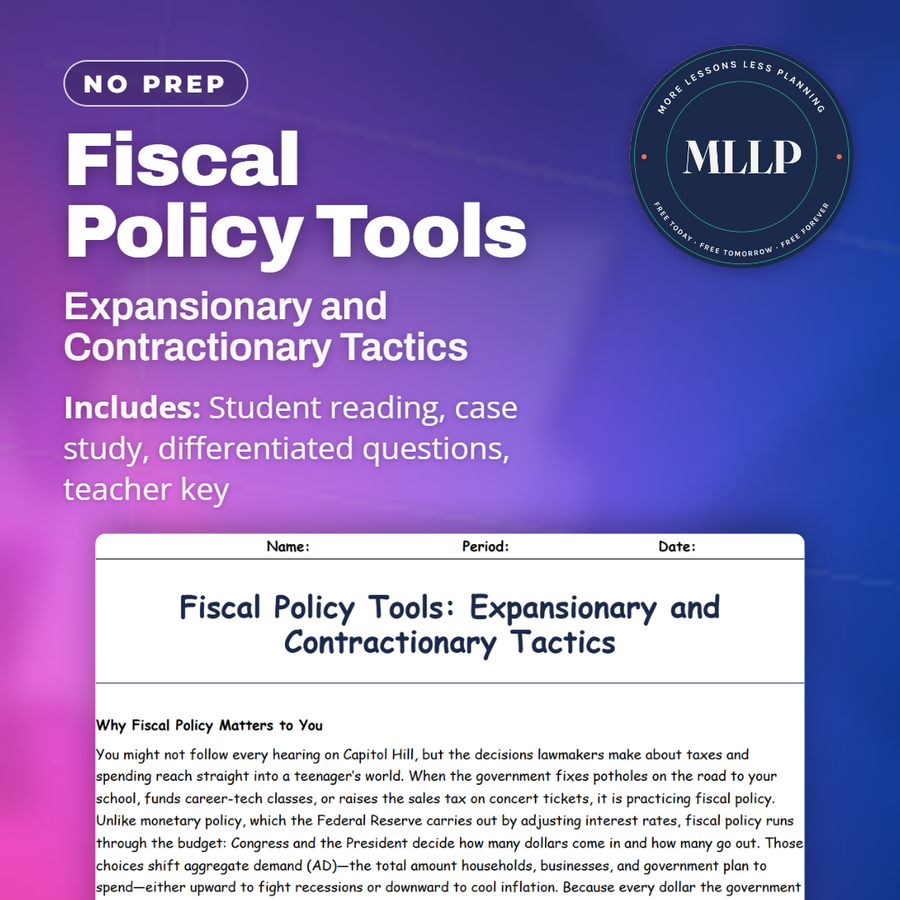
Fiscal Policy Tools: Expansionary and Contractionary Tactics
Quality reviewed September 2026
Facts verified September 8, 2026
- Grades
- Grades 9-12
- Length
- 8-page student worksheet
- Time
- About one 50-minute class period
- Great for
- Sub plans and independent work
- Includes
- Reading passage, comprehension questions + full answer key
- Format
- Print-and-go PDF
What students do
- Distinguish between expansionary and contractionary fiscal tools using examples from the key-info table
- Analyze the 2009 ARRA package to identify which components targeted immediate household demand versus long-term growth
- Match fiscal terms like "implementation lag," "fiscal multiplier," and "recognition lag" to their definitions
- Explain why the three lags (recognition, decision, implementation) delay the impact of fiscal policy
What it covers
- Expansionary tools including higher government spending and tax cuts versus contractionary tools of spending cuts and tax increases
- Fiscal multipliers and how initial spending changes ripple through the economy via consumption and investment
- Timing challenges including recognition, decision, and implementation lags that affect policy effectiveness
Start reading this worksheet
Why Fiscal Policy Matters to You
You might not follow every hearing on Capitol Hill, but the decisions lawmakers make about taxes and spending reach straight into a teenager’s world. When the government fixes potholes on the road to your school, funds career-tech classes, or raises the sales tax on concert tickets, it is practicing fiscal policy. Unlike monetary policy, which the Federal Reserve carries out by adjusting interest rates, fiscal policy runs through the budget: Congress and the President decide how many dollars come in and how many go out. Those choices shift aggregate demand (AD), the total amount households, businesses, and government plan to spend, either upward to fight recessions or downward to cool inflation. Because every dollar the government spends or cuts from taxes changes jobs, prices, and paychecks, understanding the tools of fiscal policy helps students connect the headlines to their everyday lives and even their weekend spending money.
Expansionary Policy: Putting Money into the Economy
When unemployment climbs and factories work below capacity, policymakers reach for expansionary tools. The first lever is a rise in government spending (G): more funding for broadband in rural areas, rebuilding bridges, or hiring additional teachers. Each project directly hires workers and buys materials, creating an immediate increase in aggregate demand. The second lever is a cut in tax rates (T). Lower payroll or corporate taxes leave families with more take-home pay and firms with extra cash to invest. The result is a change in consumption (C) and investment (I) that multiplies through local restaurants, streaming subscriptions, and equipment suppliers. Economists track the fiscal multiplier, the ratio of the change in GDP to the initial change in spending or taxes, to estimate the total punch of a policy. During deep downturns, the multiplier often tops one because idle factories can ramp up production quickly and households are eager to spend newfound income rather than save.
Contractionary Policy: Tapping the Brakes
Inflation feels like money melting in your pocket: prices rise faster than paychecks. To stop that spiral, the government can trim spending. For example, it might pause new highway contracts or reduce certain subsidies, removing demand straight from the economy. Alternatively, it can raise taxes, redirecting dollars from mall food courts and new smartphones into the Treasury instead. Both moves shift the AD curve leftward, cooling price growth. Contractionary policy has political costs: cutting popular programs or raising taxes attracts criticism in election season. For that reason, leaders often rely on the Fed to lift interest rates first and reach for fiscal brakes only when inflation is persistent or extreme.
Like what you read? The full reading, the case study, and every question set are in the free download below, along with the answer key.
Why this matters
A recession does not announce itself with a start date, which is why the three lags matter: time to recognize a downturn, more time to decide on a response, still more to get it moving. ARRA's tax credits reached households quickly while its infrastructure spending took far longer.
A billion dollars in spending rarely produces exactly a billion in growth, and the fiscal multiplier explains that gap. I have students trace how ARRA worked through several channels at once, so expansionary and contractionary policy stop being opposite ends of a vocabulary list.
From one teacher to another
I use this reading to help students see how fiscal policy tools work in practice. My students first learn the difference between expansionary and contractionary approaches, then analyze the 2009 ARRA package to see how tax credits, extended benefits, and infrastructure spending all worked together. A key concept is the fiscal multiplier, which shows why a one-billion dollar outlay doesn't produce one billion in GDP growth but sometimes more. They also discover why timing matters through the three lags: it takes time to recognize problems, make decisions, and actually implement spending. These insights help them understand real debates about stimulus and why policymakers sometimes act faster during crises.
What you get
- Answer Key
-
Student Worksheet
The 2009 stimulus package split $787 billion three ways, with about $288 billion in tax relief such as a Making Work Pay credit adding roughly $15 weekly to paychecks, $223 billion in extended unemployment and health subsidies, and $275 billion for highways, transit, and broadband. The Congressional Budget Office later credited it with raising real GDP by 1.5 to 3 percent and keeping between 1.5 and 3 million Americans employed.
Download
Where should I send the next one?
Everything here is free and it stays that way. Leave your email and I'll send you the new lessons as they go up. You can unsubscribe from any one of them.
Related resources
Budget Deficits & Surpluses: Understanding Fiscal Balances
Federal Budget & Debt: Funding the Nation’s Priorities
Fiscal Policy Impact: Fueling or Hindering Economic Growth
Major Tax Categories

Market Failures: Why Markets Don’t Always Work
National Debt Explained: Risks, Ratios, and Consequences
Every lesson on this site is free to download and use. If one of them saved you a prep period, you can chip in a few bucks toward my three kids' daycare fund. That's genuinely where tips go.