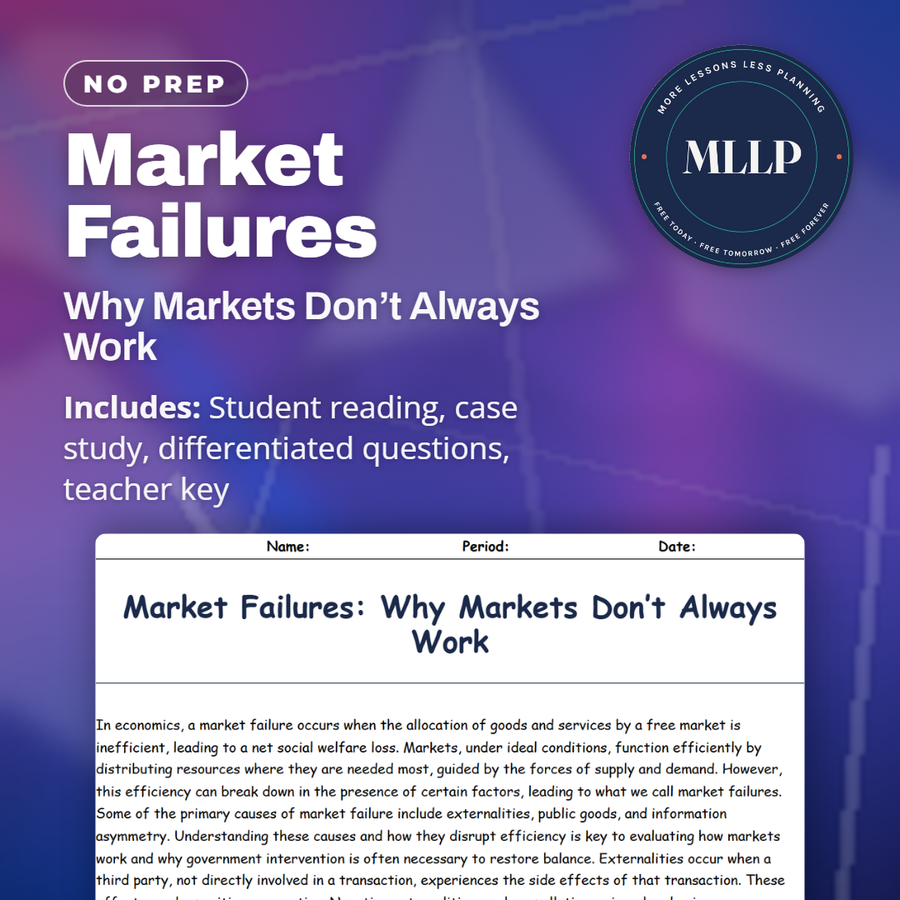
Market Failures: Why Markets Don’t Always Work
Quality reviewed September 2026
Facts verified September 8, 2026
- Grades
- Grades 9-12
- Length
- 9-page student worksheet
- Time
- About one 50-minute class period
- Great for
- Sub plans and independent work
- Includes
- Reading passage, comprehension questions + full answer key
- Format
- Print-and-go PDF
What students do
- Identify pollution from industrial factories as a negative externality in the multiple choice set
- Match key terms like externalities, information asymmetry, and public goods to their definitions
- Explain why private firms underproduce public goods such as national defense and public parks
- Analyze the case study on pollution and argue how government regulation can correct the inefficiency
What it covers
- Externalities and the costs of doing business that markets leave out of the price
- Public goods and the free rider problem, from parks to national defense
- Information asymmetry in markets like used car sales and healthcare
Start reading this worksheet
In economics, a market failure occurs when the allocation of goods and services by a free market is inefficient, leading to a net social welfare loss. Markets, under ideal conditions, function efficiently by distributing resources where they are needed most, guided by the forces of supply and demand. However, this efficiency can break down in the presence of certain factors, leading to what we call market failures. Some of the primary causes of market failure include externalities, public goods, and information asymmetry. Understanding these causes and how they disrupt efficiency is key to evaluating how markets work and why government intervention is often necessary to restore balance. Externalities occur when a third party, not directly involved in a transaction, experiences the side effects of that transaction. These effects can be positive or negative. Negative externalities, such as pollution, arise when businesses or individuals produce goods or services that harm others without compensating them for the damages. On the other hand, positive externalities occur when the actions of individuals or firms benefit others who do not pay for those benefits, such as the education of children benefiting society at large. Another common source of market failure is the existence of public goods. These goods are typically non-excludable and non-rivalrous, meaning that no one can be excluded from using them, and one person’s use of the good does not reduce its availability to others. Classic examples of public goods include things like national defense, clean air, and public parks. Because businesses cannot easily charge individuals for the use of public goods, there is little incentive for private firms to produce them, leading to underproduction of these essential resources. Information asymmetry is another factor that can cause market failure. This occurs when one party in a transaction has more or better information than the other. This lack of transparency can result in poor decision-making and inefficiencies. For example, in the healthcare industry, patients may not have enough information to make informed choices about their treatment options, while doctors or hospitals may have more information but lack the incentive to share it fully.
Externalities: The Cost of Doing Business
An externality arises when the costs or benefits of a transaction affect a third party who is not involved in the decision-making process. Externalities can be both negative and positive, and they create inefficiencies in the market. Negative externalities occur when the social cost of a product or service exceeds the private cost borne by the producers and consumers. Pollution from factories is a classic example of a negative externality. When companies release pollutants into the air or water, the social cost of that pollution—such as health problems, environmental damage, or cleanup costs—falls on society rather than the company itself. As a result, the market fails to account for these additional costs, leading to overproduction and an inefficient allocation of resources. On the other hand, positive externalities occur when the benefits of a transaction extend to third parties. A good example is education. When individuals invest in their education, they not only increase their own productivity but also contribute to the overall wellbeing of society by becoming more informed citizens, better workers, and more active community members. Since individuals do not directly pay for these societal benefits, there is often underinvestment in education, leading to a market failure. Government intervention can help address externalities. For negative externalities, governments often impose taxes or regulations to internalize the cost of the externality. For example, the carbon tax seeks to make companies pay for the pollution they create. For positive externalities, governments may provide subsidies or incentives, such as funding for education or public health programs, to encourage more of these beneficial activities.
Public Goods and the Free Rider Problem
Public goods are a classic example of market failure. These goods are characterized by their non-excludability and non-rivalrous nature. Non-excludable means that no one can be excluded from using the good, while non-rivalrous means that one person’s use of the good does not diminish its availability to others. Public goods like clean air, public parks, and national defense are essential to society, but they are often underproduced by private companies because there is no way to charge individuals for their consumption. This problem leads to the free rider problem, where individuals benefit from a good or service without paying for it. Since no one can be excluded from using public goods, people may choose not to pay for them, relying on others to fund their provision. As a result, there is often too little investment in public goods, and the quality or quantity of these resources can decline. Governments play a key role in addressing the underproduction of public goods by stepping in to provide them directly. Funding for public parks, infrastructure, and national defense are all examples of government intervention to ensure that these goods are available to all members of society, even if individuals are unwilling or unable to pay for them.
Like what you read? The full reading, the case study, and every question set are in the free download below, along with the answer key.
Why this matters
Why does a factory get to leave real costs off its books while charging a perfectly normal price? Markets are efficient at pricing what's easy to measure and bad at pricing what one business dumps onto everyone else. National defense and parks show the opposite failure: too hard to charge for.
Students arrive believing markets solve every problem alone, so externalities are the first real dent in that. The used-car and healthcare examples of information asymmetry land hard, because most students have felt the effect of knowing less than the person selling to them.
From one teacher to another
I use this reading when my students have a solid grip on supply and demand and are ready to see where markets fall short. The passages walk through externalities, the free rider problem, and information asymmetry with examples students recognize, like used car lots and polluting factories. The case study asks them to weigh pollution taxes and regulation as fixes, which sets up a good class debate. The answer key makes it easy to hand off to a sub.
What you get
- Answer Key
-
Student Worksheet
A factory dumping toxic chemicals into a nearby river cuts its own costs while residents absorb higher healthcare bills and a damaged water supply, the case study behind the reading's negative externality. On the positive side, education counts too, since a more informed workforce benefits the whole community beyond the student who paid tuition, and the FDA regulates drug information to close the gap between doctors and patients.
Download
Where should I send the next one?
Everything here is free and it stays that way. Leave your email and I'll send you the new lessons as they go up. You can unsubscribe from any one of them.
Related resources
Budget Deficits & Surpluses: Understanding Fiscal Balances
Federal Budget & Debt: Funding the Nation’s Priorities
Fiscal Policy Impact: Fueling or Hindering Economic Growth
Fiscal Policy Tools: Expansionary and Contractionary Tactics
Major Tax Categories
National Debt Explained: Risks, Ratios, and Consequences
Every lesson on this site is free to download and use. If one of them saved you a prep period, you can chip in a few bucks toward my three kids' daycare fund. That's genuinely where tips go.