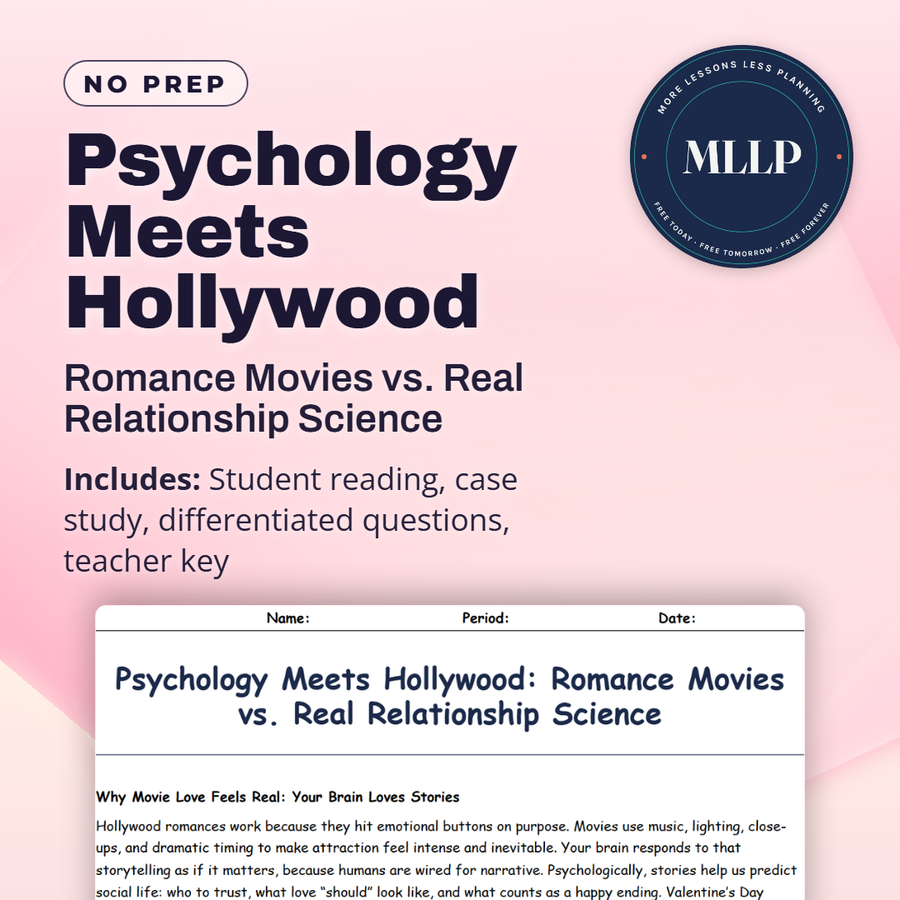
Psychology Meets Hollywood: Romance Movies vs. Real Relationship Science
Quality reviewed September 2026
Facts verified September 9, 2026
- Subject
- Social Studies
- Grades
- Grades 9-12
- Length
- 8-page student worksheet
- Time
- About one 50-minute class period
- Great for
- Sub plans and independent work
- Includes
- Reading passage, comprehension questions + full answer key
- Format
- Print-and-go PDF
What students do
- Connect romance movie tropes to psychological concepts like confirmation bias and cognitive distortions
- Distinguish between intensity and stability as signs of relationship health
- Analyze how anxious-avoidant cycles look romantic on screen but create real-life stress
- Rewrite unhealthy relationship scenes using consent and clear communication
What it covers
- Romance tropes and psychological concepts
- Anxious-avoidant attachment patterns
- Consent, communication, and repair skills
Start reading this worksheet
Why Movie Love Feels Real: Your Brain Loves Stories
Hollywood romances work because they hit emotional buttons on purpose. Movies use music, lighting, close-ups, and dramatic timing to make attraction feel intense and inevitable. Your brain responds to that storytelling as if it matters, because humans are wired for narrative. Psychologically, stories help us predict social life: who to trust, what love “should” look like, and what counts as a happy ending. Valentine’s Day makes movie romance even more influential because it’s the season when people rewatch love stories and compare them to real life. The problem is that movie love often teaches relationship shortcuts. It can suggest that chemistry is enough, that grand gestures fix everything, or that persistence is romantic even after someone has said no. Those messages can be confusing for teens because they blur the line between healthy effort and unhealthy pressure. In real relationships, the most important skills are not dramatic speeches. They are communication, consent, boundaries, and repair after conflict. This reading won’t “ruin romance.” It will help you watch with a smarter lens. You’ll learn how common movie tropes connect to real psychological concepts like attachment patterns, cognitive distortions, and social comparison. Then you’ll practice the most important question: “Is this behavior healthy in real life, or does it only work because the script guarantees a happy ending?” That question is a Valentine skill you can use forever.
Tropes vs. Truth: What Movies Get Right—and What They Over-Sell
Romance movies often use the same relationship moves because they’re exciting to watch. One common trope is the “grand gesture,” where a big public act proves love. Psychologically, gestures can feel meaningful because they signal effort and commitment. But in real life, public pressure can override consent. A healthy gesture is something both people would genuinely enjoy, not something that corners someone into saying yes. Another trope is “jealousy as proof.” Movies sometimes show jealousy as passion, as if controlling behavior equals caring. In psychology, jealousy is a feeling; it becomes harmful when it leads to surveillance, threats, isolation, or disrespect. A healthy partner doesn’t demand proof through sacrifice. They build trust through consistency. Movies also romanticize “mind-reading.” Characters magically know what the other person needs without asking. Real relationships don’t work that way. Assuming intent creates misunderstandings and conflict. This links to cognitive distortions like mind-reading (“They did that to hurt me”) and catastrophizing (“If they didn’t text back, it’s over”). Healthy relationships reduce guessing by using clear language. Finally, many movies compress time. A relationship that develops over months is shown in two scenes. That can make intensity look normal. In real psychology, strong bonds usually require time, shared experiences, and repeated trust-building moments.
Attachment on Screen: The Chaser, the Runner, and the Anxiety Loop
Many movie couples fall into a pattern: one person chases hard, the other pulls away, and the tension builds until a dramatic reunion. In psychology, this can look like an anxious-avoidant cycle. The anxious partner seeks reassurance and closeness; the avoidant partner feels pressured and distances. Movies make this cycle feel romantic because it creates suspense. In real life, it often creates stress, misunderstandings, and emotional exhaustion. A helpful skill is recognizing that chemistry isn’t the same as compatibility. An anxious-avoidant cycle can feel intense because uncertainty keeps attention high. But intensity isn’t always healthy. Real stability can feel quieter—more predictable texts, consistent plans, and respectful boundaries. For teens, this is important because media sometimes teaches that “calm = boring.” In healthy psychology, calm often means safe. Movies also tend to reward persistence. A character keeps pursuing until the other person “finally realizes” the love was there all along. That can blur boundaries. Persistence is only healthy when it respects consent and comfort. If someone says no, withdraws, or looks uncomfortable, continuing is not romantic—it’s pressure. The biggest takeaway: don’t judge your relationship by how it would look in a montage. Judge it by how it feels in daily life—respected, safe, and able to be yourself.
Like what you read? The full reading, the case study, and every question set are in the free download below, along with the answer key.
Why this matters
A jealous partner who shows up uninvited reads as romantic on screen because the film cuts straight to the reunion and skips the argument that got them there. Real relationships do not get that edit, and that gap is what this reading asks students to notice.
Intensity gets mistaken for proof a relationship is working, when psychology points the other way: an anxious-avoidant cycle can feel like passion while producing real stress for both people. Rewriting a movie scene with actual consent and direct communication is the moment it clicks. The healthier version is not less dramatic because it is boring, it is less dramatic because nobody in the scene is being manipulated.
From one teacher to another
Hollywood makes relationships look easy because the script guarantees a happy ending. In real psychology, the most important skills aren't dramatic speeches. They're conversations nobody wants to watch: "What are you comfortable with?" or "Let's talk about that misunderstanding." A jealous, chasing partner looks romantic on screen because the director cuts to the reunion. In a classroom, I show how that pattern matches an anxious-avoidant cycle, which usually creates stress unless people learn to communicate directly. The worksheet asks students to rewrite movie scenes using real relationship skills.
What you get
Download
Where should I send the next one?
Everything here is free and it stays that way. Leave your email and I'll send you the new lessons as they go up. You can unsubscribe from any one of them.
Related resources
Animal Courtship Biology: Sexual Selection in the Wild
Famous Relationship Cases in Forensics: Evidence vs. Emotion in the Public Eye
Forensic Science and Domestic Violence
Forensic Science: Online Romance Scams
Government and Relationships: How Laws Have Shaped “Love” in U.S. History
Love Hormones: Oxytocin, Dopamine, and the Brain
Every lesson on this site is free to download and use. If one of them saved you a prep period, you can chip in a few bucks toward my three kids' daycare fund. That's genuinely where tips go.