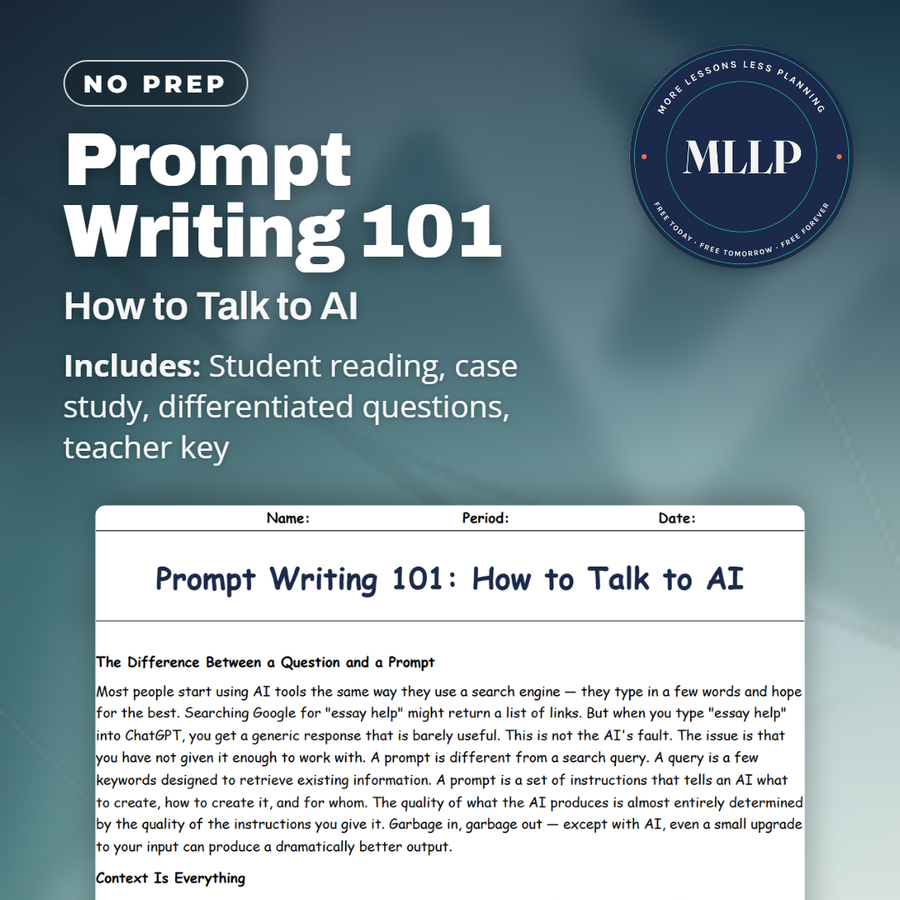
Prompt Writing 101: How to Talk to AI
Quality reviewed September 2026
Facts verified September 20, 2026
- Subject
- Career & Life Skills
- Grades
- Grades 9-12
- Length
- 9-page student worksheet
- Time
- About one 50-minute class period
- Great for
- Sub plans and independent work
- Includes
- Reading passage, comprehension questions + full answer key
- Format
- Print-and-go PDF
What students do
- Five terms, from prompt to specificity, get matched against their definitions
- Three fill-in-the-blank sentences use the reading's own language about instructions and the iterative approach
- Answer three multiple choice questions about context, iteration, and why prompting matters beyond school
- Trace how Marcus's second prompt fixed the mistakes that sank his first cover letter, in short answer form
What it covers
- All seven passages on prompts, context, specificity, and common beginner mistakes
- The key info table defining prompt, context, specificity, and the other core terms
- Marcus's cover letter case study and its two model-answer short response questions
Start reading this worksheet
The Difference Between a Question and a Prompt
Most people start using AI tools the same way they use a search engine: they type in a few words and hope for the best. Searching Google for "essay help" might return a list of links. But when you type "essay help" into ChatGPT, you get a generic response that is barely useful. This is not the AI's fault. The issue is that you have not given it enough to work with. A prompt is different from a search query. A query is a few keywords designed to retrieve existing information. A prompt is a set of instructions that tells an AI what to create, how to create it, and for whom. The quality of what the AI produces is almost entirely determined by the quality of the instructions you give it. Garbage in, garbage out. Except with AI, even a small upgrade to your input can produce a dramatically better output.
Context Is Everything
The single most important thing you can add to any prompt is context. Context tells the AI who you are, what situation you are in, and why you need something. Without context, the AI has to guess, and it will guess wrong or produce something too generic to be useful. Compare these two prompts. Prompt A: "Write a cover letter." Prompt B: "Write a cover letter for a 17-year-old applying for a part-time cashier position at a grocery store. I have no prior work experience but I was a team captain for my school's soccer team for two years. Keep the tone professional but not stiff, and keep it under 200 words." Both prompts ask for a cover letter. But Prompt B will produce something you could actually use. Prompt A will produce something that could have been written for anyone, which means it works for no one in particular. Context does not have to be complicated. You just have to answer the invisible questions the AI is asking: Who needs this? What is it for? What should it sound like? How long should it be? The more of those questions you answer upfront, the better your results.
Specificity Beats Vagueness Every Time
Vague prompts produce vague outputs. This is one of the most consistent rules in working with AI. If you ask for "a poem," you will get a generic poem. If you ask for "a four-stanza poem written from the perspective of a teenager who just got their driver's license, using a hopeful tone and simple language," you will get something specific and usable. Specificity includes details about format, length, tone, audience, and purpose. "Explain photosynthesis" will get you a textbook-style paragraph. "Explain photosynthesis to a 10-year-old who loves soccer, using a metaphor involving a field" will get you something memorable and creative. The AI has enormous capabilities, but it needs direction. Think of yourself as a director giving instructions to an incredibly skilled but completely literal actor. The actor will do exactly what you say, no more and no less, so your instructions need to be good.
Like what you read? The full reading, the case study, and every question set are in the free download below, along with the answer key.
Why this matters
The gap between a mediocre AI response and a genuinely useful one is almost always the prompt, not the tool, and that is a skill nobody teaches directly. Students who leave high school knowing how to give an AI enough context, specificity, and a clear task are the ones who get a usable cover letter, a real study guide, or a workable first draft, while everyone else gets Marcus's first rejection letter. It is also a communication skill that outlasts any particular AI tool: learning to name your audience, your constraints, and your actual goal before you ask for something is exactly what a good email to a boss or a clear request to a teacher requires too.
From one teacher to another
Marcus typed one vague line into ChatGPT, asked for a cover letter, and submitted it without reading it closely; the AI invented a resume full of experience a high school junior does not have, and he got rejected. This reading breaks down the difference between a search query and a real prompt, why context and specificity change everything about the output, and the four core elements, a task verb, a format, constraints, and background, that strong prompts share. It walks through common beginner mistakes like vague verbs, stacking too many requests into one message, and forgetting to name an audience. Students also read about iteration, the idea that a first AI response is a draft to refine through conversation rather than a final answer to accept or reject.
What you get
Download
Where should I send the next one?
Everything here is free and it stays that way. Leave your email and I'll send you the new lessons as they go up. You can unsubscribe from any one of them.
Related resources
AI Image Generators: Crafting Effective Prompts
AI Translation Tools and When NOT to Trust Them
AI as a Study Partner: Smart Ways to Learn With It
AI for Research: Fact-Checking and Source-Finding
AI in Microsoft Word, Google Docs, and Canva
Free vs. Paid AI: What's Worth It for a Student?
Every lesson on this site is free to download and use. If one of them saved you a prep period, you can chip in a few bucks toward my three kids' daycare fund. That's genuinely where tips go.