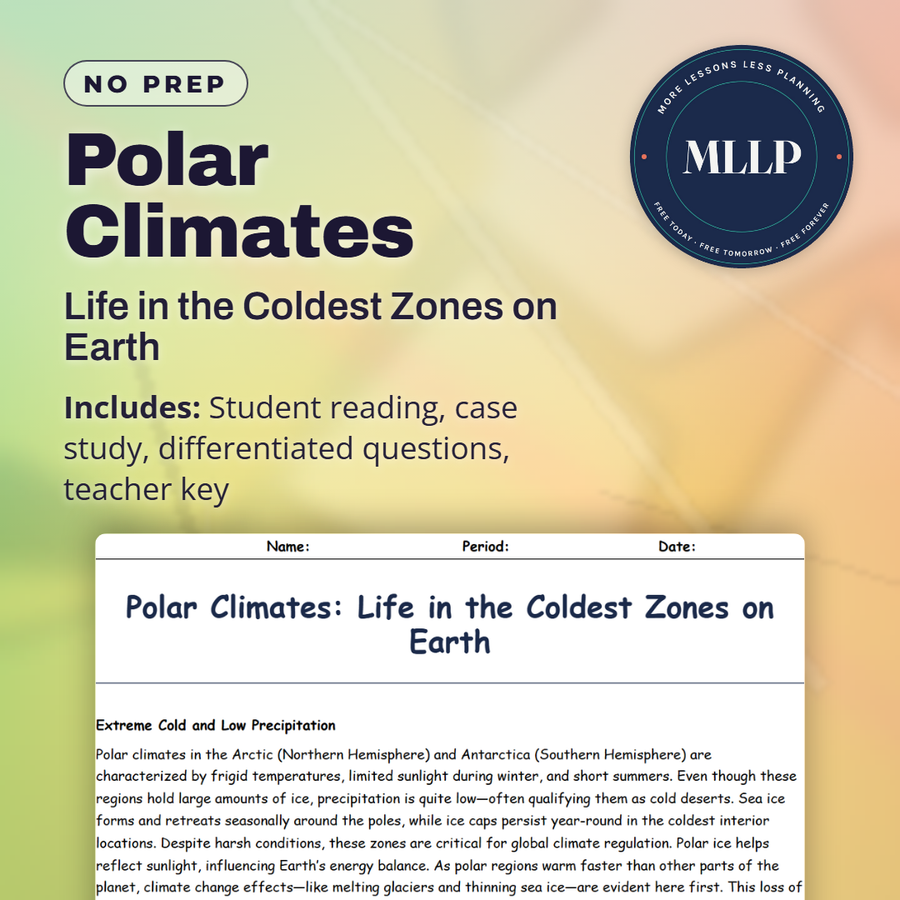
Polar Climates: Life in the Coldest Zones on Earth
Quality reviewed September 2026
Facts verified September 14, 2026
- Subject
- Social Studies
- Grades
- Grades 9-12
- Length
- 6-page student worksheet
- Time
- About one 50-minute class period
- Great for
- Sub plans and independent work
- Includes
- Reading passage, comprehension questions + full answer key
- Format
- Print-and-go PDF
What students do
- Match terms like permafrost, sea ice, and tundra to their correct definitions
- Fill in the blank sentences on polar regions reflecting sunlight, permafrost releasing methane, and the tundra ecosystem
- Answer multiple choice questions on what characterizes polar climates, what tundra vegetation looks like, and why ice shelf collapse concerns scientists in Antarctica
- Write short answers on why polar climates have low precipitation despite so much ice, how melting sea ice affects polar bears, and what ice shelf collapse could mean globally
What it covers
- The Arctic and Antarctica, including sea ice, tundra vegetation, and adaptations like blubber and fur in animals such as polar bears and emperor penguins
- How climate change accelerates permafrost thaw, sea ice loss, and glacier flow in polar regions
- A case study on melting permafrost damaging roads and buildings in Arctic Alaska towns, plus a reference table comparing the Arctic and Antarctica
Start reading this worksheet
Extreme Cold and Low Precipitation
Polar climates in the Arctic (Northern Hemisphere) and Antarctica (Southern Hemisphere) are characterized by frigid temperatures, limited sunlight during winter, and short summers. Even though these regions hold large amounts of ice, precipitation is quite low, often qualifying them as cold deserts. Sea ice forms and retreats seasonally around the poles, while ice caps persist year-round in the coldest interior locations. Despite harsh conditions, these zones are critical for global climate regulation. Polar ice helps reflect sunlight, influencing Earth’s energy balance. As polar regions warm faster than other parts of the planet, climate change effects (like melting glaciers and thinning sea ice) are evident here first. This loss of reflective ice can accelerate warming, creating feedback loops with worldwide consequences.
Adaptations and Limited Vegetation
Life in polar climates must endure freezing winds, low temperatures, and extended darkness. Tundra ecosystems feature mostly mosses, lichens, and low shrubs that can survive the short growing season. Animals like polar bears in the Arctic or emperor penguins in Antarctica have evolved specialized traits for insulation and energy storage. Thick fur, blubber, and behaviors like huddling together help them withstand sub-zero conditions. Much of the Arctic supports indigenous communities like the Inuit, who have historically thrived on hunting marine mammals and fish. Technological advancements, however, are changing lifestyles, with some adopting modern infrastructure. Yet hunting and fishing remain culturally significant. In Antarctica, only scientific researchers and support staff live temporarily at research stations; no permanent human population exists.
Like what you read? The full reading, the case study, and every question set are in the free download below, along with the answer key.
Why this matters
Roads and building foundations are cracking apart in Arctic Alaska towns as permafrost starts to thaw, releasing methane as it goes. That is not a distant problem happening to polar bears alone, it is infrastructure failing under people's homes right now. The Arctic and Antarctica get treated as one generic cold place too often, when a side by side comparison shows how much they actually differ.
Students usually picture the poles as empty and static, so the Alaska case study surprises them: permafrost thaw is active and local, not a slow abstraction decades away. Comparing Arctic sea ice to Antarctic ice shelves side by side is what makes ice shelf collapse stop sounding like one interchangeable disaster.
From one teacher to another
This one does a good job separating the Arctic and Antarctica instead of treating polar climates as one generic cold place, which helps when students compare them on the reference table. The permafrost case study in Alaska gives a specific, local angle on climate change that is easier for students to picture than global temperature graphs. It works well right before or after a unit on climate zones or biomes.
What you get
Download
Where should I send the next one?
Everything here is free and it stays that way. Leave your email and I'll send you the new lessons as they go up. You can unsubscribe from any one of them.
Related resources
Biomes & Ecosystems: Life Across Earth’s Habitats
Climate vs. Weather: Understanding the Difference
Convergent Boundaries: Where Plates Collide
Deserts: Survival in the Harshest Climates
Divergent Boundaries: Where Plates Pull Apart
Earth’s Layers: From Crust to Core
Every lesson on this site is free to download and use. If one of them saved you a prep period, you can chip in a few bucks toward my three kids' daycare fund. That's genuinely where tips go.