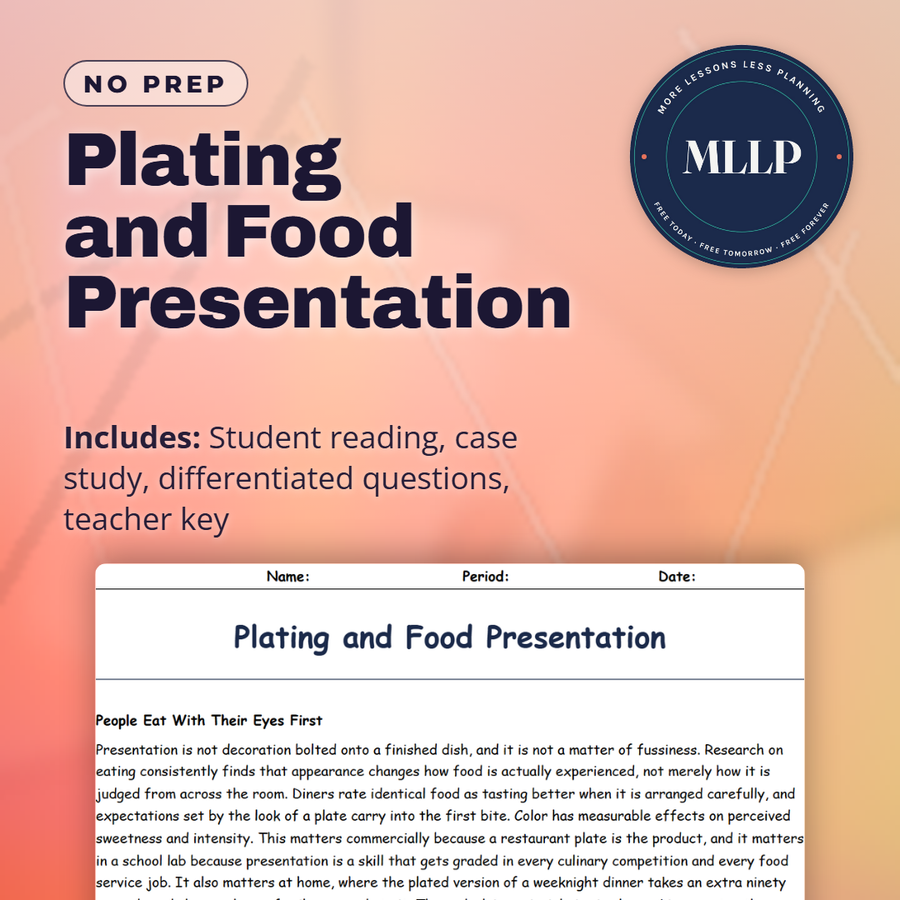
Plating and Food Presentation
Quality reviewed September 2026
Facts verified September 23, 2026
- Subject
- Career & Life Skills
- Grades
- Grades 9-12
- Length
- 8-page student worksheet
- Time
- About one 50-minute class period
- Great for
- Sub plans and independent work
- Includes
- Reading passage, comprehension questions + full answer key
- Format
- Print-and-go PDF
What students do
- A plate works like a frame, and the reading builds the composition rules from a focal point out to negative space and a clean rim
- Explain why braising liquid gets spooned around a dish instead of poured directly over it
- Two groups plate the identical braised chicken and potatoes, and only one of them warms the plate and wipes the rim
- Explain the three-part test a garnish has to pass before it earns a spot on the plate
What it covers
- Why appearance changes how food is actually experienced, beyond simply how it looks from across a room
- The composition rules behind a focal point, negative space, and an unpatterned white plate
- The garnish test, edible, related to the dish, and adding something a diner would actually eat
Start reading this worksheet
People Eat With Their Eyes First
Presentation is not decoration bolted onto a finished dish, and it is not a matter of fussiness. Research on eating consistently finds that appearance changes how food is actually experienced, not merely how it is judged from across the room. Diners rate identical food as tasting better when it is arranged carefully, and expectations set by the look of a plate carry into the first bite. Color has measurable effects on perceived sweetness and intensity. This matters commercially because a restaurant plate is the product, and it matters in a school lab because presentation is a skill that gets graded in every culinary competition and every food service job. It also matters at home, where the plated version of a weeknight dinner takes an extra ninety seconds and changes how a family responds to it. The underlying principle is simple: cooking creates the flavor, and plating communicates it. A dish that tastes excellent but arrives as a shapeless pile on a smeared plate has undersold itself before anyone picks up a fork. None of this requires expensive equipment or artistic training. It requires a clean plate, a plan for where things go, and the discipline to spend the last two minutes on arrangement rather than treating the pan as the finish line. There is a commercial reason worth naming as well. Plates get photographed now, by the restaurant and by the people eating, and a dish that photographs badly loses reach it would otherwise have gotten for free. That is not the reason to plate well, but it is a reason presentation has become a graded skill in culinary programs.
The Plate Is a Composition
A plate is a frame, and the food inside it is a composition with a few reliable rules. Start with a focal point, the single most important element, usually the protein or the main item, and place it deliberately rather than in the dead center by default. Many cooks work off an imaginary clock face, setting the main item between four and eight o'clock, closest to the diner, with starch and vegetables filling the space behind it. Negative space is as important as the food. Leaving part of the plate empty gives the eye somewhere to rest and makes the portion look intentional, while food pushed to every edge reads as crowded no matter how good it is. The rim is a frame and not a canvas, so nothing should sit on it and no sauce or fingerprints should smear it, which is why plates get wiped with a clean cloth before they leave the kitchen. Odd numbers of items look more natural than even numbers, so three scallops or five gnocchi arrange better than four or six. Repetition and grouping help, since three small piles of the same garnish read as intentional while the same amount scattered randomly reads as an accident. Sightlines matter as much as arrangement does. A plate has a front, the edge nearest the diner, and components are placed so that nothing important hides behind something taller. Turning the plate before it leaves the kitchen so its best angle faces the guest is a standard final step in a professional dining room.
Height, Texture, and Color
Flat food looks unfinished, so building some vertical dimension is one of the fastest ways to improve a plate. Height is created by leaning items against each other, mounding a starch and setting the protein partly on top, or stacking components in layers. It should still be structurally stable and easy to eat, because a tower that collapses when a fork touches it has failed at the actual job. Texture contrast does double duty, improving both the look and the eating. A dish where everything is soft feels monotonous, so a crisp element such as toasted breadcrumbs, fried shallots, toasted nuts, or a crisp-skinned protein adds interest visually and in the mouth. Color is the fastest fix available to a student cook. Brown and beige dominate a lot of cooking, especially braises, roasts, and anything fried, and a plate of brown food on a white plate looks tired regardless of how it tastes. A green element, whether herbs, a vegetable, or a scattering of scallions, or something red or orange like roasted peppers, tomato, or paprika, lifts the whole plate immediately. Plate color matters too: white plates make colors pop and are the standard for exactly that reason, while busy patterned plates compete with the food. Plate size interacts with all of this. The same portion looks generous on a smaller plate and stingy on an oversized one, which is why restaurants choose a plate size for each dish rather than using one size for everything. Matching the plate to the portion is often a faster fix than rearranging the food on it.
Like what you read? The full reading, the case study, and every question set are in the free download below, along with the answer key.
Why this matters
Plating is a graded skill in every culinary competition and every food service job, but the more immediate use for a student is noticing that a family dinner plated with a little intention gets a different reaction at the table than the same food dumped on straight from the pan. The reading is specific about why that happens, since appearance sets expectations that carry into the first bite rather than simply decorating a dish that is already finished.
From one teacher to another
Diners eat with their eyes before the fork ever moves, and the reading opens with real evidence that appearance changes how food is actually experienced rather than only how it gets judged from a distance. From there it treats the plate as a frame, with a focal point placed deliberately, negative space left on purpose, and a rim that stays as clean as an unused edge. It covers height and texture, the fix a green or red element gives a plate dominated by brown, and four ways to apply sauce, pooling, drizzling, a smear, and dotting, along with the plain rule that a garnish has to be something a diner would actually eat. The case study plates the same braised chicken and potatoes two ways and scores the warmed, deliberately arranged plate almost two full points higher on identical food. I use this one right before a plating lab, so students have language for choices they are about to make with their hands.
What you get
Download
Where should I send the next one?
Everything here is free and it stays that way. Leave your email and I'll send you the new lessons as they go up. You can unsubscribe from any one of them.
Related resources
Cooking Methods: Dry Heat vs. Moist Heat
Herbs, Spices, and Building Flavor
How to Read and Follow a Recipe
Kitchen Tools and Equipment
Knife Skills and the Basic Cuts
Measuring Techniques: Dry, Liquid, and Weight
Every lesson on this site is free to download and use. If one of them saved you a prep period, you can chip in a few bucks toward my three kids' daycare fund. That's genuinely where tips go.