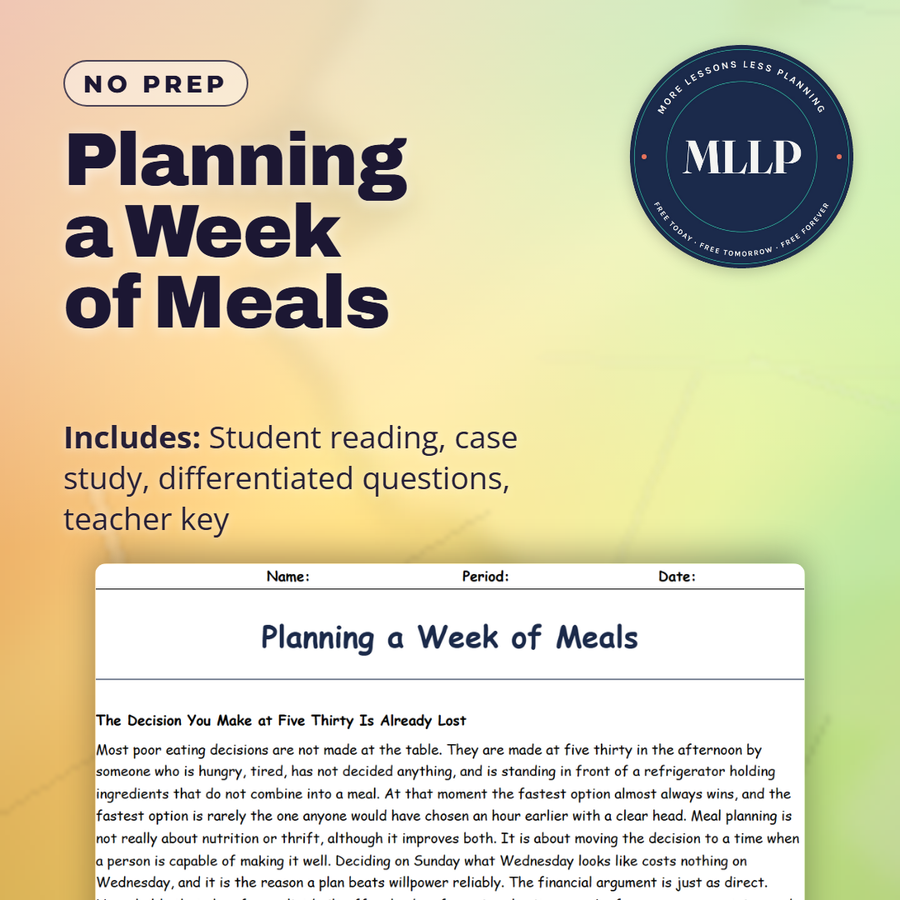
Planning a Week of Meals
Quality reviewed September 2026
Facts verified September 23, 2026
- Subject
- Career & Life Skills
- Grades
- Grades 9-12
- Length
- 9-page student worksheet
- Time
- About one 50-minute class period
- Great for
- Sub plans and independent work
- Includes
- Reading passage, comprehension questions + full answer key
- Format
- Print-and-go PDF
What students do
- Explain why a plan beats willpower at five thirty on a tired evening
- Identify the temperature range where bacteria multiply fastest in stored food
- Devon's grocery spending gets tracked from his first apartment through the following month
- The largest package on the shelf gets tested against the idea that bigger is automatically cheaper
What it covers
- Why inventorying the kitchen comes before writing a single item on a grocery list
- The unit price trick for comparing packages of different sizes honestly
- Devon's grocery bill and the nineteen dollars of spinach he threw away
Start reading this worksheet
The Decision You Make at Five Thirty Is Already Lost
Most poor eating decisions are not made at the table. They are made at five thirty in the afternoon by someone who is hungry, tired, has not decided anything, and is standing in front of a refrigerator holding ingredients that do not combine into a meal. At that moment the fastest option almost always wins, and the fastest option is rarely the one anyone would have chosen an hour earlier with a clear head. Meal planning is not really about nutrition or thrift, although it improves both. It is about moving the decision to a time when a person is capable of making it well. Deciding on Sunday what Wednesday looks like costs nothing on Wednesday, and it is the reason a plan beats willpower reliably. The financial argument is just as direct. Households that shop from a list built off a plan buy fewer impulse items, make fewer emergency trips, and throw away less food. Food waste in the United States has been estimated at roughly thirty to forty percent of the food supply, and a substantial share of that is thrown away at home, meaning food a household already paid for. Every wilted bag of spinach bought with good intentions and no plan is money spent on nothing. A plan is what connects the produce someone buys on Saturday to a specific dinner on Tuesday, which is the difference between groceries and garbage.
Shop Your Kitchen Before You Shop the Store
Planning starts at home, not at the store, and skipping this step is the most common reason a well-intentioned plan produces a third jar of cumin and no dinner. Take inventory first. Look at what is in the refrigerator, the freezer, and the pantry, and pay particular attention to whatever is about to turn, because those items should anchor the first two or three meals of the week rather than being discovered later in a state nobody wants to touch. Building around what already exists cuts the grocery bill before a single item goes into a cart. The second step is to plan against the actual calendar rather than an imaginary one. A week is not seven identical evenings. If Tuesday has practice until seven and Thursday has a shift, those nights get a fifteen-minute meal, a planned leftover, or something that finished cooking on Sunday. Assigning an ambitious recipe to the busiest night of the week is how plans collapse, and it collapses in a predictable way that a person can simply route around in advance. It also helps to accept that seven planned dinners is more ambition than most households need. Four or five planned meals plus one leftover night and one deliberately flexible night is a more durable structure, because it has slack built in. A plan with no slack breaks the first time something ordinary goes wrong, and something ordinary goes wrong most weeks.
Cook Once, Eat Twice, and Let Ingredients Overlap
The most efficient meal plans are built so that ingredients and effort carry across multiple meals rather than each dinner starting from zero. Overlapping ingredients is the first technique. Buying one bunch of cilantro for one recipe wastes most of the bunch, while planning two or three dishes that use it means the whole bunch gets used and the cost per meal drops. The same logic applies to a rotisserie chicken, a large bag of rice, a head of cabbage, or a container of yogurt. Cooking once and eating twice is the second. Doubling a batch of chili, rice, roasted vegetables, or ground turkey costs almost no additional time, since the pan is already hot and the cutting board is already dirty, and it converts one cooking session into two or three meals. Planned leftovers are different from accidental leftovers in an important way. A planned leftover is assigned to a specific night, so it gets eaten. An accidental leftover sits in a container until nobody is willing to open it. Component cooking extends the idea further. Preparing building blocks rather than finished dishes, meaning a pot of grain, a roasted tray of vegetables, a cooked protein, and one good sauce, allows a week of genuinely different meals from the same containers, since the same components become a grain bowl, a wrap, a salad, and a soup depending on assembly. Theme nights reduce decisions further, because Monday being pasta night makes the question smaller and easier.
Like what you read? The full reading, the case study, and every question set are in the free download below, along with the answer key.
Why this matters
A student who can plan a week of meals is solving a problem that follows them out of this classroom and into a dorm room, a first apartment, or a family's kitchen, usually sooner than they expect. Devon's numbers make the point better than a lecture could, since the same amount of food cost him over a hundred dollars less once the plan connected each purchase to an actual dinner instead of a hopeful one. The habits in the reading, from checking the fridge first to reading a unit price tag, are small enough to start using on the very next grocery trip.
From one teacher to another
Devon spent three hundred forty dollars on groceries his first month living alone and still ate fast food four nights a week, and tracking down where that money actually went is the case study this reading ends on. Before that, students read why the decision made at five thirty by someone tired and hungry is usually already lost, and why taking inventory of the kitchen has to come before a grocery list gets written. The reading covers building a week around four or five planned dinners instead of seven, cooking once to eat twice, reading unit price tags honestly, and the specific temperatures that keep leftovers safe. It closes with Devon cutting his grocery bill by more than a third without spending less on food that actually became dinner.
What you get
Download
Where should I send the next one?
Everything here is free and it stays that way. Leave your email and I'll send you the new lessons as they go up. You can unsubscribe from any one of them.
Related resources
Building a Balanced Plate with MyPlate
Carbs, Protein, and Fat in the Kitchen
Decoding the Nutrition Facts Label
Food Allergies and Intolerances
Food Marketing and Nutrition Misinformation
Nutrition Across the Lifespan
Every lesson on this site is free to download and use. If one of them saved you a prep period, you can chip in a few bucks toward my three kids' daycare fund. That's genuinely where tips go.