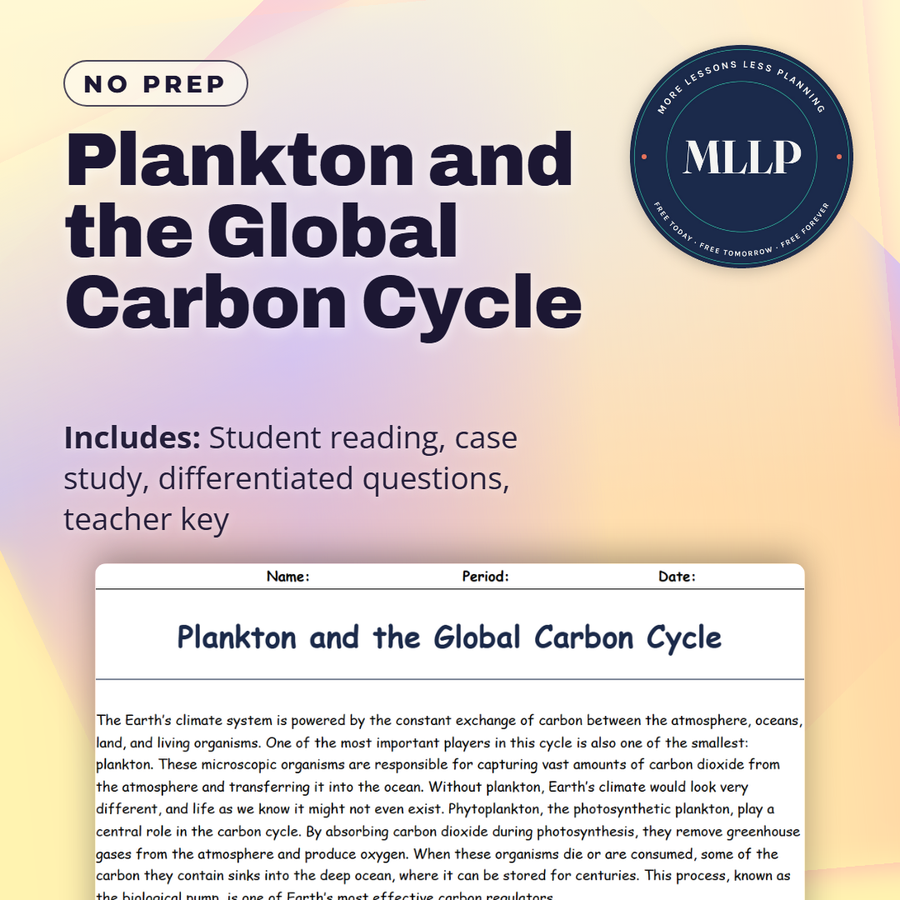
Plankton and the Global Carbon Cycle
Quality reviewed September 2026
Facts verified September 14, 2026
- Subject
- Science
- Grades
- Grades 9-12
- Length
- 7-page student worksheet
- Time
- About one 50-minute class period
- Great for
- Sub plans and independent work
- Includes
- Reading passage, comprehension questions + full answer key
- Format
- Print-and-go PDF
What students do
- Match terms like phytoplankton, zooplankton, the biological pump, and coccolithophores to their correct definitions
- Fill in the blank sentences on the biological pump, limiting nutrients, and carbonate shells
- Answer multiple choice questions on the biological pump, coccolithophore carbon storage, and iron fertilization results
- Write short answers on why plankton stabilize climate, how zooplankton boost the biological pump, and the risks of manipulating plankton growth
What it covers
- How phytoplankton, zooplankton, and coccolithophores each move carbon through the ocean
- The biological pump and how sinking organic matter locks carbon away for centuries
- A case study on 1990s and 2000s ocean iron fertilization experiments
Start reading this worksheet
The Earth’s climate system is powered by the constant exchange of carbon between the atmosphere, oceans, land, and living organisms. One of the most important players in this cycle is also one of the smallest: plankton. These microscopic organisms are responsible for capturing vast amounts of carbon dioxide from the atmosphere and transferring it into the ocean. Without plankton, Earth’s climate would look very different, and life as we know it might not even exist. Phytoplankton, the photosynthetic plankton, play a central role in the carbon cycle. By absorbing carbon dioxide during photosynthesis, they remove greenhouse gases from the atmosphere and produce oxygen. When these organisms die or are consumed, some of the carbon they contain sinks into the deep ocean, where it can be stored for centuries. This process, known as the biological pump, is one of Earth’s most effective carbon regulators.
Carbon Fixation by Phytoplankton
Like plants on land, phytoplankton capture carbon dioxide and convert it into organic molecules. This process, called carbon fixation, occurs throughout the sunlit photic zone of the ocean. Because plankton are so abundant and widespread, their combined activity accounts for at least half of the photosynthesis on Earth. This means that every second breath you take may be owed to the oxygen produced by marine plankton. Carbon fixation is not evenly distributed. Areas of high productivity, such as coastal upwelling zones and polar waters, absorb much more carbon than nutrient-poor gyres. Seasonal blooms also have an outsized effect, temporarily drawing down atmospheric carbon on massive scales. These patterns highlight the importance of regional and seasonal variations in the ocean’s carbon cycle.
Sinking Carbon and the Biological Pump
When plankton die or are eaten, their remains sink into the deep ocean. Some of this material is decomposed and recycled, but a significant fraction reaches depths where it can remain stored for hundreds to thousands of years. This downward transfer of carbon is known as the biological pump. It essentially locks away carbon, preventing it from quickly returning to the atmosphere as carbon dioxide. Zooplankton play an important role by packaging phytoplankton into fecal pellets that sink faster, enhancing the pump’s efficiency. Larger plankton species, such as diatoms with silica shells, also contribute significantly because their heavy remains sink more readily. This process explains why the ocean acts as such a powerful buffer against climate change.
Like what you read? The full reading, the case study, and every question set are in the free download below, along with the answer key.
Why this matters
Carbon that phytoplankton pull out of the air during photosynthesis does not stay at the surface. Zooplankton package it into sinking fecal pellets as part of the biological pump, locking it away for centuries once it reaches the deep ocean, while coccolithophores add another route by building carbon into carbonate shells that eventually settle out.
I put a real ethical question to students here: the iron fertilization experiments from the 1990s and early 2000s show that adding iron can trigger a bloom big enough to pull carbon dioxide from the air, so should anyone do that on purpose. The science and the debate are equally unsettled.
From one teacher to another
Carbon moves through the ocean in this worksheet, from phytoplankton fixing it during photosynthesis to zooplankton packaging it into sinking fecal pellets. The case study covers iron fertilization experiments from the 1990s and early 2000s, where scientists added iron to trigger phytoplankton blooms and pull carbon dioxide out of the atmosphere. It raises real questions about the ethics of manipulating ocean chemistry.
What you get
Download
Where should I send the next one?
Everything here is free and it stays that way. Leave your email and I'll send you the new lessons as they go up. You can unsubscribe from any one of them.
Related resources
Chemosynthesis at Hydrothermal Vent Communities

Cyanobacteria and the Breath of Life
Diatoms, Dinoflagellates, and Coccolithophores Explained

Harmful Algal Blooms: Red Tides, Toxins, and Ecological Consequences
Photosynthesis in the Marine Environment
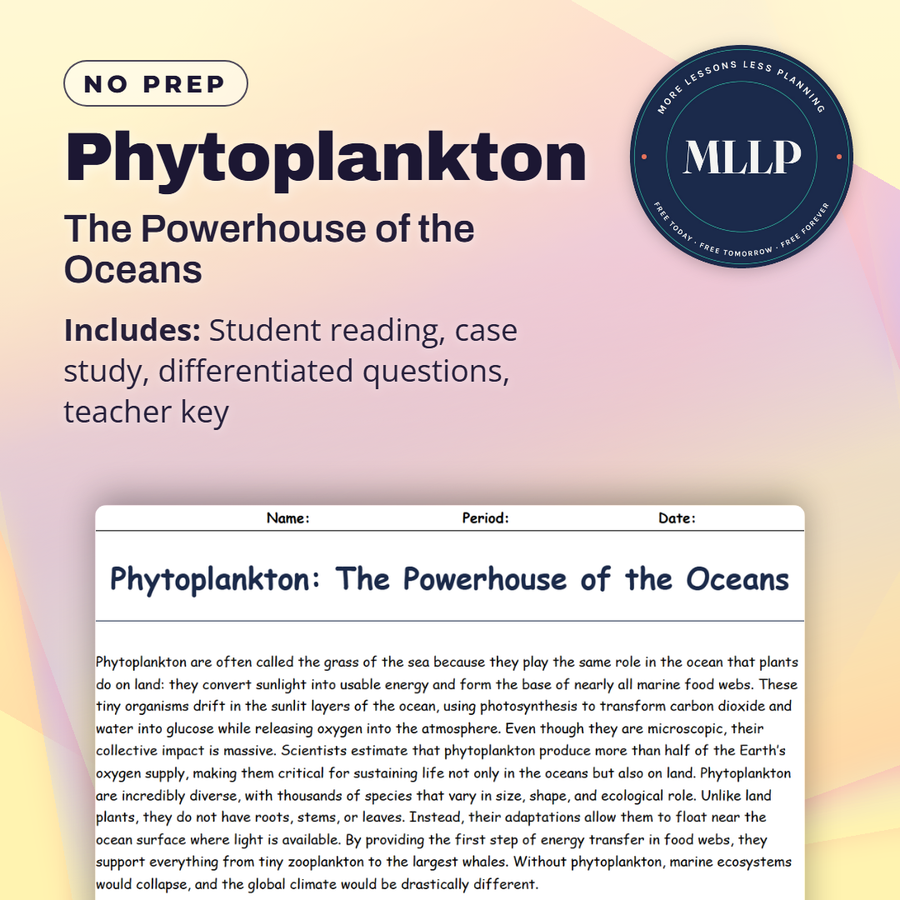
Phytoplankton: The Powerhouse of the Oceans
Every lesson on this site is free to download and use. If one of them saved you a prep period, you can chip in a few bucks toward my three kids' daycare fund. That's genuinely where tips go.