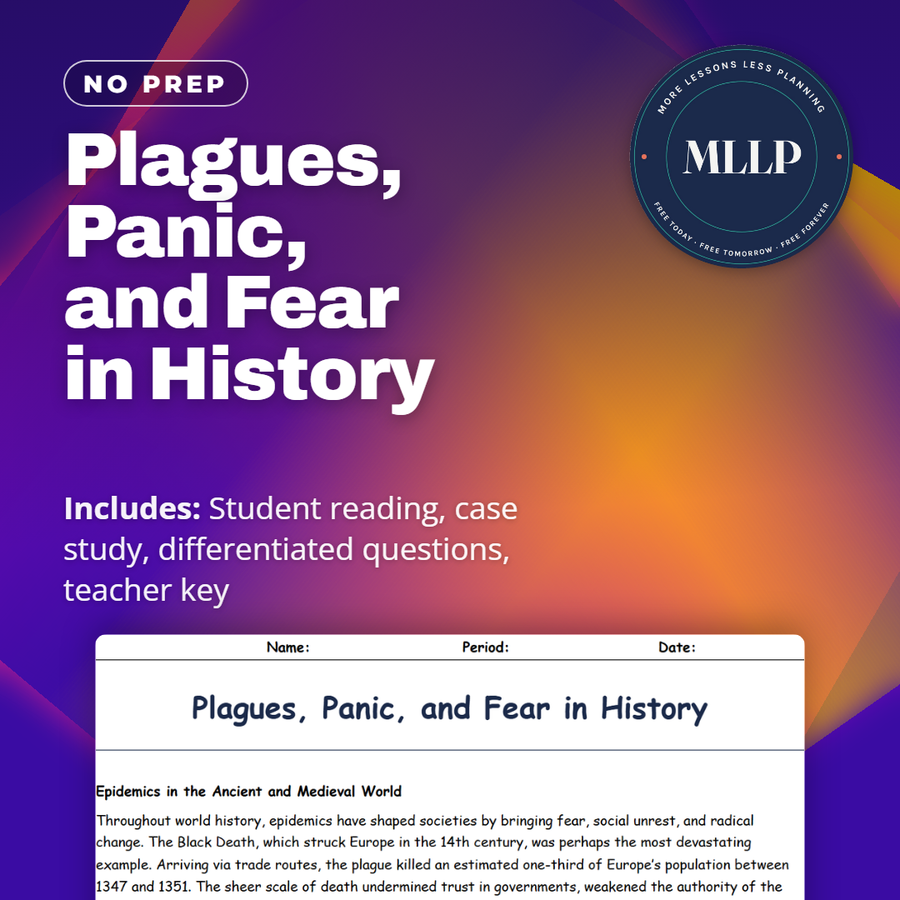
Plagues, Panic, and Fear in History
Quality reviewed September 2026
Facts verified September 9, 2026
- Subject
- Social Studies
- Grades
- Grades 9-12
- Length
- 6-page student worksheet
- Time
- About one 50-minute class period
- Great for
- Sub plans and independent work
- Includes
- Reading passage, comprehension questions + full answer key
- Format
- Print-and-go PDF
What students do
- Analyze historical patterns of fear and scapegoating during epidemics
- Evaluate how the Black Death reshaped European society and feudalism
- Examine the connection between misinformation and social unrest
- Trace how pandemics drove innovation in public health and infrastructure
What it covers
- The Black Death and medieval social unrest
- 19th-century cholera and urban reform
- Pandemics as catalysts for historical change
Start reading this worksheet
Epidemics in the Ancient and Medieval World
Throughout world history, epidemics have shaped societies by bringing fear, social unrest, and radical change. The Black Death, which struck Europe in the 14th century, was perhaps the most devastating example. Arriving via trade routes, the plague killed an estimated one-third of Europe’s population between 1347 and 1351. The sheer scale of death undermined trust in governments, weakened the authority of the Church, and led to widespread scapegoating of minority groups, particularly Jews, who were falsely accused of poisoning wells. The psychological impact was enormous: people interpreted the plague as divine punishment, which in turn reshaped religious and cultural practices. But Europe was not alone. The Antonine Plague of the Roman Empire (165–180 CE) and the Justinian Plague of the Byzantine Empire (541–542 CE) both devastated empires at their peaks, contributing to military decline and economic collapse. Epidemics often revealed how fragile societies could be when confronted with invisible threats. Panic, fear, and rumor spread faster than medical knowledge, leaving societies vulnerable not only to disease but also to the destructive social consequences of mistrust and hysteria.
The Age of Cholera and Industrialization
By the 19th century, new waves of disease coincided with rapid industrialization and urban growth. Cholera outbreaks swept across Europe, Asia, and the Americas, spreading through contaminated water supplies in overcrowded cities. Unlike the plague, cholera often killed within hours of infection, sparking terror in working-class neighborhoods. Governments struggled to control outbreaks, and early theories, such as miasma theory (the belief that foul air caused disease), often misdirected efforts. These outbreaks forced changes in urban planning and public health. Cities began building sewer systems, regulating waste disposal, and investing in clean water supplies. Yet cholera also produced political conflict: riots broke out in Russia and Britain as poor communities believed elites were deliberately spreading disease. Once again, epidemics revealed the deep connection between disease, fear, and social unrest.
Like what you read? The full reading, the case study, and every question set are in the free download below, along with the answer key.
Why this matters
Entire towns during the Black Death blamed their own Jewish neighbors for a disease no one understood, because panic needed somewhere to land. That same pattern of misdirected blame resurfaces centuries later, once cholera tears through crowded, filthy cities and someone still has to be blamed for it.
A history of disease can feel like unrelieved grimness, and this reading complicates that assumption: the same fear that destroyed communities during the Black Death eventually forced governments to build the sewer systems and clean water that ended cholera's grip on cities. I want students leaving this unit knowing that terror does not only wreck things, it also pushes people to rebuild differently than before.
From one teacher to another
I use this one because it keeps students honest about how fear works. During the Black Death, entire communities blamed Jewish people because panic needed a target. The worksheet doesn't shy away from that violence, but it also shows cholera later forcing governments to build sewer systems and clean water. The same fear that destroyed communities also rebuilt them. Students come out understanding that history repeats patterns, not because people are evil, but because terror changes how we think.
What you get
Download
Where should I send the next one?
Everything here is free and it stays that way. Leave your email and I'll send you the new lessons as they go up. You can unsubscribe from any one of them.
Related resources


Every lesson on this site is free to download and use. If one of them saved you a prep period, you can chip in a few bucks toward my three kids' daycare fund. That's genuinely where tips go.