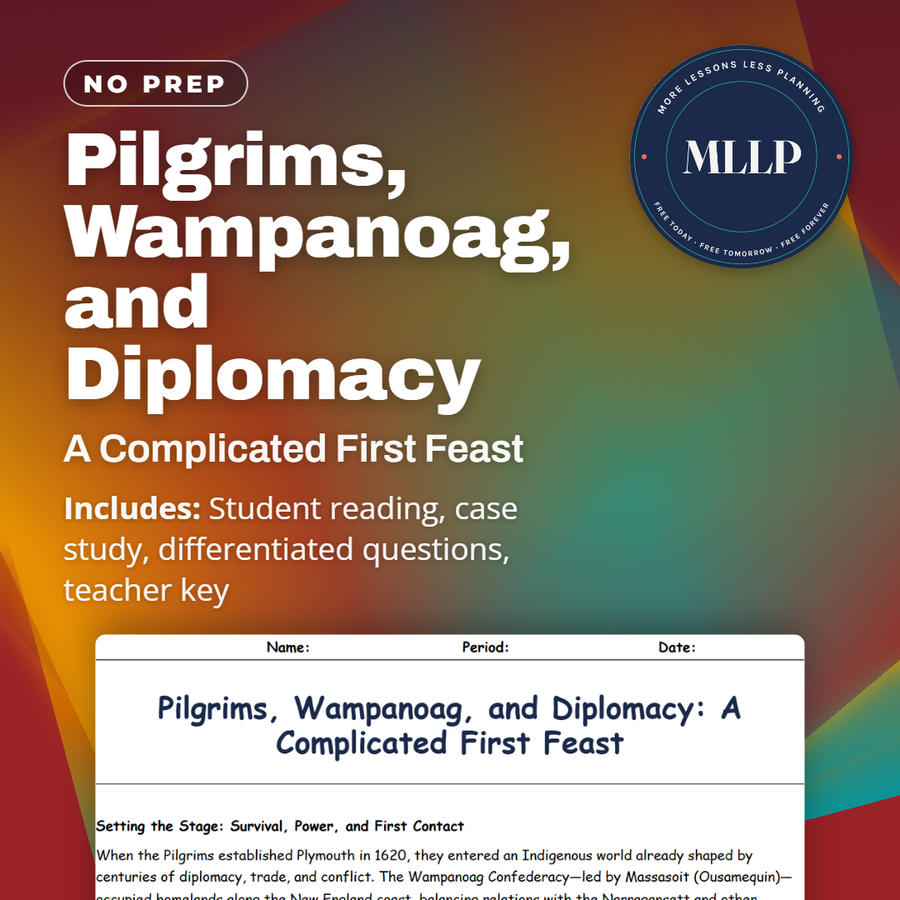
Pilgrims, Wampanoag, and Diplomacy: A Complicated First Feast
Quality reviewed September 2026
Facts verified September 9, 2026
- Subject
- Social Studies
- Grades
- Grades 9-12
- Length
- 9-page student worksheet
- Time
- About one 50-minute class period
- Great for
- Sub plans and independent work
- Includes
- Reading passage, comprehension questions + full answer key
- Format
- Print-and-go PDF
What students do
- Analyze why each side (English, Wampanoag, interpreters, rivals) entered the 1621 agreement
- Trace how different legal concepts (deed versus stewardship) set up future conflicts
- Evaluate the role of cultural brokers like Tisquantum in early negotiations
- Distinguish between ceremonial reciprocity and binding legal obligation across cultures
What it covers
- Wampanoag confederacy, Massasoit, and regional power balancing
- Strategic motives in early alliance-building
- Misalignments between English property law and Wampanoag land use
Start reading this worksheet
Setting the Stage: Survival, Power, and First Contact
When the Pilgrims established Plymouth in 1620, they entered an Indigenous world already shaped by centuries of diplomacy, trade, and conflict. The Wampanoag Confederacy, led by Massasoit (Ousamequin), occupied homelands along the New England coast, balancing relations with the Narragansett and other neighbors. A catastrophic epidemic (1616–1619) had devastated many coastal communities, shifting the balance of power and increasing vulnerability to rival expansion. The English were not unknown figures; previous voyages had brought disease, metal tools, textiles, and episodes of violence including kidnappings. The newcomers faced starvation, exposure, and unfamiliar ecologies. Their survival during the first winter depended on learning local agricultural and foraging practices: planting corn (maize) with fish fertilizer, timing crops to seasonal cycles, and identifying edible plants. Cultural brokers such as Tisquantum (Squanto) and Samoset helped initiate dialogue and translate terms. Tisquantum was a Patuxet man who had been enslaved, traveled the Atlantic, and returned to find his village decimated. By spring 1621, both sides recognized a strategic opening: the settlers needed food and security; the Wampanoag sought a counterweight to the Narragansett and access to trade. What later became a holiday origin story began as an experiment in mutual need, risk management, and pragmatic diplomacy.
The 1621 Alliance: Terms, Motives, and Realpolitik
In March 1621, Plymouth and Wampanoag representatives negotiated a treaty centered on mutual defense, procedures for dispute resolution, and the return of runaways. For Massasoit, limited alignment with a small but well-connected English outpost offered leverage against the Narragansett. For the Pilgrims, the alliance promised time: time to plant and harvest, to construct fortifications, and to learn the land’s rhythms. The famous harvest gathering of 1621 (later remembered as “the First Thanksgiving”) functioned as a diplomatic feast, where shared hunting and food preparation communicated reciprocity and signaled strength through disciplined ceremony and visible arms. Beneath the cordial surface, however, lay different assumptions about land, law, and jurisdiction. English documents treated land as private property (surveyed, deeded, and sold), while Wampanoag relationships to place emphasized stewardship, seasonal use, and collective rights. These mismatched frameworks, compounded by demographic growth and missionary pressure, would later strain the alliance. The treaty was never a permanent peace; it was a contingent arrangement shaped by realpolitik in a contested borderland.
Diplomacy at the Table: Ceremony, Reciprocity, and Misunderstandings
Public diplomacy often unfolds through ritual: greetings, gift exchange, shared labor, and feasting. The 1621 gathering did cultural work on both sides. Wampanoag hunters brought game; English settlers offered garden produce and grains. These gestures modeled respect and reciprocity, yet each side also read the event through distinct cultural logics. For the English, written covenants, oaths, and signatures anchored legitimacy; for the Wampanoag, kinship, reputation, and demonstrated generosity grounded obligations. Such differences mattered. An English “purchase” might be understood by Wampanoag parties as permission to use or share land within customary practice, not the permanent, exclusive transfer imagined in English law. Gaps in legal translation, combined with population growth, livestock trespass, and competing alliances, eroded early trust. Remembering the feast only as a scene of harmony flattens the story; it was also a negotiation about power, place, and future claims.
Like what you read? The full reading, the case study, and every question set are in the free download below, along with the answer key.
Why this matters
Two men can shake hands over the same feast and walk away having agreed to completely different things. That is what happened in spring 1621, when English and Wampanoag leaders spoke the language of alliance while meaning opposite legal ideas by it.
Most students arrive already knowing the harvest-sharing version of this story and assume that settles it. Reconstructing Massasoit's actual calculation, an alliance against the Narragansett rather than friendship for its own sake, forces them to hold two valid worldviews at once. They leave understanding later conflict as a collision between incompatible systems instead of a broken promise, a harder and more honest lesson.
From one teacher to another
The textbook version makes this a story of friendly help and harvest sharing. This worksheet shows the realpolitik underneath. The case study reconstructs a negotiation in spring 1621: Massasoit weighs the English as a hedge against the Narragansett; the Pilgrims need food and security; interpreters broker trust; and gifts and a feast signal mutual respect. But the words don't mean the same thing on both sides. When English leaders speak of a "sale," they mean permanent private property marked by a document and seal. When Wampanoag leaders speak, they mean permission to use land according to seasonal practice and kinship obligation. Students see how no parchment can bridge two legal worlds that have never met. The answer key connects early diplomacy to later conflict, not as betrayal but as the collision of incompatible systems, a much tougher lesson than "peace lasted as long as people were nice."
What you get
Download
Where should I send the next one?
Everything here is free and it stays that way. Leave your email and I'll send you the new lessons as they go up. You can unsubscribe from any one of them.
Related resources
Black Friday Forensics: Shoplifting, Organized Theft, and Crowd Violence
Black Friday Smart Shopper: Economics and Personal Finance in Action
Black Friday: Are the “Deals” Actually Good for Shoppers?
Black Friday’s Economic Impact: Who Gains, Who Pays, and What It Means for the Economy
Budget a Feast: Unit Prices, Deals, and Receipts
Colonial Foodways: Indigenous Knowledge and European Adaptation
Every lesson on this site is free to download and use. If one of them saved you a prep period, you can chip in a few bucks toward my three kids' daycare fund. That's genuinely where tips go.