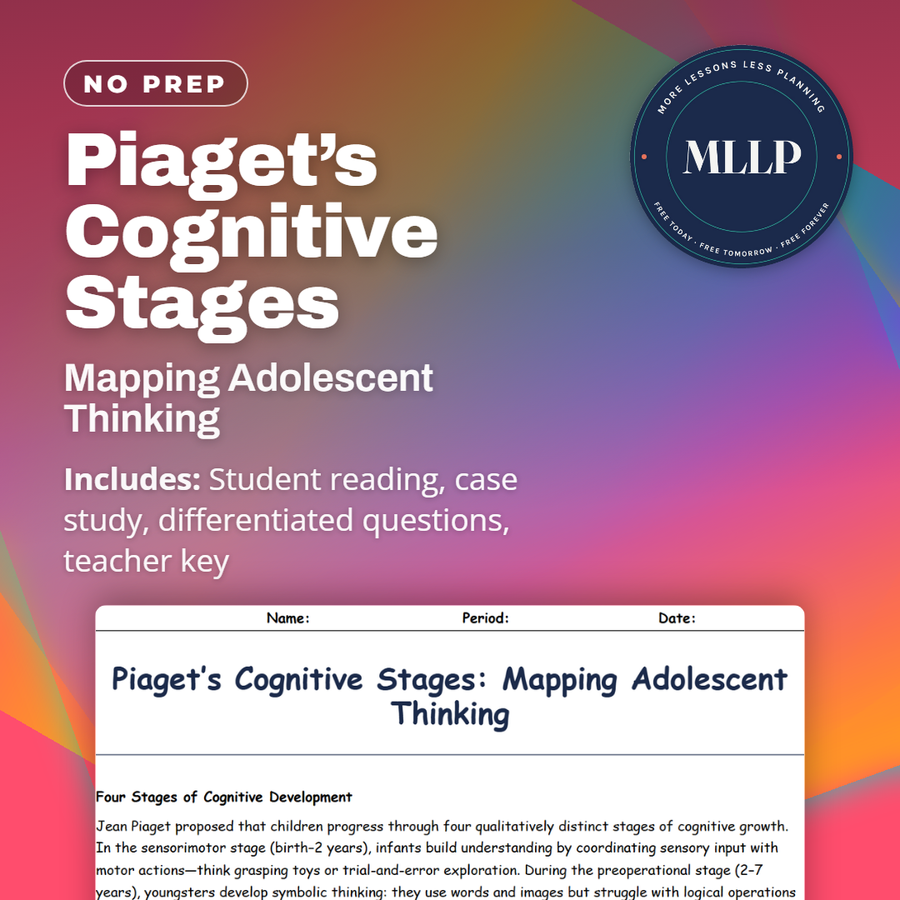
Piaget’s Cognitive Stages: Mapping Adolescent Thinking
Quality reviewed September 2026
Facts verified September 10, 2026
- Subject
- Social Studies
- Grades
- Grades 9-12
- Length
- 7-page student worksheet
- Time
- About one 50-minute class period
- Great for
- Sub plans and independent work
- Includes
- Reading passage, comprehension questions + full answer key
- Format
- Print-and-go PDF
What students do
- Match terms like schema, assimilation, accommodation, concrete stage, and formal stage to their definitions
- Fill in the blank sentences about sensorimotor coordination, disequilibrium, and abstract reasoning
- Answer short answer questions on why peer discussion helped students accommodate new schemas and one limitation of Piaget's stage theory
- Read a case study about a class building fraction understanding and answer questions about how the paper pizza activity revealed students' existing schemas
What it covers
- Piaget's four stages of cognitive development from sensorimotor through formal operational
- Schemas, assimilation, and accommodation, and how disequilibrium drives cognitive growth
- Adolescent abstract reasoning, plus criticisms of the stage model and cross-cultural findings
Start reading this worksheet
Four Stages of Cognitive Development
Jean Piaget proposed that children progress through four qualitatively distinct stages of cognitive growth. In the sensorimotor stage (birth–2 years), infants build understanding by coordinating sensory input with motor actions. Think grasping toys or trial-and-error exploration. During the preoperational stage (2–7 years), youngsters develop symbolic thinking: they use words and images but struggle with logical operations and often display egocentrism, perceiving the world only from their own viewpoint. In the concrete operational stage (7–11 years), children become capable of logical reasoning about tangible, here-and-now events: they grasp concepts like conservation of mass and reversibility. Finally, the formal operational stage (11+ years) brings abstract and hypothetical reasoning: adolescents can think scientifically, engage in systematic problem-solving, and contemplate future possibilities. Understanding these stages helps educators tailor instruction to students’ developing capacities.
Schemas, Assimilation, and Accommodation
Central to Piaget’s theory are schemas: mental frameworks that organize knowledge. When encountering new information, children initially use assimilation, integrating experiences into existing schemas: a child who knows “dog” might call a cat “dog.” When discrepancies arise, they employ accommodation, modifying schemas to fit new information, learning that cats differ from dogs. This dynamic interplay drives cognitive growth: equilibrium occurs when schemas explain experiences, disequilibrium when challenges prompt accommodation, leading to a more sophisticated understanding. For example, a middle schooler studying fractions may assimilate new fraction problems into their whole-number schemas but must accommodate by grasping that fractions represent parts of a whole, not additional wholes.
Key Milestones in Adolescent Abstract Reasoning
In the formal operational stage, adolescents develop hypothetico-deductive reasoning: they can generate hypotheses, deduce logical consequences, and systematically test them. This enables teenagers to tackle algebraic equations, understand scientific methods, and engage in moral reasoning. They grasp proportional relationships, think about metacognition, and ponder philosophical questions (“What would happen if gravity disappeared?”). Educators can leverage this capacity by presenting open-ended problems, promoting debates, and encouraging reflective journaling. However, some adolescents may exhibit idealistic egocentrism, believing that their thoughts and feelings are unique (“no one understands me”), which can lead to self-consciousness. Awareness of these cognitive and emotional shifts helps teachers foster both intellectual growth and emotional support during middle and high school years.
Like what you read? The full reading, the case study, and every question set are in the free download below, along with the answer key.
Why this matters
A class builds fraction understanding through a paper pizza activity, and that hands-on moment is where students' existing schemas get exposed and disrupted. Assimilation and accommodation move off the definitions page once fractions stop fitting what a student already believed about numbers, and working through that disequilibrium is the real learning.
I teach this right after Erikson so students weigh two ways of mapping how kids change, cognitive and psychosocial. What sticks most is watching peer discussion move accommodation out of theory, since students watch each other actually revise an idea instead of just reading that revision happens.
From one teacher to another
I use this with my psych students right after we cover Erikson, since it pairs well for comparing childhood development theories. The fractions case study is my favorite part because it shows assimilation and accommodation happening in a math class instead of staying abstract. Students match schema, assimilation, and accommodation to their definitions, then work through short answer questions about why peer discussion helps kids revise their thinking.
What you get
Download
Where should I send the next one?
Everything here is free and it stays that way. Leave your email and I'll send you the new lessons as they go up. You can unsubscribe from any one of them.
Related resources
Bandura’s Social Learning: Modeling Behavior and Self-Efficacy
Behaviorism Basics: How B.F. Skinner Shaped Learning Theory
Carl Jung’s Archetypes: Exploring the Collective Unconscious
Erikson’s Stages: Identity and Development Across the Lifespan
Maslow’s Motivation Theory
Milgram’s Obedience Study: Power, Authority, and Ethics
Every lesson on this site is free to download and use. If one of them saved you a prep period, you can chip in a few bucks toward my three kids' daycare fund. That's genuinely where tips go.