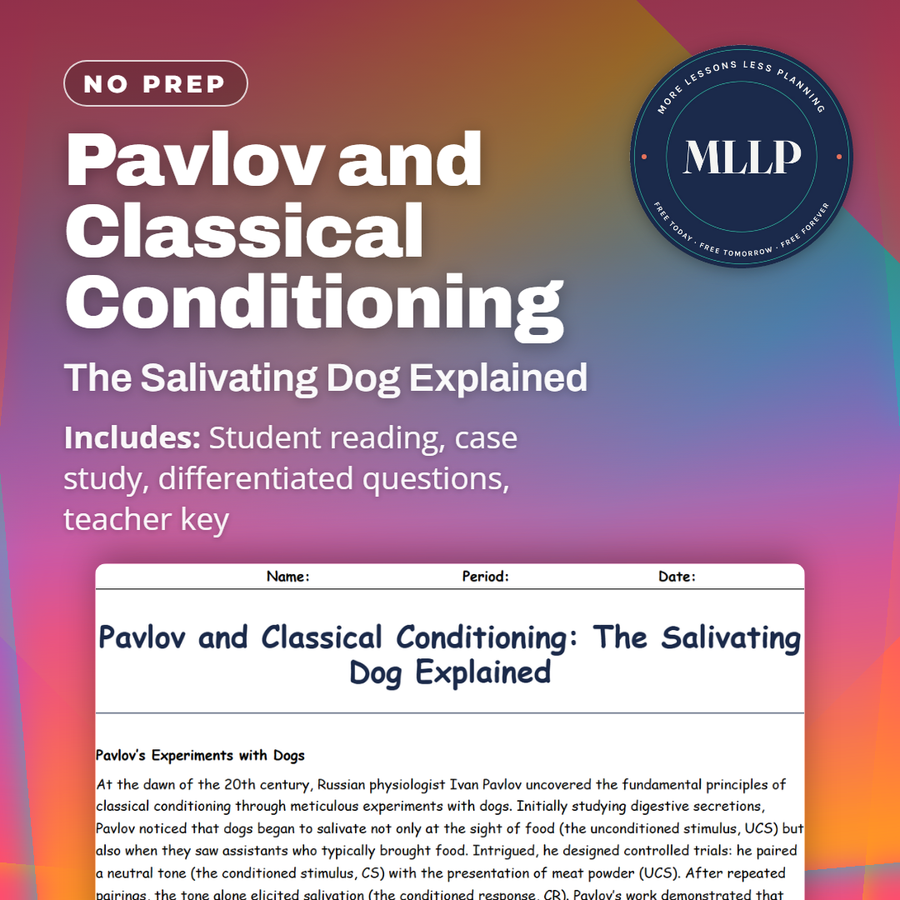
Pavlov and Classical Conditioning: The Salivating Dog Explained
Quality reviewed September 2026
Facts verified September 10, 2026
- Subject
- Social Studies
- Grades
- Grades 9-12
- Length
- 6-page student worksheet
- Time
- About one 50-minute class period
- Great for
- Sub plans and independent work
- Includes
- Reading passage, comprehension questions + full answer key
- Format
- Print-and-go PDF
What students do
- Match terms like acquisition, extinction, spontaneous recovery, generalization, and discrimination to their definitions
- Fill in the blank sentences about the association between stimuli, taste aversion, and relaxation pairing in systematic desensitization
- Answer short answer questions on why spontaneous recovery shows extinction does not erase learning and how taste aversion differs from typical conditioning
- Read a case study about a student overcoming test anxiety through gradual exposure and answer questions about the unconditioned stimulus and extinction
What it covers
- Pavlov's dog experiments and how the conditioned stimulus, unconditioned stimulus, and conditioned response work together
- The processes of acquisition, extinction, spontaneous recovery, generalization, and discrimination
- Real world examples of classical conditioning in phobias, taste aversion, and advertising, plus its use in exposure therapy
Start reading this worksheet
Pavlov’s Experiments with Dogs
At the dawn of the 20th century, Russian physiologist Ivan Pavlov uncovered the fundamental principles of classical conditioning through meticulous experiments with dogs. Initially studying digestive secretions, Pavlov noticed that dogs began to salivate not only at the sight of food (the unconditioned stimulus, UCS) but also when they saw assistants who typically brought food. Intrigued, he designed controlled trials: he paired a neutral tone (the conditioned stimulus, CS) with the presentation of meat powder (UCS). After repeated pairings, the tone alone elicited salivation (the conditioned response, CR). Pavlov’s work demonstrated that organisms learn to anticipate biologically significant events through associations, revealing that reflexive responses can be triggered by previously neutral cues, in essence, that learning involves forming links between stimuli in the environment.
Key Processes: Acquisition, Extinction, and Beyond
Classical conditioning unfolds through distinct phases. Acquisition refers to the period during which the CS and UCS are repeatedly paired, gradually increasing the strength of the CR. If the CS is repeatedly presented without the UCS (tone without food), extinction occurs: the CR diminishes. Yet, after a pause, the CS alone can once again elicit the CR in a phenomenon called spontaneous recovery, indicating that extinction suppresses rather than erases the learned association. Further, conditioned responses can generalize (a dog trained to salivate at one tone may respond similarly to tones of different pitches) and discriminate, learning to respond only to the original CS when similar stimuli predict no reward. These processes underscore the flexibility and resilience of associative learning.
Real‐World Examples
Classical conditioning extends far beyond Pavlov’s laboratory. In phobias, a neutral stimulus (e.g., a dog) paired with a frightening event (dog bite) becomes a CS that triggers fear (CR) long after the event. Taste aversion demonstrates how one pairing of food (UCS) with illness (UCR) can create long-lasting avoidance of that taste (CR), even if nausea occurs hours later, an evolutionary adaptation protecting organisms from poisoning. In marketing, brands pair logos (CS) with pleasing images or music (UCS) to elicit positive emotions (CR) when consumers later see the logo. These examples highlight how classical conditioning shapes emotional responses, preferences, and even irrational fears in everyday life.
Like what you read? The full reading, the case study, and every question set are in the free download below, along with the answer key.
Why this matters
The dread of walking into an exam room is a scenario most students already know firsthand, which is exactly the case study this reading uses: a student overcoming test anxiety through gradual exposure. Naming the unconditioned stimulus inside a story that close to their own life makes acquisition and extinction stick as more than vocabulary to memorize.
Most students assume extinction means the learning is gone, so the idea that an extinguished response can reappear later, spontaneous recovery, tends to surprise them. This reading comes before the operant conditioning one, so the involuntary side of learning is settled before comparing it to behavior shaped on purpose by consequences.
From one teacher to another
I run this reading right when we introduce classical conditioning, before students touch the Skinner material. The case study on a student's test anxiety is the one that gets them, since a lot of them relate to that exact kind of dread walking into an exam room. They match acquisition, extinction, spontaneous recovery, generalization, and discrimination to definitions, then apply the vocabulary in the fill in the blanks. It sets up the comparison to operant conditioning nicely.
What you get
Download
Where should I send the next one?
Everything here is free and it stays that way. Leave your email and I'll send you the new lessons as they go up. You can unsubscribe from any one of them.
Related resources
Bandura’s Social Learning: Modeling Behavior and Self-Efficacy
Behaviorism Basics: How B.F. Skinner Shaped Learning Theory
Carl Jung’s Archetypes: Exploring the Collective Unconscious

Erikson’s Stages: Identity and Development Across the Lifespan
Maslow’s Motivation Theory
Milgram’s Obedience Study: Power, Authority, and Ethics
Every lesson on this site is free to download and use. If one of them saved you a prep period, you can chip in a few bucks toward my three kids' daycare fund. That's genuinely where tips go.