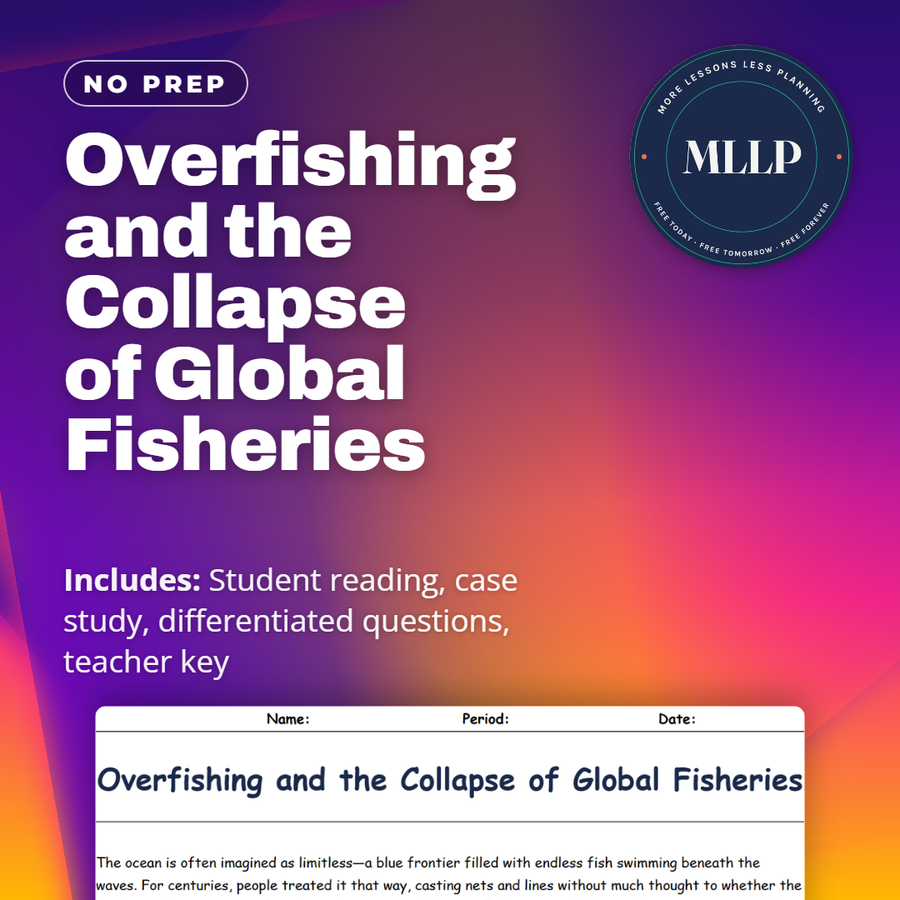
Overfishing and the Collapse of Global Fisheries
Quality reviewed September 2026
Facts verified September 14, 2026
- Subject
- Science
- Grades
- Grades 9-12
- Length
- 7-page student worksheet
- Time
- About one 50-minute class period
- Great for
- Sub plans and independent work
- Includes
- Reading passage, comprehension questions + full answer key
- Format
- Print-and-go PDF
What students do
- Match terms like overfishing, habitat destruction, disrupted food webs, boom-and-bust cycles, and sustainable regulation to their correct definitions
- Fill in the blank sentences on the Newfoundland cod collapse, the Marine Stewardship Council, and illegal, unreported, and unregulated fishing
- Answer multiple choice questions on what drives overfishing, what happens when predators disappear, and the purpose of marine protected areas
- Write short answers on how overfishing affects biodiversity and food security, why international cooperation matters, and how students can support sustainable seafood
What it covers
- The technology, demand, and weak regulation that drive overfishing worldwide
- How removing top predators disrupts marine food webs and damages seafloor habitats
- A case study on the 1992 collapse of the Newfoundland cod fishery
Start reading this worksheet
The ocean is often imagined as limitless: a blue frontier filled with endless fish swimming beneath the waves. For centuries, people treated it that way, casting nets and lines without much thought to whether the supply could ever run out. But the reality is very different. Today, many of the world’s most important fish populations are in serious trouble. Overfishing, the practice of taking fish from the ocean faster than they can reproduce, has pushed species to the edge of collapse and reshaped entire marine ecosystems. This story isn’t just about fish; it’s about people, culture, and the future of our planet.
Causes of Overfishing
At the heart of the problem is a mix of human ambition, technology, and weak rules. Fishing used to mean small boats and simple nets. Now, fleets are equipped with sonar that can track schools of fish, massive trawl nets that sweep across the ocean floor, and longlines stretching for miles with thousands of hooks. These advances bring in enormous hauls, but they don’t give fish populations time to recover. Add to this the global appetite for seafood (shrimp cocktails, sushi bars, fish sticks in school cafeterias) and you have a demand that never seems to slow down. Governments also play a role. Some countries subsidize fishing fleets, encouraging them to keep fishing even when catches drop. Others lack the enforcement power to stop illegal, unreported, or unregulated (IUU) fishing on the open seas. With vast stretches of ocean that no single nation fully controls, it becomes a race: whoever catches the most, wins, at least until the resource is gone.
Ecological Impacts of Overfishing
The ocean is not just a pantry; it’s a living system where everything is connected. When large numbers of fish are pulled out, the balance of the food web is disturbed. Predators such as sharks, tuna, and swordfish are especially vulnerable because they grow slowly and reproduce less often. When these top predators disappear, smaller species can explode in number, creating ripple effects through the ecosystem. The story of the Atlantic cod is a sobering reminder. Once so abundant off North America’s east coast that early explorers claimed you could scoop them out of the sea with baskets, cod were fished relentlessly until their populations crashed in the 1990s. Even after strict bans, recovery has been painfully slow. Beyond fish, overfishing damages habitats. Trawling nets that scrape across the seafloor flatten coral reefs and disturb bottom-dwelling species. These aren’t places that bounce back quickly, sometimes not at all.
Like what you read? The full reading, the case study, and every question set are in the free download below, along with the answer key.
Why this matters
The Newfoundland cod fishery once seemed too large to ever run out, then it collapsed within a few decades once technology let boats find and catch fish faster than they could reproduce. That 1992 collapse turned a fishery once considered inexhaustible into a case study in what unchecked demand can do to a population.
Removing the fish themselves is only half the story here, so this reading traces how losing top predators disrupted the wider food web and damaged seafloor habitat along with it. The collapse reached far past whatever boats actually pulled up.
From one teacher to another
Fishing fleets today can find and catch fish faster than those fish can reproduce, and this reading traces what that mismatch does to entire ecosystems. Students look at how technology, subsidies, and weak enforcement combine to drive overfishing, then follow the ripple effects through the food web. The Newfoundland cod case study covers a fishery that once seemed endless and collapsed within a few decades. Vocabulary like boom-and-bust cycle and sustainable regulation connects the science to the economics.
What you get
Download
Where should I send the next one?
Everything here is free and it stays that way. Leave your email and I'll send you the new lessons as they go up. You can unsubscribe from any one of them.
Related resources
Climate Change and Coral Reefs: Fragile Ecosystems at Risk
Climate Change and Ocean Warming
Global Ocean Treaties and the Future of Marine Protection
Marine Pollution: Plastics, Oil Spills, and Chemicals
Nutrient Pollution and the Formation of Dead Zones
Ocean Conservation Strategies and Marine Protected Areas
Every lesson on this site is free to download and use. If one of them saved you a prep period, you can chip in a few bucks toward my three kids' daycare fund. That's genuinely where tips go.