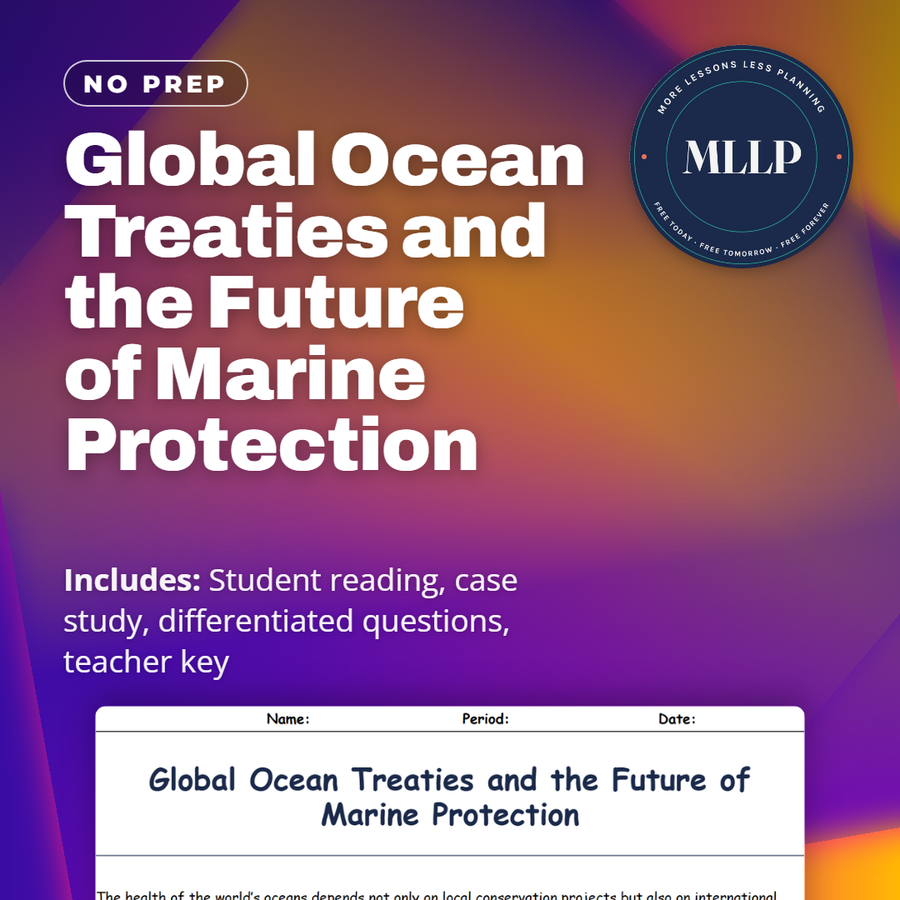
Global Ocean Treaties and the Future of Marine Protection
Quality reviewed September 2026
Facts verified September 14, 2026
- Subject
- Science
- Grades
- Grades 9-12
- Length
- 6-page student worksheet
- Time
- About one 50-minute class period
- Great for
- Sub plans and independent work
- Includes
- Reading passage, comprehension questions + full answer key
- Format
- Print-and-go PDF
What students do
- Match terms like the High Seas Treaty, the International Whaling Commission, UNCLOS, the Antarctic Treaty, and the Paris Accord to their correct definitions
- Fill in the blank sentences on the Paris Accord, environmental impact assessments, and voluntary compliance
- Answer multiple choice questions on what UNCLOS is called, the International Whaling Commission's achievement, and why global treaties are hard to enforce
- Write short answers on how grassroots campaigns influence treaties, emerging ocean challenges, and why the High Seas Treaty is a historic step
What it covers
- How international agreements like UNCLOS set rules for ocean resources and territorial waters
- Successes and enforcement challenges across treaties like the International Whaling Commission and the Antarctic Treaty
- A case study on the High Seas Treaty (BBNJ), which protects biodiversity in international waters
Start reading this worksheet
The health of the world’s oceans depends not only on local conservation projects but also on international cooperation. Oceans do not follow political boundaries; currents, migrating species, and pollution move freely across borders. To protect these shared waters, nations have developed global ocean treaties, agreements that set rules for how humans can use and safeguard the seas. These treaties reflect both the successes and challenges of uniting countries around a common cause: protecting the planet’s largest ecosystem.
Overview of International Treaties
One of the most important frameworks is the United Nations Convention on the Law of the Sea (UNCLOS), often described as the “constitution of the oceans.” It defines countries’ rights to marine resources, territorial waters, and responsibilities for conservation. Other treaties focus on more specific issues. The Convention on Biological Diversity (CBD) includes marine ecosystems in its goals, while the International Whaling Commission (IWC) regulates whaling to prevent overexploitation. In recent years, new agreements have emerged to address plastic pollution, high-seas conservation, and climate-related threats to oceans.
Successes and Challenges of Global Cooperation
Treaties have had many successes, such as reducing whaling, creating marine sanctuaries in Antarctica, and promoting international research. However, enforcement is difficult. Many treaties depend on countries voluntarily following rules, and not all governments have the resources or political will to comply. Conflicts often arise between conservation goals and economic interests like shipping, fishing, and oil exploration. In addition, global problems such as climate change require action beyond traditional conservation measures, making treaty negotiations more complex.
Like what you read? The full reading, the case study, and every question set are in the free download below, along with the answer key.
Why this matters
Who actually owns the ocean once a ship sails past a country's coastline? UNCLOS and the treaties built around it answer that, with agreements like the International Whaling Commission and the Antarctic Treaty each managing a resource that crosses every border at once.
An international treaty is either binding or worthless in most students' minds, so the High Seas Treaty case study complicates that. Watching decades of negotiation finally produce an agreement to protect biodiversity in waters nobody owns shows why enforcement without one government in charge is so hard.
From one teacher to another
Oceans cross borders even when nations do not, and this reading covers the treaties written to manage that overlap. Students see how UNCLOS, the International Whaling Commission, and the Antarctic Treaty each tackle a different piece of ocean governance. The case study follows the High Seas Treaty from decades of negotiation to entry into force, including the challenges of enforcing rules nobody fully owns. The vocabulary ties directly to real named agreements rather than abstract concepts.
What you get
Download
Where should I send the next one?
Everything here is free and it stays that way. Leave your email and I'll send you the new lessons as they go up. You can unsubscribe from any one of them.
Related resources
Climate Change and Coral Reefs: Fragile Ecosystems at Risk
Climate Change and Ocean Warming
Marine Pollution: Plastics, Oil Spills, and Chemicals
Nutrient Pollution and the Formation of Dead Zones
Ocean Conservation Strategies and Marine Protected Areas
Overfishing and the Collapse of Global Fisheries
Every lesson on this site is free to download and use. If one of them saved you a prep period, you can chip in a few bucks toward my three kids' daycare fund. That's genuinely where tips go.