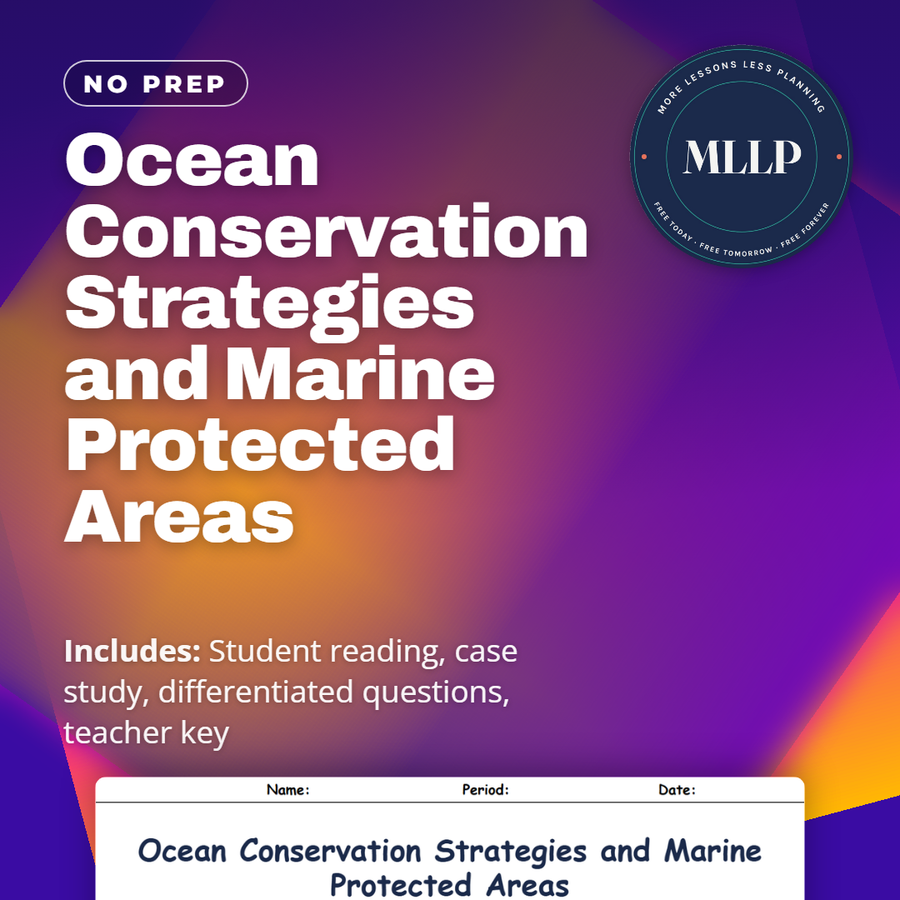
Ocean Conservation Strategies and Marine Protected Areas
Quality reviewed September 2026
Facts verified September 14, 2026
- Subject
- Science
- Grades
- Grades 9-12
- Length
- 6-page student worksheet
- Time
- About one 50-minute class period
- Great for
- Sub plans and independent work
- Includes
- Reading passage, comprehension questions + full answer key
- Format
- Print-and-go PDF
What students do
- Match terms like no-take zones, community-managed reserves, seasonal closures, international treaty zones, and local education programs to their correct definitions
- Fill in the blank sentences on marine protected areas, the Paris Accord, and enforcement
- Answer multiple choice questions on the purpose of MPAs, the legal framework behind ocean resources, and challenges facing MPAs
- Write short answers on how community-managed reserves differ from international agreements, why enforcement matters, and how local education supports conservation
What it covers
- The different types of marine protected areas, from no-take zones to community-managed reserves
- How international agreements like UNCLOS and the Paris Accord support ocean conservation alongside local efforts
- A case study on Australia's Great Barrier Reef Marine Park, established in 1975
Start reading this worksheet
The ocean covers more than 70% of our planet and supports life in countless ways, yet human activity has left it increasingly vulnerable. Overfishing, habitat destruction, and pollution are just a few of the threats. In response, countries and organizations have turned to ocean conservation strategies, with marine protected areas (MPAs) at the center of these efforts. MPAs function like underwater national parks, safeguarding ecosystems and giving species a chance to recover. But how effective are these strategies, and what more can be done to ensure the ocean’s health for future generations?
The Role of Marine Protected Areas
Marine protected areas come in many forms, from fully protected no-take zones where fishing is prohibited to multiple-use zones where sustainable activities are allowed. Their primary purpose is to conserve biodiversity and restore fish populations. Studies show that fish populations inside MPAs are often healthier and larger than those outside. This not only helps restore ecosystems but also supports surrounding fisheries, as fish eventually migrate outside protected zones. Despite their benefits, only about 8% of the world’s oceans are currently designated as MPAs, and enforcement remains a challenge.
International Agreements and Cooperation
Protecting the ocean requires collaboration across borders. The United Nations Convention on the Law of the Sea (UNCLOS) provides the legal framework for managing ocean resources, while agreements like the Paris Accord link ocean health to climate policy. Additionally, regional treaties encourage cooperation between neighboring countries that share fisheries or marine ecosystems. These agreements set ambitious targets, but they rely on countries’ willingness to enforce rules and balance economic interests with environmental responsibility.
Like what you read? The full reading, the case study, and every question set are in the free download below, along with the answer key.
Why this matters
Ocean conservation sounds like one move, roughly, roping off an area and banning fishing there. This reading covers four different strategies instead: no-take zones, community-managed reserves, seasonal closures, and international treaty zones backed by agreements like UNCLOS and the Paris Accord, each solving the problem a different way.
The Great Barrier Reef Marine Park, set up in 1975, is worth the class time because it shows several of those strategies working in the same place at once, balancing tourism and fishing against conservation while climate change keeps pushing back against all of it.
From one teacher to another
Marine protected areas come in more forms than a single blanket ban on fishing, and this reading walks through the range, from no-take zones to community-managed reserves. It connects local strategies to the international agreements, like UNCLOS and the Paris Accord, that back them up. The Great Barrier Reef Marine Park case study shows how zoning balances conservation with tourism and fishing, and where climate change still gets in the way. Vocabulary like seasonal closures and international treaty zones gives students a working conservation toolkit.
What you get
Download
Where should I send the next one?
Everything here is free and it stays that way. Leave your email and I'll send you the new lessons as they go up. You can unsubscribe from any one of them.
Related resources
Climate Change and Coral Reefs: Fragile Ecosystems at Risk
Climate Change and Ocean Warming
Global Ocean Treaties and the Future of Marine Protection
Marine Pollution: Plastics, Oil Spills, and Chemicals
Nutrient Pollution and the Formation of Dead Zones
Overfishing and the Collapse of Global Fisheries
Every lesson on this site is free to download and use. If one of them saved you a prep period, you can chip in a few bucks toward my three kids' daycare fund. That's genuinely where tips go.