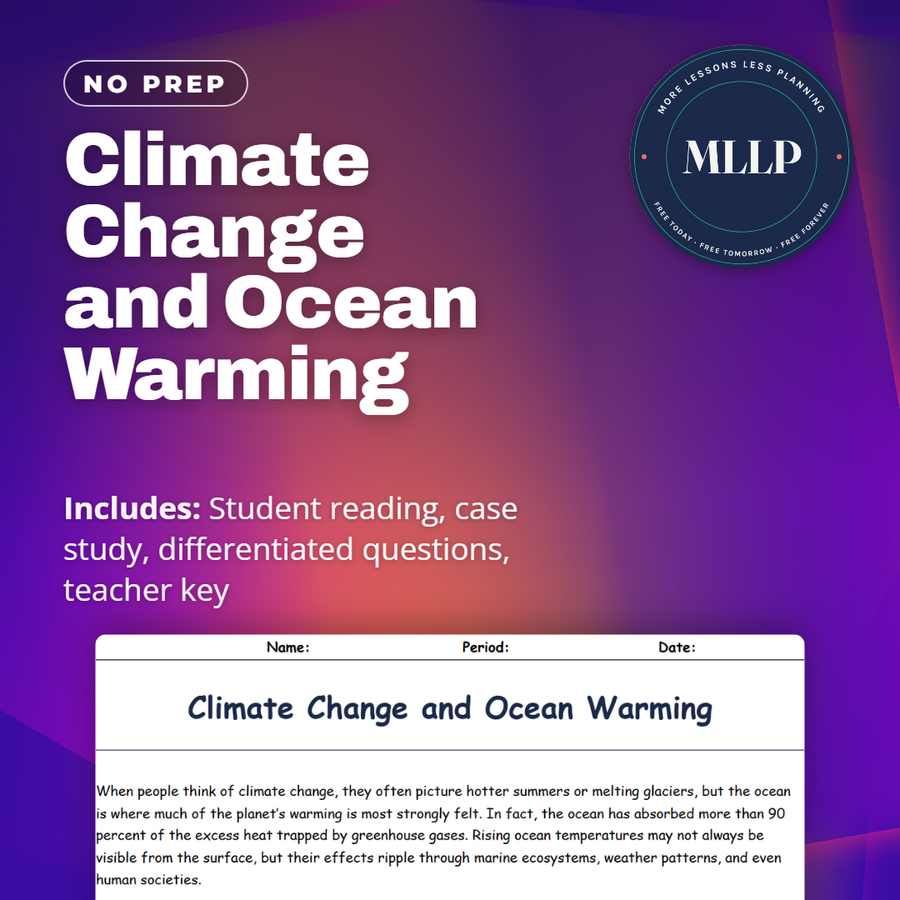
Climate Change and Ocean Warming
Quality reviewed September 2026
Facts verified September 14, 2026
- Subject
- Science
- Grades
- Grades 9-12
- Length
- 6-page student worksheet
- Time
- About one 50-minute class period
- Great for
- Sub plans and independent work
- Includes
- Reading passage, comprehension questions + full answer key
- Format
- Print-and-go PDF
What students do
- Match terms like the Paris Climate Accord, coral bleaching, stronger hurricanes, the Great Barrier Reef, and thermal expansion to their correct definitions
- Fill in the blank sentences on how much heat the ocean has absorbed, coral bleaching, and thermal expansion
- Answer multiple choice questions on why oceans are warming, thermal expansion, and sea turtle sex ratios
- Write short answers on why fish migrate poleward, how warm water fuels stronger hurricanes, and one way to help slow ocean warming
What it covers
- How rising greenhouse gases drive ocean warming and why the ocean has absorbed most of that heat
- The effects of warming on marine species, including fish migration, coral bleaching, and sea turtle hatchling sex ratios
- A case study on the Great Barrier Reef's back-to-back bleaching events in 2016 and 2017
Start reading this worksheet
When people think of climate change, they often picture hotter summers or melting glaciers, but the ocean is where much of the planet’s warming is most strongly felt. In fact, the ocean has absorbed more than 90 percent of the excess heat trapped by greenhouse gases. Rising ocean temperatures may not always be visible from the surface, but their effects ripple through marine ecosystems, weather patterns, and even human societies.
Rising Ocean Temperatures
The primary cause of ocean warming is the buildup of greenhouse gases like carbon dioxide from burning fossil fuels. This extra heat is absorbed by seawater, gradually raising the temperature of surface and deep layers alike. Even small increases in temperature can make a big difference: coral reefs bleach when waters are only 1–2°C warmer than usual, and fish species may shift to cooler regions, disrupting local ecosystems. Warm oceans also fuel stronger storms, since hurricanes draw energy from heat stored in surface waters. These changes make it clear that climate change is not just an atmospheric issue but a marine one.
Impacts on Marine Species
Marine species respond to warming in different ways. Some, like plankton, may reproduce faster in warmer conditions, but many others suffer. Fish often migrate toward the poles in search of cooler waters, throwing off traditional fishing grounds and threatening food security for coastal communities. Sea turtles, which rely on sand temperature to determine the sex of hatchlings, are producing more females than males as beaches warm. Coral reefs face mass bleaching events when their symbiotic algae are expelled under stress. These changes demonstrate how warming waters create complex challenges across the entire food web.
Like what you read? The full reading, the case study, and every question set are in the free download below, along with the answer key.
Why this matters
Most of the heat greenhouse gases trap does not stay in the air, it ends up in the ocean, and that single fact drives almost everything else here. Thermal expansion raises sea level, warmer water pushes fish populations poleward, and rising temperatures even shift sea turtle hatchling sex ratios.
Sea turtle sex ratios get students' attention fastest, since most have never considered that temperature decides an animal's sex before it hatches. From there, the Great Barrier Reef's back-to-back bleaching in 2016 and 2017 reads less like an isolated disaster and more like one symptom of the same warming ocean.
From one teacher to another
Most of the extra heat trapped by greenhouse gases ends up in the ocean, and this reading explains what that means for marine life. Students trace the chain from warming water to coral bleaching, shifting fish populations, and rising seas. The Great Barrier Reef case study covers two real bleaching events back to back, in 2016 and 2017. Vocabulary like thermal expansion and coral bleaching connects directly to the questions that follow.
What you get
Download
Where should I send the next one?
Everything here is free and it stays that way. Leave your email and I'll send you the new lessons as they go up. You can unsubscribe from any one of them.
Related resources
Climate Change and Coral Reefs: Fragile Ecosystems at Risk
Global Ocean Treaties and the Future of Marine Protection
Marine Pollution: Plastics, Oil Spills, and Chemicals
Nutrient Pollution and the Formation of Dead Zones
Ocean Conservation Strategies and Marine Protected Areas
Overfishing and the Collapse of Global Fisheries
Every lesson on this site is free to download and use. If one of them saved you a prep period, you can chip in a few bucks toward my three kids' daycare fund. That's genuinely where tips go.