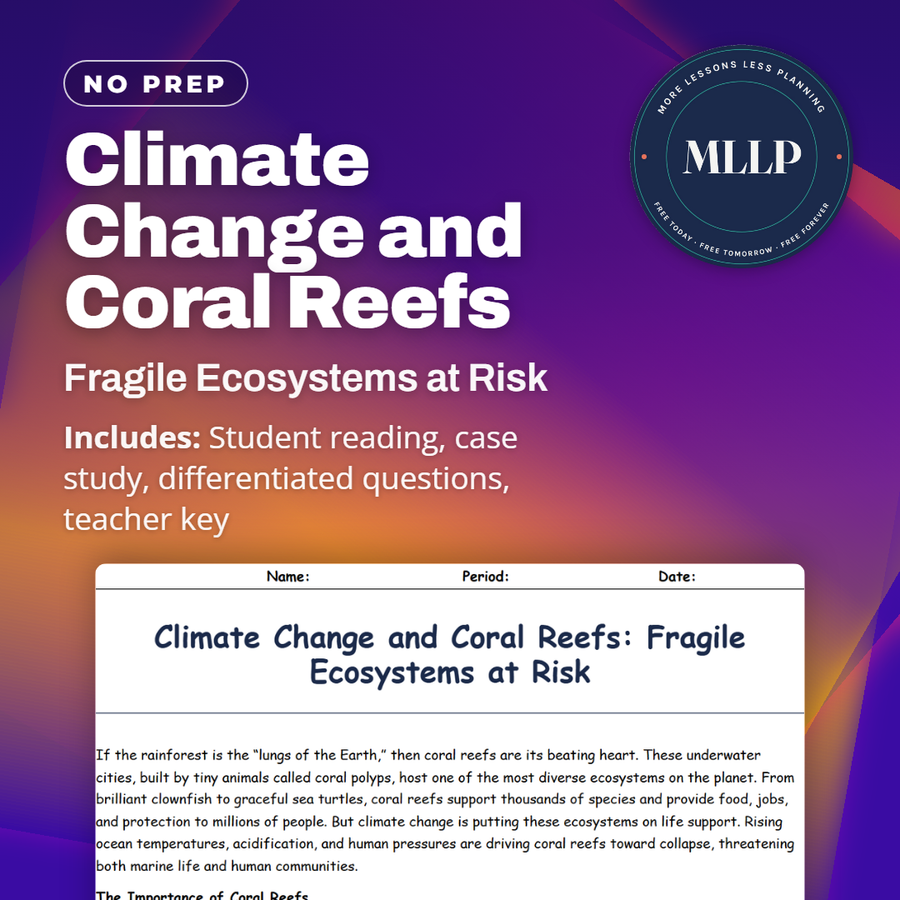
Climate Change and Coral Reefs: Fragile Ecosystems at Risk
Quality reviewed September 2026
Facts verified September 14, 2026
- Subject
- Science
- Grades
- Grades 9-12
- Length
- 7-page student worksheet
- Time
- About one 50-minute class period
- Great for
- Sub plans and independent work
- Includes
- Reading passage, comprehension questions + full answer key
- Format
- Print-and-go PDF
What students do
- Match terms like coral bleaching, ocean acidification, zooxanthellae, marine protected areas, and the Great Barrier Reef to their correct definitions
- Fill in the blank sentences on zooxanthellae, coral bleaching, and the Great Barrier Reef
- Answer multiple choice questions on the role of zooxanthellae, the effects of ocean acidification, and why reefs matter to coastal communities
- Write short answers on how climate change threatens reefs, why reefs are biodiversity hotspots, and local and global actions that could help reefs survive
What it covers
- The importance of coral reefs as biodiversity hotspots and their symbiotic relationship with zooxanthellae
- How rising temperatures and ocean acidification cause coral bleaching and weaken reef structures
- A case study on the Great Barrier Reef's repeated bleaching events in 1998, 2016, and 2020
Start reading this worksheet
If the rainforest is the “lungs of the Earth,” then coral reefs are its beating heart. These underwater cities, built by tiny animals called coral polyps, host one of the most diverse ecosystems on the planet. From brilliant clownfish to graceful sea turtles, coral reefs support thousands of species and provide food, jobs, and protection to millions of people. But climate change is putting these ecosystems on life support. Rising ocean temperatures, acidification, and human pressures are driving coral reefs toward collapse, threatening both marine life and human communities.
The Importance of Coral Reefs
Covering less than one percent of the ocean floor, coral reefs are home to nearly a quarter of all marine species. Their complex structures create shelter for fish, invertebrates, and countless other creatures. Reefs also protect coastlines by buffering waves and storms, reducing erosion and flooding. For humans, reefs mean tourism, fishing industries, and cultural value. In short, coral reefs are biodiversity hotspots that link ecology, economy, and culture in powerful ways. Yet, despite their importance, reefs are fragile. Corals are living animals that rely on a symbiotic relationship with zooxanthellae, microscopic algae that live within their tissues. These algae give corals their vibrant colors and, through photosynthesis, provide the majority of the coral’s energy. When the environment shifts, that relationship breaks down, leading to a dangerous phenomenon: coral bleaching.
How Climate Change Harms Coral Reefs
The biggest threat to reefs comes from rising sea temperatures caused by global warming. When the water gets too warm, corals expel their zooxanthellae, leaving behind white skeletons—a process known as bleaching. Without their algae partners, corals lose their main food source and may die if stressful conditions persist. Bleaching events have become increasingly common, devastating reefs across the globe, from Australia’s Great Barrier Reef to the Caribbean. Another danger is ocean acidification. As the ocean absorbs excess carbon dioxide from the atmosphere, the water’s chemistry changes, making it harder for corals to build their calcium carbonate skeletons. Acidification weakens reef structures, making them more vulnerable to storms and erosion. Combined with pollution, overfishing, and destructive practices like dynamite fishing, climate change adds to the already heavy burden reefs face.
Like what you read? The full reading, the case study, and every question set are in the free download below, along with the answer key.
Why this matters
Coral itself is not what gives a reef its color, the algae living inside its tissue is, and that partnership is also the reef's biggest weakness. Warming water and ocean acidification attack that relationship from two different directions, one triggering bleaching and the other weakening the reef structure underneath it.
By the time students reach the Great Barrier Reef timeline, with bleaching in 1998, 2016, and 2020, they stop treating coral loss as a single event and start seeing it as a pattern. That shift matters more to me than any vocabulary term on the page, because it is the difference between memorizing a fact and understanding a trend.
From one teacher to another
This worksheet walks students through why coral reefs matter, from the tiny algae that power them to the human communities that depend on them. It breaks down two major threats, warming water and acidification, and how each one damages reef structure in a different way. The Great Barrier Reef case study gives students a real timeline of bleaching events to reason through. Vocabulary like zooxanthellae and bleaching sits right next to the ecological and economic stakes.
What you get
Download
Where should I send the next one?
Everything here is free and it stays that way. Leave your email and I'll send you the new lessons as they go up. You can unsubscribe from any one of them.
Related resources
Climate Change and Ocean Warming
Global Ocean Treaties and the Future of Marine Protection
Marine Pollution: Plastics, Oil Spills, and Chemicals
Nutrient Pollution and the Formation of Dead Zones
Ocean Conservation Strategies and Marine Protected Areas
Overfishing and the Collapse of Global Fisheries
Every lesson on this site is free to download and use. If one of them saved you a prep period, you can chip in a few bucks toward my three kids' daycare fund. That's genuinely where tips go.