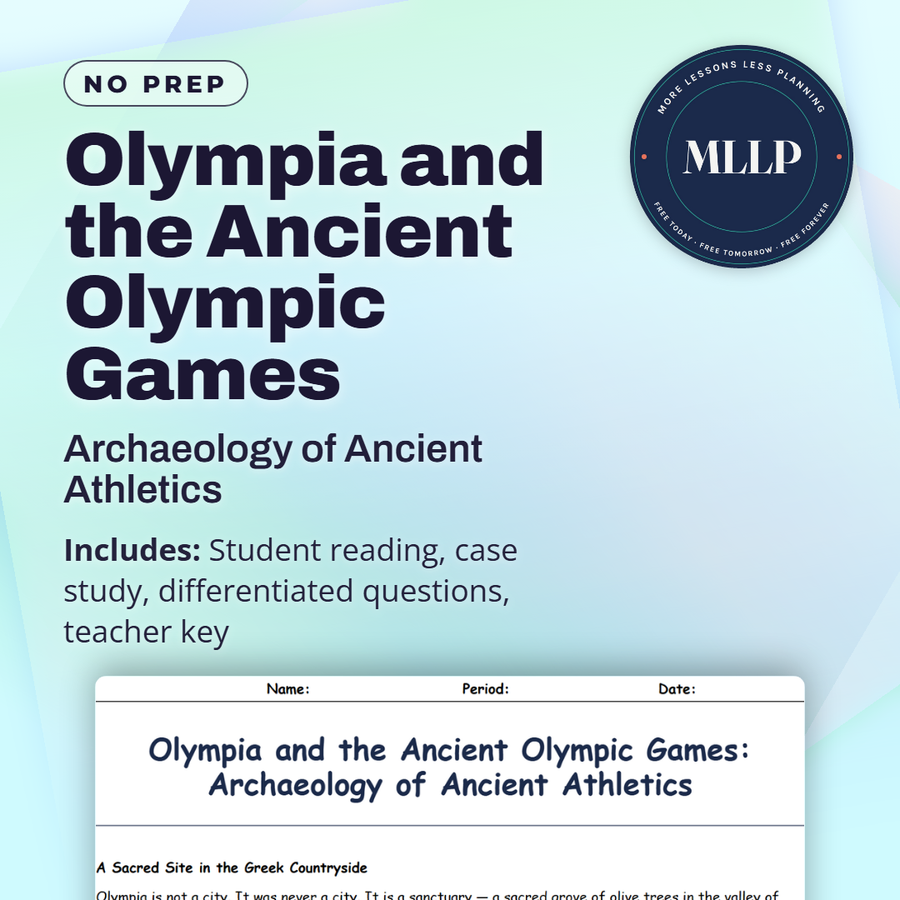
Olympia and the Ancient Olympic Games: Archaeology of Ancient Athletics
Quality reviewed September 2026
Facts verified September 21, 2026
- Subject
- Social Studies
- Grades
- Grades 9-12
- Length
- 8-page student worksheet
- Time
- About one 50-minute class period
- Great for
- Sub plans and independent work
- Includes
- Reading passage, comprehension questions + full answer key
- Format
- Print-and-go PDF
What students do
- Write in three blanks naming the olive wreath, the excavation start year, and the stadium's spectator capacity
- Match five terms, from ekecheiria to pankration, to what each one meant at the ancient Games
- A wrestler from Elis weighing a bribe offer against his family's debts frames two case study questions
- Ancient cheating scandals, recorded in bronze statues paid for by fines, get checked against a multiple-choice question on the zanes
What it covers
- The twelve-century span of the ancient Olympic Games and the sacred truce
- Bribery, cheating, and the bronze zanes statues at Olympia
- Phidias's lost gold and ivory statue of Zeus
Start reading this worksheet
A Sacred Site in the Greek Countryside
Olympia is not a city. It was never a city. It is a sanctuary: a sacred grove of olive trees in the valley of the Alpheus River in the Peloponnese, dedicated to Zeus, the king of the Greek gods. Every four years from 776 BCE until 393 CE, a continuous period of nearly twelve hundred years, athletes from across the Greek world gathered at Olympia to compete in the Games. During the sacred truce (ekecheiria), wars were paused, hostilities suspended, and athletes from rival city-states arrived under divine protection to compete, not fight. The Olympic Games were the most important Panhellenic festival in the ancient world, drawing competitors and spectators from every Greek colony and city-state from Spain to the Black Sea. The physical site of Olympia preserves one of the most extensive archaeological complexes from the ancient Greek world. German archaeologists have been excavating here since 1875 (one of the longest continuous archaeological projects in history), and the results are spectacular: the foundations of the Temple of Zeus (once home to one of the Seven Wonders of the Ancient World), the Temple of Hera (the oldest surviving Greek temple), the stadium where athletes competed, the gymnasium and palaestra where they trained, and dozens of treasury buildings where city-states deposited offerings to Zeus.
The Stadium and Athletic Competition
The ancient Olympic stadium at Olympia could hold approximately 40,000 spectators, an astonishing number for a festival site far from any major city. The track was approximately 192 meters long (one stade, which is the origin of the word 'stadium'), and athletes competed barefoot on a surface of packed earth and sand. The starting line and finishing line are still visible as stone sills in the ground, worn smooth by the feet of countless athletes over more than a thousand years of competition. Walking through the tunnel that leads from the sanctuary into the stadium is one of the most evocative experiences in archaeology. It is the same tunnel that ancient Olympians walked through before their competitions. The ancient Olympic program was different from the modern Games. Events included footraces of various distances, wrestling, boxing, the pankration (a brutal combination of boxing and wrestling with almost no rules), the pentathlon (five events: running, long jump, discus, javelin, and wrestling), chariot racing, and equestrian events. There were no team sports and no medals. Victors received olive wreaths cut from a sacred tree behind the Temple of Zeus. The real prizes were glory and status: an Olympic victory brought honor not just to the individual but to his entire city-state. City-states sponsored training, erected statues of victors, and granted them tax exemptions and free meals for life.
Cheating, Politics, and the Reality of the Games
The ancient Olympics were not the idealized festival of pure amateurism they are sometimes portrayed as. Evidence of cheating, bribery, and political manipulation appears throughout the ancient record, and in the archaeological record. At Olympia, the approach to the stadium is lined with bronze statues of Zeus paid for by fines levied on athletes who cheated. Ancient sources describe gymnasts paid to throw events, weight throwers who bribed judges, and entire city-states accused of bribing their way to victories. The zanes (Zeus statues funded by cheating fines) are a uniquely archaeological record of ancient athletic corruption: an equivalent, perhaps, of a modern doping scandal hall of shame. Political tensions also invaded the sanctuary. Wars sometimes continued despite the truce, and powerful rulers used Olympic victories as propaganda tools. Alexander the Great's father, Philip II of Macedon, won chariot races at Olympia in 356 BCE and used the victories to legitimize Macedonian claims to Greek culture. The Romans eventually adopted and modified the Games, extending participation to non-Greeks. The emperor Nero competed in 67 CE, was declared the winner of a chariot race he did not finish, and had his victory officially expunged after his death, making him perhaps history's most memorable Olympic cheater.
Like what you read? The full reading, the case study, and every question set are in the free download below, along with the answer key.
Why this matters
The ancient Olympics get remembered as pure amateur competition, but the reading's own evidence, a row of bribery-fine statues lining the path to the stadium, says otherwise. That gap between the ideal and the reality is exactly what students run into with modern sports doping scandals, and the wrestler in the case study faces the same pressure real athletes still face: a shot at glory weighed against a family that needs money now. The sacred truce is worth sitting with too, since it shows city-states willing to pause active wars for a religious festival, which says something about how deeply shared culture and belief can override even the greatest political conflicts.
From one teacher to another
Every four years for nearly twelve hundred years, athletes from across the Greek world gathered at a sacred grove to compete under a truce that paused wars in progress. Olympia was never a city, it was a sanctuary, and German archaeologists have been excavating it since 1875, uncovering the stadium, the training grounds, and the ruined Temple of Zeus. Students read about the actual events, including the brutal pankration and the pentathlon, and about the zanes, bronze statues of Zeus paid for entirely by fines levied on athletes caught cheating. A case study follows a wrestler from Elis deciding whether to take a bribe to throw his semifinal match, weighing his family's debts against the wreath he has trained four years to win. The reading also covers Emperor Nero's fake chariot win, later officially erased.
What you get
Download
Where should I send the next one?
Everything here is free and it stays that way. Leave your email and I'll send you the new lessons as they go up. You can unsubscribe from any one of them.
Related resources
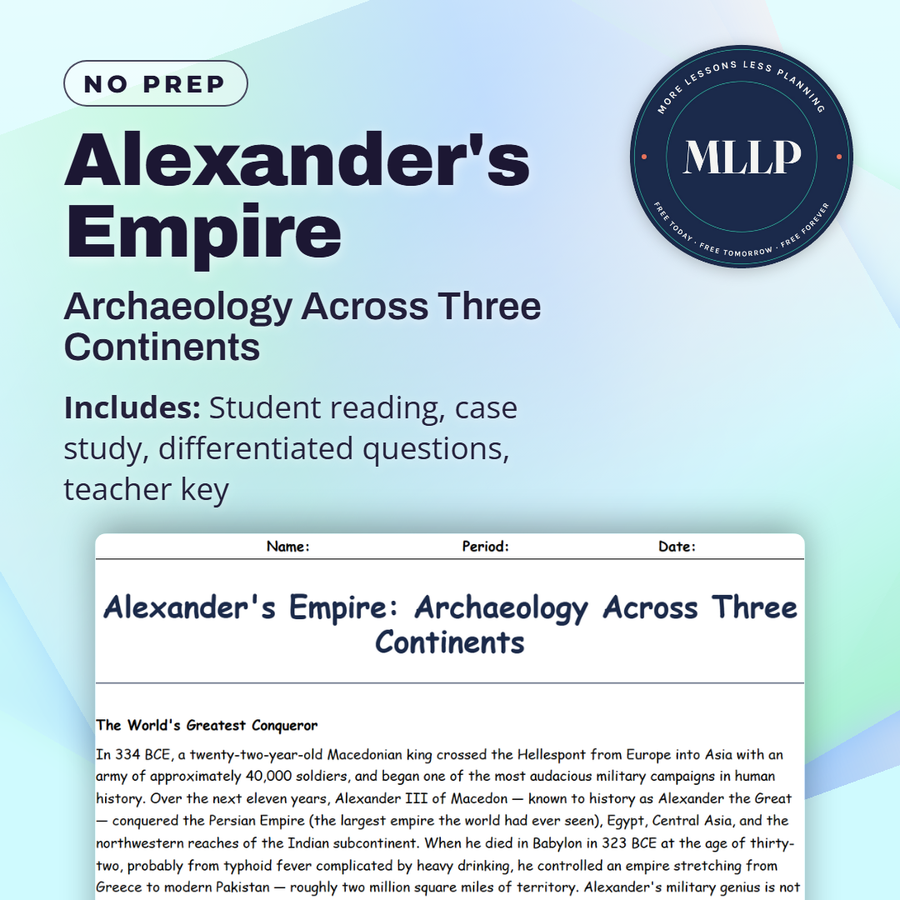
Alexander's Empire: Archaeology Across Three Continents
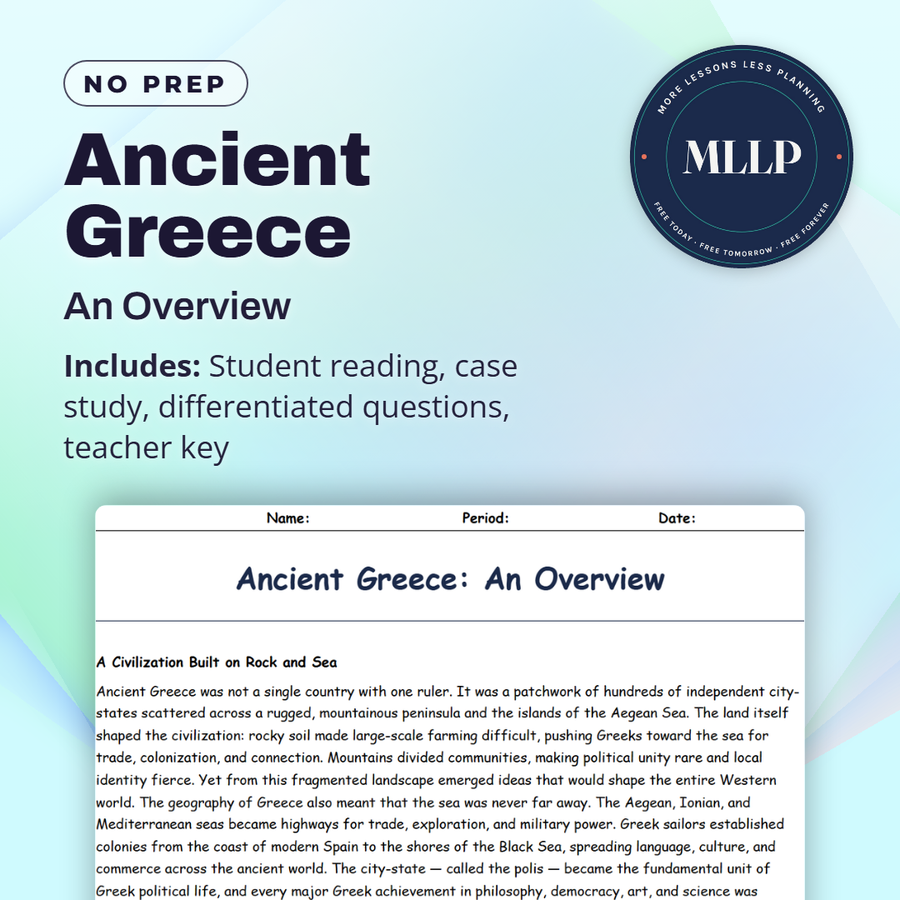
Ancient Greece: An Overview
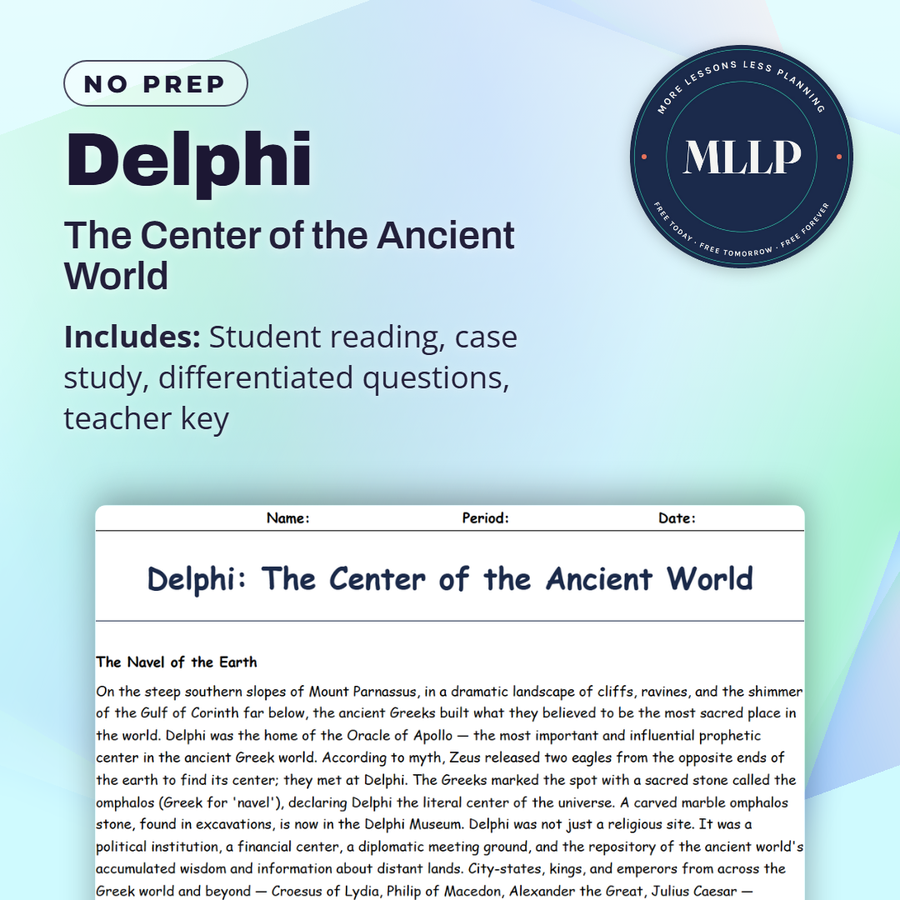
Delphi: The Center of the Ancient World
Greek Pottery: Art That Tells Stories
Knossos and the Minoans: Europe's First Civilization
Mycenae and the Trojan War: Where Myth Meets Archaeology
Every lesson on this site is free to download and use. If one of them saved you a prep period, you can chip in a few bucks toward my three kids' daycare fund. That's genuinely where tips go.