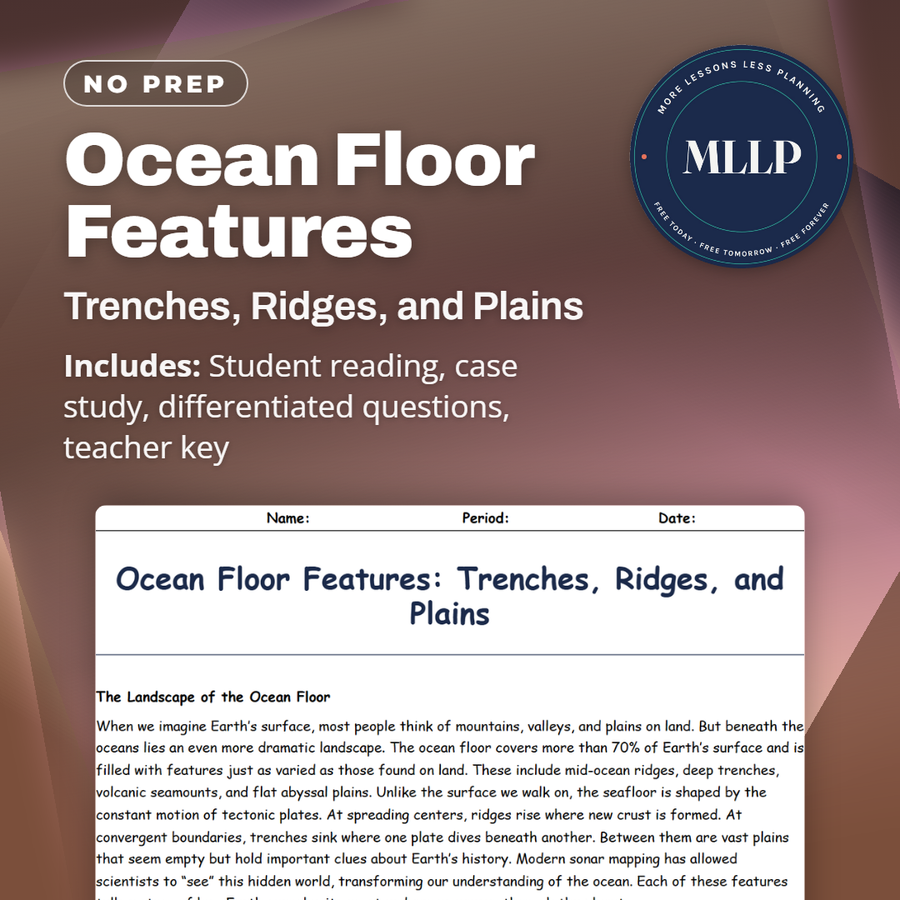
Ocean Floor Features: Trenches, Ridges, and Plains
Quality reviewed September 2026
Facts verified September 14, 2026
- Subject
- Science
- Grades
- Grades 9-12
- Length
- 6-page student worksheet
- Time
- About one 50-minute class period
- Great for
- Sub plans and independent work
- Includes
- Reading passage, comprehension questions + full answer key
- Format
- Print-and-go PDF
What students do
- Match terms like Mid-ocean ridge, Mariana Trench, Abyssal plain, Seamount, and Rift valley to their correct definitions
- Fill in the blank sentences on the Mariana Trench, how abyssal plains form, and where mid-ocean ridges rise
- Answer multiple choice questions on what forms at a divergent boundary, which trench is the deepest, and what makes abyssal plains so flat
- Write short answers on why mid-ocean ridges are the longest mountain chains on Earth, what discoveries have come from the Mariana Trench, and why abyssal plains matter both scientifically and environmentally, using the case study on the Mariana Trench
What it covers
- Mid-ocean ridges, ocean trenches, and abyssal plains as the major features of the seafloor landscape
- How sediment builds up on abyssal plains and why some areas are being studied for deep-sea mining
- A case study on the Mariana Trench, the deepest point on Earth, and the explorers who have reached it
Start reading this worksheet
The Landscape of the Ocean Floor
When we imagine Earth’s surface, most people think of mountains, valleys, and plains on land. But beneath the oceans lies an even more dramatic landscape. The ocean floor covers more than 70% of Earth’s surface and is filled with features just as varied as those found on land. These include mid-ocean ridges, deep trenches, volcanic seamounts, and flat abyssal plains. Unlike the surface we walk on, the seafloor is shaped by the constant motion of tectonic plates. At spreading centers, ridges rise where new crust is formed. At convergent boundaries, trenches sink where one plate dives beneath another. Between them are vast plains that seem empty but hold important clues about Earth’s history. Modern sonar mapping has allowed scientists to “see” this hidden world, transforming our understanding of the ocean. Each of these features tells a story of how Earth recycles its crust and moves energy through the planet.
Mid-Ocean Ridges: Earth’s Longest Mountain Chains
The mid-ocean ridges are underwater mountain ranges formed where tectonic plates pull apart. Magma rises through cracks, cools, and creates new crust. The Mid-Atlantic Ridge is a well-known example, stretching thousands of miles down the Atlantic Ocean. These ridges are not only the longest mountain chains on Earth but also the birthplace of new seafloor. Ridges often include a central valley called a rift, where volcanic activity is common. Heat from below fuels hydrothermal vents, releasing mineral-rich fluids that support unique ecosystems. Scientists study these ridges to understand both plate tectonics and the deep-sea life that thrives in extreme environments.
Like what you read? The full reading, the case study, and every question set are in the free download below, along with the answer key.
Why this matters
The Mariana Trench holds the deepest point on Earth, yet it sits alongside features built by the opposite process: mid-ocean ridges that form where plates pull apart, and abyssal plains that build up quietly from settling sediment. Reading them side by side turns the seafloor into a landscape with a history instead of a flat unknown.
Most of my students assume the seafloor is flat and empty until this reading, so I pause on the fact that some abyssal plains are now being studied for deep-sea mining. The quiet sediment that looked empty a moment ago turns out to be worth arguing over.
From one teacher to another
Beneath the waves lies a landscape as dramatic as anything on land, with underwater mountain ranges, deep trenches, and vast flat plains. This worksheet covers how mid-ocean ridges form where plates pull apart, how trenches form where plates collide and one sinks beneath the other, and how abyssal plains build up from settling sediment. The case study on the Mariana Trench, home to the deepest point on Earth, covers its formation and the explorers who have reached its bottom.
What you get
Download
Where should I send the next one?
Everything here is free and it stays that way. Leave your email and I'll send you the new lessons as they go up. You can unsubscribe from any one of them.
Related resources
Continental Drift and Seafloor Spreading Made Simple
Continental Margins: Active vs. Passive Boundaries
Earth’s Layers and Plate Tectonics Explained
Geological Hazards: Tsunamis, Undersea Earthquakes, and Landslides
Hydrothermal Vents and Their Ecosystems
Marine Geology and Natural Resources
Every lesson on this site is free to download and use. If one of them saved you a prep period, you can chip in a few bucks toward my three kids' daycare fund. That's genuinely where tips go.