North America: Geography, Culture, and Economy
Quality reviewed September 2026
Facts verified September 14, 2026
- Subject
- Social Studies
- Grades
- Grades 9-12
- Length
- 7-page student worksheet
- Time
- About one 50-minute class period
- Great for
- Sub plans and independent work
- Includes
- Reading passage, comprehension questions + full answer key
- Format
- Print-and-go PDF
What students do
- Match terms like the Rocky Mountains, the Great Plains, and the Great Lakes to their correct definitions
- Fill in the blank sentences on the Mississippi River, the Great Plains, and the levee failures during Hurricane Katrina
- Answer multiple choice questions on the Great Lakes, the trade agreement that replaced NAFTA, and why New Orleans was vulnerable to Katrina
- Write short answers on how immigration has shaped North American culture, why the region leads economically, and what Hurricane Katrina revealed about inequality
What it covers
- North America's physical geography, including the Rocky and Appalachian Mountains, the Great Plains, the Great Lakes, and the Mississippi River
- The region's economy and trade, including the USMCA agreement linking the United States, Canada, and Mexico
- A case study on Hurricane Katrina and how geography and inequality combined to worsen the disaster in New Orleans
Start reading this worksheet
The Geography of North America
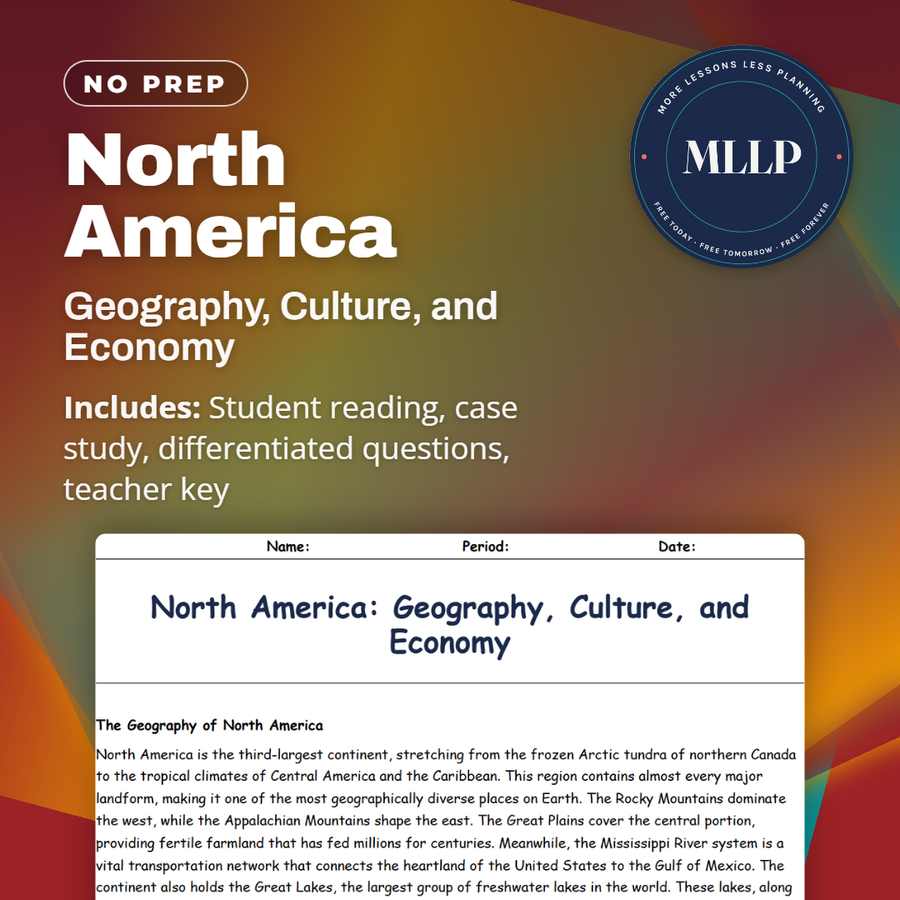
North America is the third-largest continent, stretching from the frozen Arctic tundra of northern Canada to the tropical climates of Central America and the Caribbean. This region contains almost every major landform, making it one of the most geographically diverse places on Earth. The Rocky Mountains dominate the west, while the Appalachian Mountains shape the east. The Great Plains cover the central portion, providing fertile farmland that has fed millions for centuries. Meanwhile, the Mississippi River system is a vital transportation network that connects the heartland of the United States to the Gulf of Mexico. The continent also holds the Great Lakes, the largest group of freshwater lakes in the world. These lakes, along with the Canadian Shield, rich in minerals and forests, have provided both economic resources and natural beauty. The northern climates are harsh, with long winters and frozen ground, while the southern regions enjoy milder weather and fertile soils. This climatic variety allows North America to produce a wide range of agricultural products, from wheat in Canada, to corn in the U.S. Midwest, to tropical crops in Mexico and Central America. Geography has always been central to North America’s development, shaping both its opportunities and its challenges.
Culture and Identity Across the Continent
North America is a cultural mosaic, formed by centuries of migration and settlement. Indigenous peoples were the first to shape the land, and their traditions still influence modern culture, from art and spirituality to respect for the environment. The arrival of European colonists in the 15th and 16th centuries changed the region dramatically, introducing new political systems, languages, and religions. The forced migration of enslaved Africans added yet another layer, leaving lasting cultural and musical traditions that continue to thrive. In the modern era, immigration has continued to reshape the cultural identity of North America. Cities like New York, Toronto, and Los Angeles are often described as “melting pots,” where cultures, languages, and traditions blend together. The influence of the United States on global culture is especially significant. From Hollywood films to fast food chains, American culture has become an international export. At the same time, cultural diversity has created tensions over identity, assimilation, and equality. Despite these challenges, the blending of traditions remains one of North America’s defining strengths, giving it a vibrancy and richness unmatched in much of the world.
The Economic Power of North America
North America is home to some of the world’s strongest economies. The United States leads globally in technology, finance, and manufacturing. Canada’s economy thrives on natural resources like oil, timber, and minerals, while Mexico plays a central role in manufacturing and trade. Together, these three countries are linked by agreements like the North American Free Trade Agreement (NAFTA), later replaced by the United States-Mexico-Canada Agreement (USMCA). This cooperation created one of the world’s largest trading blocs, moving goods, services, and people across borders with fewer restrictions. The region’s wealth also comes from innovation. Silicon Valley in California is the hub of the global technology industry, producing the software, devices, and online platforms that shape modern life. Meanwhile, Wall Street in New York City remains the most powerful financial center on Earth, influencing markets worldwide. Despite this success, economic inequality is a major issue. While many in the U.S. and Canada enjoy high living standards, poverty is widespread in parts of Mexico and Central America. This inequality fuels migration northward, as people seek better opportunities for themselves and their families. North America’s economy demonstrates both the potential of global leadership and the challenges of uneven development.
Like what you read? The full reading, the case study, and every question set are in the free download below, along with the answer key.
Why this matters
When the levees broke in New Orleans during Hurricane Katrina, the flooding did not hit every neighborhood the same way. The levee failures and evacuation gaps hit poorer neighborhoods hardest, turning a storm into a lesson about inequality as much as geography. The Mississippi River and the Great Plains connect to real economic output, and USMCA links the United States, Canada, and Mexico.
I teach this case study right after a unit on natural disasters, because students expect the landforms part and get caught off guard by how squarely the evacuation gaps landed on the city's poorest neighborhoods. It reframes North America as shaped as much by policy and inequality as by mountains and rivers.
From one teacher to another
This reading pulls together North America's landforms, culture, and economy in one worksheet. I like that students see how the Mississippi River and Great Plains connect to real economic output, then move into the USMCA trade agreement between the U.S., Canada, and Mexico. The case study on Hurricane Katrina ties geography directly to inequality, showing how levee failures and evacuation gaps hit poorer neighborhoods hardest. This pairs well with a unit on natural disasters or North American government.
What you get
Download
Where should I send the next one?
Everything here is free and it stays that way. Leave your email and I'll send you the new lessons as they go up. You can unsubscribe from any one of them.
Related resources

Every lesson on this site is free to download and use. If one of them saved you a prep period, you can chip in a few bucks toward my three kids' daycare fund. That's genuinely where tips go.