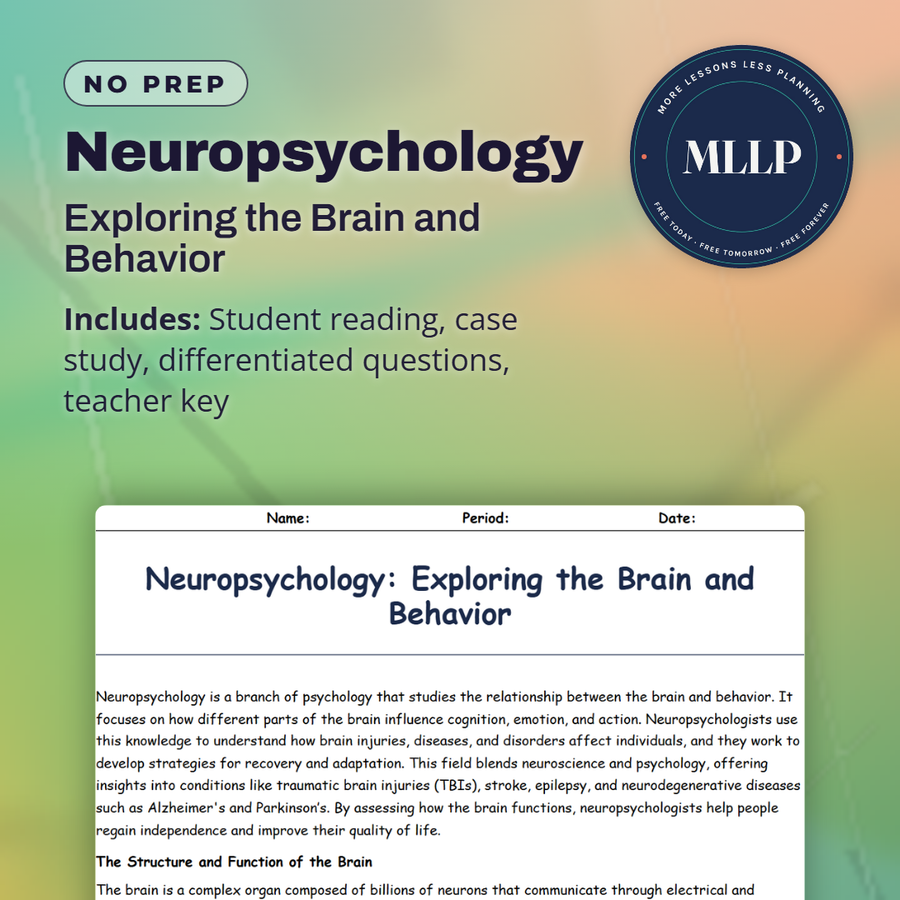
Neuropsychology: Exploring the Brain and Behavior
Quality reviewed September 2026
Facts verified September 10, 2026
- Subject
- Social Studies
- Grades
- Grades 9-12
- Length
- 7-page student worksheet
- Time
- About one 50-minute class period
- Great for
- Sub plans and independent work
- Includes
- Reading passage, comprehension questions + full answer key
- Format
- Print-and-go PDF
What students do
- Match five brain regions, including the frontal lobe and cerebellum, to their functions
- Fill in blanks naming cognitive rehabilitation, the amygdala, and neuroimaging
- Read a case study on recovering from a traumatic brain injury and answer how the neuropsychologist located the damage
- Write short answers on neuroimaging techniques and the role of neuroplasticity in recovery
What it covers
- The structure and function of major brain regions, from the frontal lobe to the brainstem
- How brain function connects to behavior and what happens when regions are damaged
- Neurodegenerative diseases and the tools neuropsychologists use, including neuroimaging
Start reading this worksheet
Neuropsychology is a branch of psychology that studies the relationship between the brain and behavior. It focuses on how different parts of the brain influence cognition, emotion, and action. Neuropsychologists use this knowledge to understand how brain injuries, diseases, and disorders affect individuals, and they work to develop strategies for recovery and adaptation. This field blends neuroscience and psychology, offering insights into conditions like traumatic brain injuries (TBIs), stroke, epilepsy, and neurodegenerative diseases such as Alzheimer's and Parkinson’s. By assessing how the brain functions, neuropsychologists help people regain independence and improve their quality of life.
The Structure and Function of the Brain
The brain is a complex organ composed of billions of neurons that communicate through electrical and chemical signals. It is divided into several regions, each with distinct functions. The frontal lobe is responsible for decision-making, planning, and self-control. Damage to this area can lead to impulsive behavior or difficulties in problem-solving. The parietal lobe processes sensory information, helping us navigate our surroundings. The temporal lobe plays a key role in memory and language, while the occipital lobe is responsible for vision. The cerebellum, located at the back of the brain, coordinates movement and balance. The brainstem regulates vital functions such as breathing and heart rate. The brain also has specialized areas, such as Broca’s area, which is involved in speech production, and Wernicke’s area, which helps with language comprehension. When these regions are damaged, individuals may experience language difficulties known as aphasia.
Brain Function and Behavior
The connection between brain function and behavior is at the heart of neuropsychology. For example, the limbic system, which includes structures like the amygdala and hippocampus, regulates emotions and memory. Overactivity in the amygdala is associated with anxiety, while damage to the hippocampus can result in memory loss. Neuropsychologists study these relationships to understand how brain dysfunction affects behavior. They use tools like functional magnetic resonance imaging (fMRI) and electroencephalography (EEG) to observe brain activity and identify abnormalities. Neuropsychological assessments, which involve tasks like memory recall and problem-solving, provide additional insights into cognitive strengths and weaknesses.
Like what you read? The full reading, the case study, and every question set are in the free download below, along with the answer key.
Why this matters
Students tend to think a brain injury either heals completely or leaves permanent damage, with nothing in between. The traumatic brain injury case study in this reading complicates that: a neuropsychologist locates the damage through neuroimaging, then cognitive rehabilitation helps recovery, and neuroplasticity plays a role in how that recovery happens.
Once students tie the frontal lobe and cerebellum to actual functions instead of memorizing a diagram, they can explain why damage to different regions produces different, specific behavior changes instead of one generic kind of brain damage. That distinction turns the case study into more than a list of symptoms to recall.
From one teacher to another
This is the reading I use for the brain unit since it walks through each lobe and ties damage to specific behavior changes, which sticks with students more than a diagram alone. They match brain regions like the frontal lobe and cerebellum to their functions, fill in blanks on the amygdala and neuroimaging, then read a case study on a traumatic brain injury and how cognitive rehabilitation helped recovery. Short answer questions cover neuroplasticity. Comes with an answer key.
What you get
Download
Where should I send the next one?
Everything here is free and it stays that way. Leave your email and I'll send you the new lessons as they go up. You can unsubscribe from any one of them.
Related resources
Clinical Psychology: Understanding and Treating Mental Health Disorders
Consumer Psychology: Understanding Behavior and Decision-Making
Developmental Psychology: Understanding Human Growth Across the Lifespan
Educational Psychology: Understanding Learning Processes and Teaching Strategies
Health Psychology: The Link Between Mind and Body
Industrial/Organizational Psychology: Understanding Workplace Behavior and Productivity
Every lesson on this site is free to download and use. If one of them saved you a prep period, you can chip in a few bucks toward my three kids' daycare fund. That's genuinely where tips go.