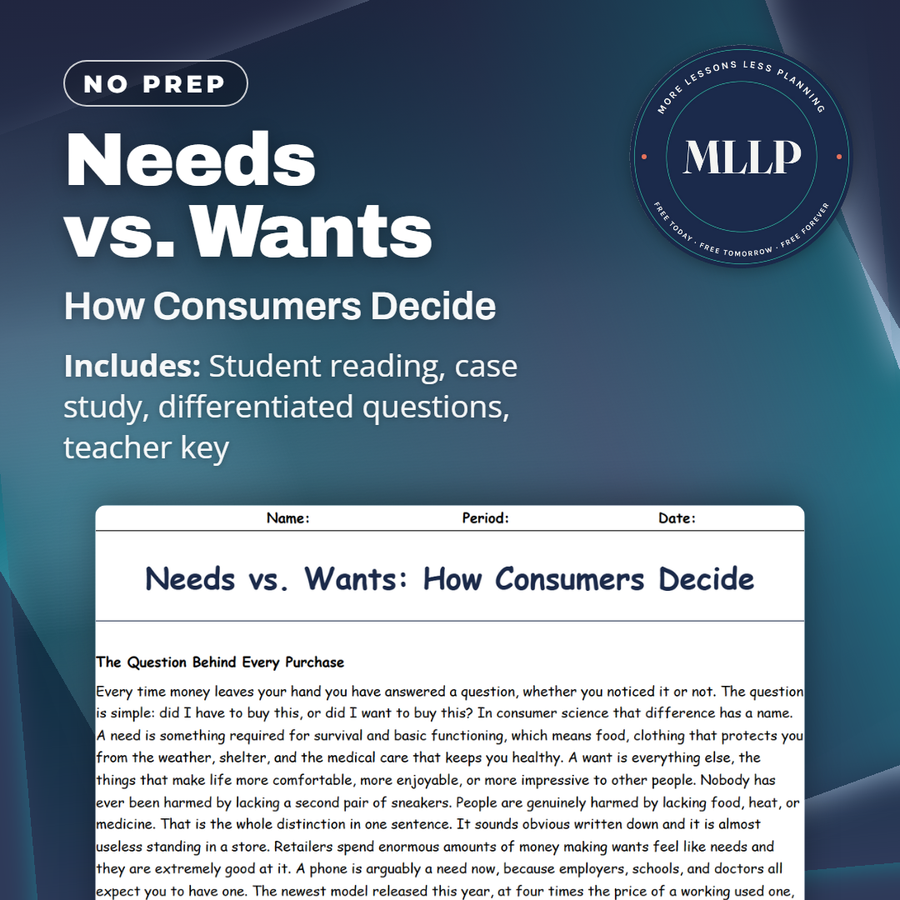
Needs vs. Wants: How Consumers Decide
Quality reviewed September 2026
Facts verified September 23, 2026
- Subject
- Career & Life Skills
- Grades
- Grades 9-12
- Length
- 8-page student worksheet
- Time
- About one 50-minute class period
- Great for
- Sub plans and independent work
- Includes
- Reading passage, comprehension questions + full answer key
- Format
- Print-and-go PDF
What students do
- Classify a list of purchases as needs or wants using the reading's own safety test
- Alina's three competing purchases get sorted using her own handwritten notes as evidence
- Identify the opportunity cost in a sample spending decision from the reading
- A value statement like wanting to be better with money gets rewritten as a specific goal
What it covers
- The need versus want test and why the line blurs in a real household
- Scarcity, trade offs, and opportunity cost applied to everyday spending choices
- Alina's case study weighing work shoes, a phone, and concert tickets against each other
Start reading this worksheet
The Question Behind Every Purchase
Every time money leaves your hand you have answered a question, whether you noticed it or not. The question is simple: did I have to buy this, or did I want to buy this? In consumer science that difference has a name. A need is something required for survival and basic functioning, which means food, clothing that protects you from the weather, shelter, and the medical care that keeps you healthy. A want is everything else, the things that make life more comfortable, more enjoyable, or more impressive to other people. Nobody has ever been harmed by lacking a second pair of sneakers. People are genuinely harmed by lacking food, heat, or medicine. That is the whole distinction in one sentence. It sounds obvious written down and it is almost useless standing in a store. Retailers spend enormous amounts of money making wants feel like needs and they are extremely good at it. A phone is arguably a need now, because employers, schools, and doctors all expect you to have one. The newest model released this year, at four times the price of a working used one, is a want wearing a need's clothing. Learning to spot that swap is the single most valuable consumer skill a person can develop, and over a lifetime it is worth more than every coupon you will ever clip. The test is not whether something is nice, useful, or even smart to own. The test is whether you would still be safe, fed, housed, and healthy without it. If the answer is yes, it is a want, and wants are not the enemy. They are simply the part of the budget that gets decided last.
Where the Line Actually Blurs
In a textbook the two categories sit in tidy columns. In an actual household they overlap constantly, and pretending otherwise is how people end up feeling guilty about reasonable purchases. Shelter is a need, but the specific apartment is a want, and there is a wide range between the cheapest room available and the place with the parking spot and the dishwasher. Transportation to work is a need in most American communities, where public transit is thin and jobs are spread out. A particular vehicle at a particular price is a want layered on top of that need. Clothing follows the same pattern. Steel-toed boots for a warehouse shift are a need, and the brand name printed on them is not. The useful move is not to force every purchase into one box but to identify the need underneath and then ask how much want you are attaching to it. Consumer scientists describe this as separating the function from the features. The function is what the item has to do. The features are everything the manufacturer added to make you choose their version. A winter coat has one job, which is keeping you warm and dry. Waterproofing serves that job. A designer logo does not, though it may serve a different and entirely real human need to belong and to be seen a certain way by peers. Recognizing that as a want rather than dismissing it keeps the analysis honest. Wants tied to identity and belonging are powerful, they are normal, and they still have to fit inside a finite amount of money.
Scarcity and What You Give Up
Underneath every consumer decision sits the most basic idea in economics, and it applies just as much to a teenager with ninety dollars as to a family of five. Scarcity means that resources are limited while wants are unlimited. There is always another thing worth buying and never quite enough money to buy all of it, which is true at every income level. Because resources are scarce, every choice is also a trade-off. Choosing one thing means not choosing something else, and the value of the next best option you gave up is called opportunity cost. This is the concept people skip, and skipping it is expensive. If you spend ninety dollars on concert tickets, the real price is not ninety dollars. The real price is the tickets minus whatever the second-best use of that ninety dollars would have been, whether that is work shoes, a car repair fund, or two weeks of gas. When the second-best option was trivial, the purchase is easy to defend. When the second-best option was something you actually needed, the same ninety dollars was a bad decision even though the concert was genuinely fun. Money spent is only half the cost of anything. Time works exactly the same way. An hour spent driving across town to save four dollars costs you the hour, and if you could have earned fifteen dollars working that hour, the trip lost money. Households that manage resources well are the ones that count both prices.
Like what you read? The full reading, the case study, and every question set are in the free download below, along with the answer key.
Why this matters
Every teenager with a part time job runs into this exact tension, wanting something the same week that money is needed somewhere more urgent, whether that is work shoes, a phone bill, or tickets to something with friends. The reading's point that a want tied to belonging is still real and still worth naming honestly matters here, because pretending it does not exist is what makes a budget collapse the first week someone breaks it. Learning to name the function under a purchase, and to ask what buying it stops a person from buying instead, is a habit that outlasts any single decision about shoes or a concert.
From one teacher to another
Alina has three hundred forty dollars and three competing claims on it, worn out work shoes, an aging phone, and concert tickets with her closest friends, and she is certain all three are needs until she stops to check. The reading draws the line between a need and a want using one test, whether a person would still be safe, fed, housed, and healthy without the item, then complicates that line on purpose with real examples like a specific apartment or a designer logo on a work boot. Students work through scarcity and opportunity cost, the value of the next best option given up, and a six step decision process built around naming the problem before naming the product. Alina's own notes, safe footing with no substitute against a phone that just works fine, become the case study's evidence.
What you get
Download
Where should I send the next one?
Everything here is free and it stays that way. Leave your email and I'll send you the new lessons as they go up. You can unsubscribe from any one of them.
Related resources
Advertising Tactics: How You Get Persuaded
Building a Household Budget
Comparison Shopping and Unit Pricing
Consumer Rights and Responsibilities
Grocery Shopping on a Budget
Making a Major Purchase
Every lesson on this site is free to download and use. If one of them saved you a prep period, you can chip in a few bucks toward my three kids' daycare fund. That's genuinely where tips go.