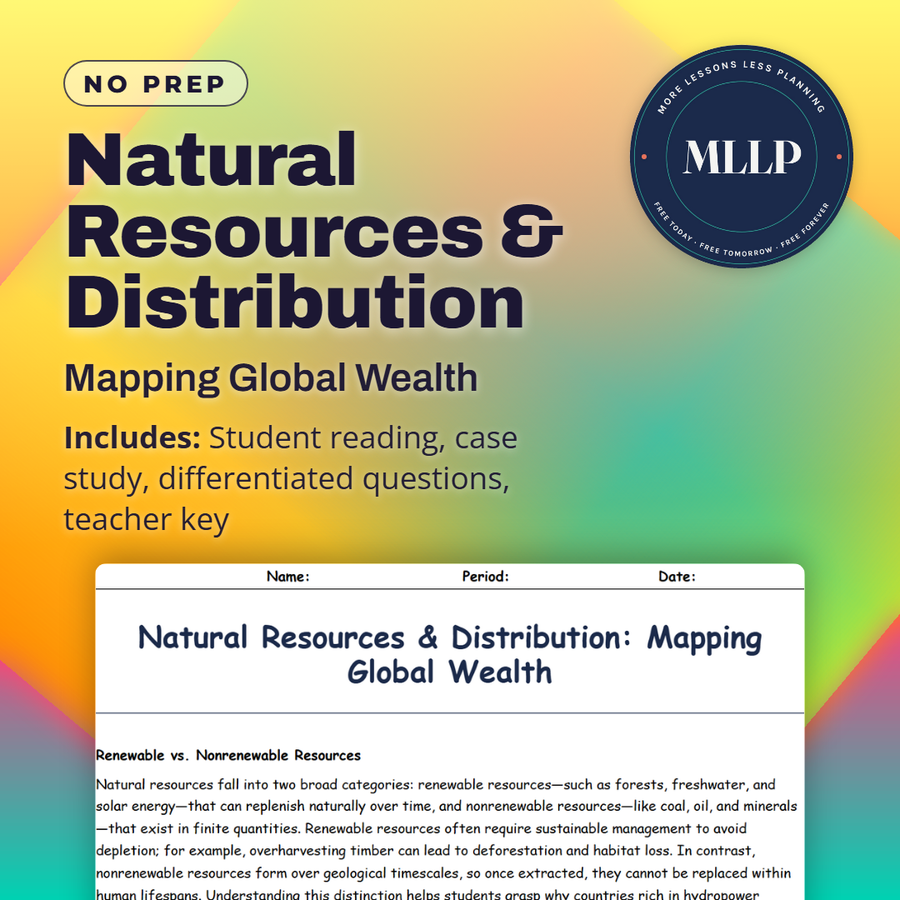
Natural Resources & Distribution: Mapping Global Wealth
Quality reviewed September 2026
Facts verified September 14, 2026
- Subject
- Social Studies
- Grades
- Grades 9-12
- Length
- 6-page student worksheet
- Time
- About one 50-minute class period
- Great for
- Sub plans and independent work
- Includes
- Reading passage, comprehension questions + full answer key
- Format
- Print-and-go PDF
What students do
- Match terms like desalination, sovereign wealth fund, resource curse, and OPEC production quotas to their correct definitions
- Fill in the blank sentences on nonrenewable resources, renewable energy sources, and desalination plants
- Answer multiple choice questions on the top producer of rare earth metals, what the resource curse means, and the purpose of a sovereign wealth fund
- Write short answers on the tradeoffs of relying on nonrenewable exports, how transparent governance prevents the resource curse, and why countries diversify resource revenue
What it covers
- The difference between renewable resources like timber and freshwater and nonrenewable resources like oil and rare earth metals
- How resource endowments are unevenly distributed across the globe and what that means for import dependent and resource rich nations
- A case study on Botswana's diamond wealth and how the Pula Fund helped the country avoid the resource curse
Start reading this worksheet
Renewable vs. Nonrenewable Resources
Natural resources fall into two broad categories: renewable resources (such as forests, freshwater, and solar energy) that can replenish naturally over time, and nonrenewable resources (like coal, oil, and minerals) that exist in finite quantities. Renewable resources often require sustainable management to avoid depletion; for example, overharvesting timber can lead to deforestation and habitat loss. In contrast, nonrenewable resources form over geological timescales, so once extracted, they cannot be replaced within human lifespans. Understanding this distinction helps students grasp why countries rich in hydropower potential may invest differently than those endowed with vast oil reserves. Policies for renewable resources emphasize conservation, replanting, and clean technology, whereas nonrenewable-focused nations must consider extraction rates, price volatility, and long-term economic planning. As global demand soars, balancing current needs with future sustainability becomes a critical challenge for policymakers and communities alike.
Global Patterns of Resource Distribution
Resource endowments are unevenly spread across the globe. Oil reserves concentrate in the Middle East and Russia, while major copper and cobalt deposits lie in Chile and the Democratic Republic of Congo. Forest cover dominates parts of Canada, Russia, and Brazil, and freshwater availability varies drastically from the Great Lakes region to semi-arid zones in Central Asia. These patterns arise from geological history, climate, and topography. Table 1: Key Resources and Leading Producers Mapping these deposits reveals geopolitical hotspots: nations with scarce resources may face import dependence and higher prices, whereas resource “haves” can leverage exports for economic growth. Yet abundance brings its own risks: “resource curse” dynamics can lead to corruption, economic volatility, and underinvestment in other sectors, highlighting that raw wealth doesn’t always translate to broad prosperity.
Like what you read? The full reading, the case study, and every question set are in the free download below, along with the answer key.
Why this matters
Oil and diamonds sound like guaranteed wealth, but plenty of resource-rich countries end up poorer for it, trapped in the resource curse. Botswana is the exception: diamond revenue there built schools, roads, and the Pula Fund instead of instability. The mineral in the ground matters less than whether a government spends that money out in the open.
Students walk in assuming oil or diamonds make a country rich automatically, so setting Botswana beside a resource curse case forces them to separate the resource from the governance. That distinction carries straight into the OPEC and sovereign wealth fund material later on, where the same question, who controls the money, keeps coming back.
From one teacher to another
This reading introduces the resource curse and shows it is not inevitable. Botswana is the counterexample here, showing how a country turned diamond wealth into schools, roads, and a stabilization fund instead of instability. This pairs well with the industrial resources reading, since both deal with how countries manage what comes out of the ground.
What you get
Download
Where should I send the next one?
Everything here is free and it stays that way. Leave your email and I'll send you the new lessons as they go up. You can unsubscribe from any one of them.
Related resources
Agriculture & Food Production: Feeding the Future
Economic Development Indicators: GDP, HDI & Beyond
Economic Sectors Explained: Primary, Secondary, Tertiary & Quaternary
Economic Systems Compared: Capitalism, Socialism & Mixed Models
Globalization & Outsourcing: Connecting World Economies
Industrial Resources & Sustainability: Balancing Growth
Every lesson on this site is free to download and use. If one of them saved you a prep period, you can chip in a few bucks toward my three kids' daycare fund. That's genuinely where tips go.