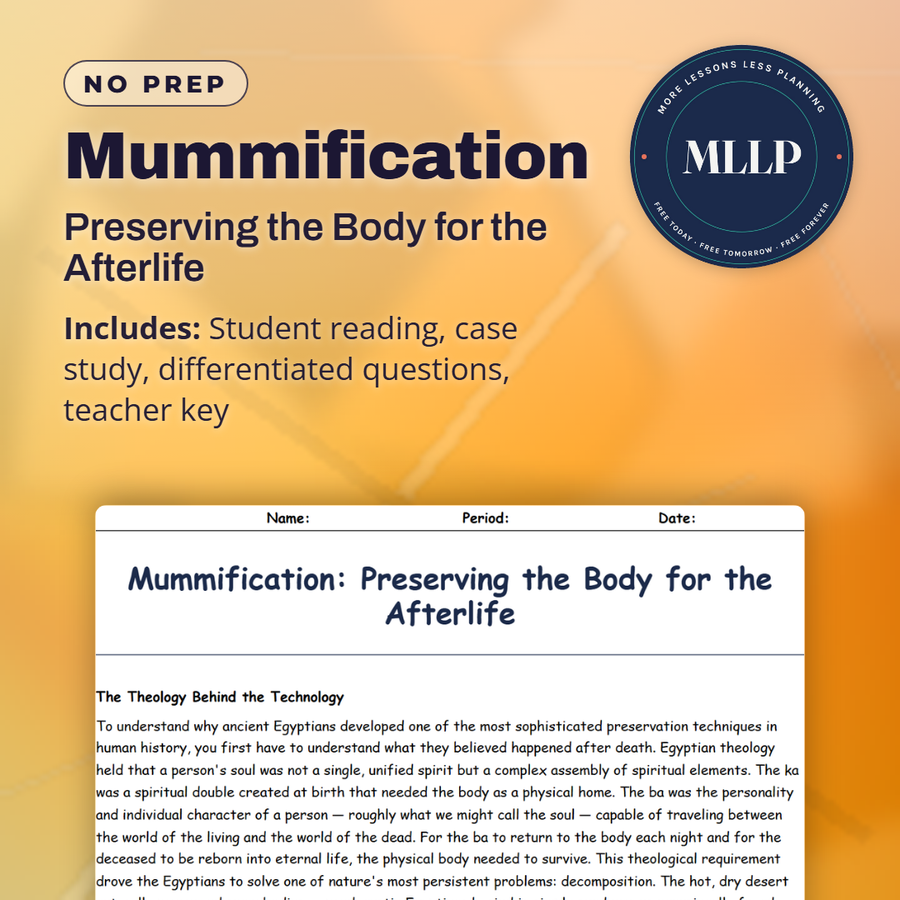
Mummification: Preserving the Body for the Afterlife
Quality reviewed September 2026
Facts verified September 21, 2026
- Subject
- Social Studies
- Grades
- Grades 9-12
- Length
- 9-page student worksheet
- Time
- About one 50-minute class period
- Great for
- Sub plans and independent work
- Includes
- Reading passage, comprehension questions + full answer key
- Format
- Print-and-go PDF
What students do
- The removed organs get sorted by which canopic jar and which Son of Horus protected each one
- Fill in the seventy-day mummification timeline from the first incision to the final wrapping
- An embalmer named Ipy finds evidence of a hidden murder on his table, and students weigh what he owes the dead man
- Explain why the Weighing of the Heart made the heart the one organ Egyptians left inside the body
What it covers
- The seventy-day mummification process and canopic jars
- The Book of the Dead and the Weighing of the Heart
- What CT scans and DNA analysis reveal about mummies today
Start reading this worksheet
The Theology Behind the Technology
To understand why ancient Egyptians developed one of the most sophisticated preservation techniques in human history, you first have to understand what they believed happened after death. Egyptian theology held that a person's soul was not a single, unified spirit but a complex assembly of spiritual elements. The ka was a spiritual double created at birth that needed the body as a physical home. The ba was the personality and individual character of a person (roughly what we might call the soul), capable of traveling between the world of the living and the world of the dead. For the ba to return to the body each night and for the deceased to be reborn into eternal life, the physical body needed to survive. This theological requirement drove the Egyptians to solve one of nature's most persistent problems: decomposition. The hot, dry desert naturally preserved some bodies: predynastic Egyptians buried in simple sand graves occasionally found their dead preserved by the arid conditions. But as Egypt developed and burials moved indoors into tombs, away from the desiccating sand, the bodies began to decay. Mummification was the deliberate, technological response to this problem, a process refined over more than 2,000 years from simple preservation attempts in the Old Kingdom to the elaborate, standardized seventy-day procedure of the New Kingdom.
The Seventy-Day Process
The full mummification process took approximately seventy days and was performed by a specialized class of embalmers who combined the roles of priest and mortuary technician. The process began immediately after death. First, embalmers removed all internal organs except the heart, which the Egyptians believed was the seat of intelligence and emotion and needed to remain with the body for the judgment of the dead. The brain was removed through the nasal cavity using a long hook. The Egyptians considered the brain unimportant, and it was discarded. The lungs, liver, intestines, and stomach were removed through a cut in the left side of the abdomen. The removed organs were preserved separately in four canopic jars, each protected by one of the four Sons of Horus: Imsety (human-headed, protecting the liver), Hapy (baboon-headed, protecting the lungs), Duamutef (jackal-headed, protecting the stomach), and Qebehsenuef (falcon-headed, protecting the intestines). The body cavity was then packed with natron (a naturally occurring salt found in dried lake beds), and the entire body was covered in natron for forty days, drawing out all remaining moisture. After forty days, the shriveled body was cleaned, rubbed with oils and resins, and wrapped in hundreds of meters of linen bandage, with protective amulets tucked between the layers.
Who Got Mummified?
Full mummification was expensive: the seventy-day process with all its materials and priestly services cost approximately the equivalent of a skilled worker's annual salary. As a result, elaborate mummification was initially reserved for the pharaoh and the highest nobility. Over time, as Egypt's wealth grew and the funerary industry expanded, middle-class Egyptians could afford simplified versions of the process. By the New Kingdom, even lower-status Egyptians might receive basic preservation, and animals such as sacred cats, ibises, baboons, crocodiles, and bulls were mummified in enormous quantities as religious offerings. Animal mummies have been found in the millions. The catacombs of Saqqara, south of Cairo, contained well over a million ibis mummies alone, packed into clay pots and stacked in underground corridors for hundreds of meters. Cats were mummified so frequently that in the 19th century, when Egyptian farmers discovered large deposits of cat mummies, they were shipped to England and ground up as fertilizer before archaeologists realized their historical value. Recent analysis using CT scanning has revealed that many animal mummies (perhaps a third) contain no animal at all, just feathers, sticks, or mud, suggesting that the mummy-making industry was not always strictly honest.
Like what you read? The full reading, the case study, and every question set are in the free download below, along with the answer key.
Why this matters
Ipy's dilemma in the case study is a version of a problem that has not gone away: what do you do when your job puts you in contact with evidence of a wrong, and reporting it could cost you your livelihood or put you at risk. Doctors, morticians, and lab technicians face versions of this today. The reading does not resolve Ipy's choice for students, and that is deliberate. It is worth sitting with a case where there is no clean answer, only competing loyalties.
The reading's last section also matters on its own. CT scans of mummies have found heart disease, malaria, and healed injuries in bodies thousands of years old, which means the study of ancient disease is not finished. Every scan of a body prepared for the afterlife is now teaching modern medicine something about how long conditions like atherosclerosis have been part of human life, proof that this field still produces new discoveries.
From one teacher to another
Mummification only makes sense once you understand what Egyptians believed happened after death, so this reading starts with the theology before it gets to the process. The soul needed a preserved body to return to, which is why embalmers spent seventy days removing organs into four canopic jars, drying the body in natron salt, and wrapping it in hundreds of meters of linen. Getting to the afterlife took more than a preserved body, too: the Book of the Dead guided the soul through the underworld to the Weighing of the Heart, where Anubis balanced the deceased's heart against the feather of Ma'at while a monster named Ammit waited to consume any heart that failed. Students also look at who could actually afford this process, and how CT scans and DNA analysis are still revealing new information about mummified bodies without unwrapping them. The case study puts an embalmer named Ipy in front of a body that shows unmistakable signs of murder, and asks what he owes the truth versus the family paying him.
What you get
Download
Where should I send the next one?
Everything here is free and it stays that way. Leave your email and I'll send you the new lessons as they go up. You can unsubscribe from any one of them.
Related resources
Ancient Egypt: Land of the Pharaohs, An Overview
Building the Pyramids: Engineering Without Modern Technology
Daily Life in Ancient Egypt: Beyond the Pharaohs
Egyptian Religion and the Afterlife
Hatshepsut: The Woman Who Became Pharaoh
Hieroglyphics and the Rosetta Stone: Cracking the Code
Every lesson on this site is free to download and use. If one of them saved you a prep period, you can chip in a few bucks toward my three kids' daycare fund. That's genuinely where tips go.