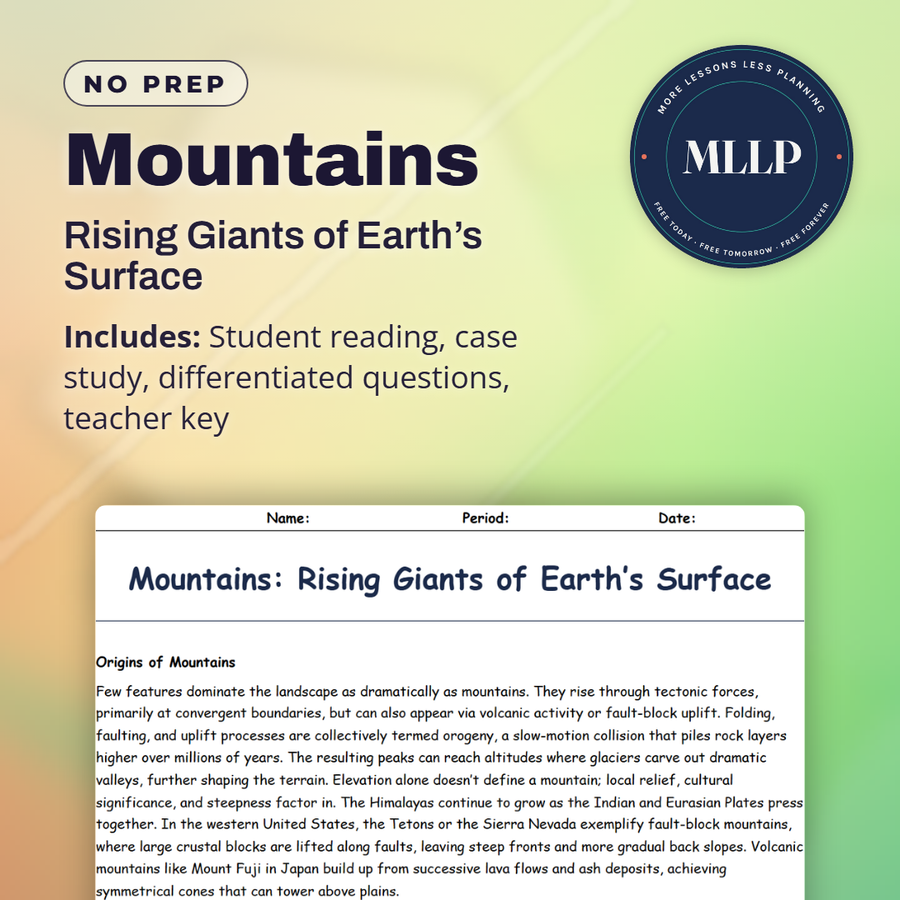
Mountains: Rising Giants of Earth’s Surface
Quality reviewed September 2026
Facts verified September 14, 2026
- Subject
- Social Studies
- Grades
- Grades 9-12
- Length
- 7-page student worksheet
- Time
- About one 50-minute class period
- Great for
- Sub plans and independent work
- Includes
- Reading passage, comprehension questions + full answer key
- Format
- Print-and-go PDF
What students do
- Match terms like orogeny, fault-block mountain, and rain shadow to their correct definitions
- Fill in the blank sentences on fault-block mountains, orogeny, and how peaks act as water towers
- Answer multiple choice questions on how fold mountains form, where rain shadows develop, and what makes volcanic mountains different
- Write short answers on why mountain regions are biodiversity hotspots, how tourism affects mountain communities, and how climate change threatens water towers
What it covers
- How mountains form through orogeny at convergent boundaries, fault-block uplift, and volcanic activity, with examples like the Himalayas, Sierra Nevada, and Mount Fuji
- How mountains shape climate through orographic rainfall and rain shadows, creating biodiversity hotspots and serving as water towers for rivers
- A case study on eco-tourism in the Himalayas and a table comparing fold, fault-block, and volcanic mountain types
Start reading this worksheet
Origins of Mountains
Few features dominate the landscape as dramatically as mountains. They rise through tectonic forces, primarily at convergent boundaries, but can also appear via volcanic activity or fault-block uplift. Folding, faulting, and uplift processes are collectively termed orogeny, a slow-motion collision that piles rock layers higher over millions of years. The resulting peaks can reach altitudes where glaciers carve out dramatic valleys, further shaping the terrain. Elevation alone doesn’t define a mountain; local relief, cultural significance, and steepness factor in. The Himalayas continue to grow as the Indian and Eurasian Plates press together. In the western United States, the Tetons or the Sierra Nevada exemplify fault-block mountains, where large crustal blocks are lifted along faults, leaving steep fronts and more gradual back slopes. Volcanic mountains like Mount Fuji in Japan build up from successive lava flows and ash deposits, achieving symmetrical cones that can tower above plains.
Types of Mountains
Fold mountains like the Alps or the Andes often feature complex layering of rock, twisted into intricate folds by immense compressional forces. Fault-block mountains arise when crust is stretched, causing large slabs to tilt or uplift. Volcanic mountains form from repeated eruptions, layering molten rock that cools into basalt, andesite, or other igneous materials. Over time, erosion sculpts mountain surfaces, carving ridges and valleys that expose the internal structure. Glacial action leaves a distinct imprint, especially on “younger” ranges still cold enough to sustain ice. Glaciers grind rock, creating U-shaped valleys, sharp aretes, and pyramidal horns like the famed Matterhorn in the Alps. Weathering from wind, rain, and temperature fluctuations can also shape the contours, eventually reducing lofty peaks to more subdued landscapes. Because these processes span countless millennia, mountains can appear eternal to us, though they are geologically transient.
Mountains and Climate
Mountains significantly influence weather. Air forced up a slope cools and condenses, producing orographic rainfall on the windward side. Meanwhile, the far side often becomes a rain shadow, fostering a drier environment. Thus, the same mountain range can feature lush forests on one side and semiarid conditions on the other. Additionally, temperature drops as altitude increases, so higher elevations often have alpine conditions that mimic polar regions. These climatic differences create biodiversity hotspots. Unique plant and animal species adapt to the thinner atmosphere, colder temperatures, and steeper slopes. Mountains also serve as water towers, capturing snow and rain that feed rivers. When glaciers recede due to warming trends, downstream communities may face water shortages or disrupted hydropower. Monitoring mountain ecosystems and ice cover helps scientists predict potential impacts on agriculture and urban water supplies.
Like what you read? The full reading, the case study, and every question set are in the free download below, along with the answer key.
Why this matters
Calling the Himalayas a water tower is not just a metaphor, since mountains serve as water towers for the rivers that depend on them. Mountains reach that height three different ways, folding, faulting, or volcanic activity, so no two ranges got tall the same way.
The eco-tourism case study is where students stop treating mountains as scenery, weighing the income tourism brings against the strain on a fragile environment. That trade-off makes climate change shrinking water towers feel like a traceable consequence, not an abstract warning.
From one teacher to another
I like how this one lays out the three ways mountains form side by side, so students can compare orogeny, fault-block uplift, and volcanic building instead of memorizing them separately. The mountain climate section ties directly into the rain shadow and water tower ideas, which makes a nice bridge if you are also covering climate zones. The Himalayas case study gives students a concrete eco-tourism trade-off to work through in the short answer section.
What you get
Download
Where should I send the next one?
Everything here is free and it stays that way. Leave your email and I'll send you the new lessons as they go up. You can unsubscribe from any one of them.
Related resources
Biomes & Ecosystems: Life Across Earth’s Habitats
Climate vs. Weather: Understanding the Difference
Convergent Boundaries: Where Plates Collide
Deserts: Survival in the Harshest Climates

Divergent Boundaries: Where Plates Pull Apart
Earth’s Layers: From Crust to Core
Every lesson on this site is free to download and use. If one of them saved you a prep period, you can chip in a few bucks toward my three kids' daycare fund. That's genuinely where tips go.