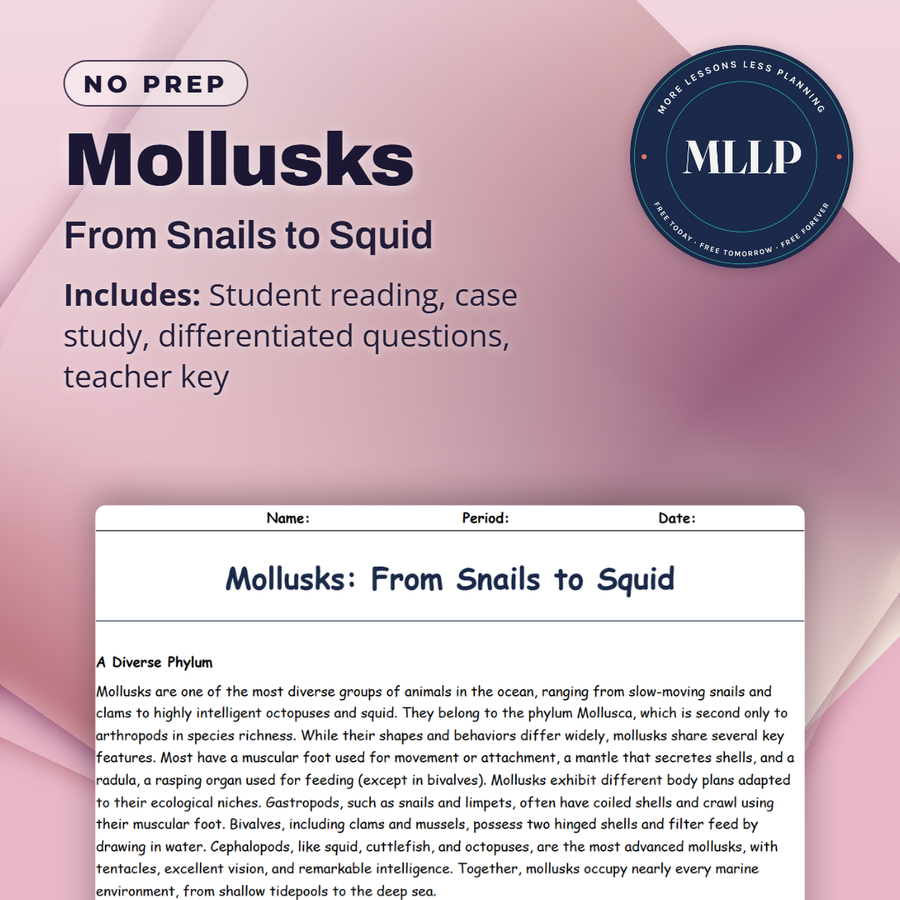
Mollusks: From Snails to Squid
Quality reviewed September 2026
Facts verified September 14, 2026
- Subject
- Science
- Grades
- Grades 9-12
- Length
- 5-page student worksheet
- Time
- About one 50-minute class period
- Great for
- Sub plans and independent work
- Includes
- Reading passage, comprehension questions + full answer key
- Format
- Print-and-go PDF
What students do
- Match terms like gastropods, cephalopods, bivalves, radula, and mantle to their correct definitions
- Fill in the blank sentences on what bivalves filter from the water, how cephalopods camouflage, and what the mantle does
- Answer multiple choice questions on the radula, which mollusks are cephalopods, and how cephalopods avoid predators
- Write short answers on why bivalves matter to marine environments, what makes cephalopod eyes and brains unusual, how shelled mollusks and cephalopods differ in defense, and why the giant squid remained a mystery for so long
What it covers
- The three main mollusk groups, gastropods, bivalves, and cephalopods, and the feeding and defense strategies each uses
- Cephalopod intelligence, including problem-solving, camouflage, and advanced vision
- A case study on the giant squid and how little was known about it until footage surfaced in 2004 and 2012
Start reading this worksheet
A Diverse Phylum
Mollusks are one of the most diverse groups of animals in the ocean, ranging from slow-moving snails and clams to highly intelligent octopuses and squid. They belong to the phylum Mollusca, which is second only to arthropods in species richness. While their shapes and behaviors differ widely, mollusks share several key features. Most have a muscular foot used for movement or attachment, a mantle that secretes shells, and a radula, a rasping organ used for feeding (except in bivalves). Mollusks exhibit different body plans adapted to their ecological niches. Gastropods, such as snails and limpets, often have coiled shells and crawl using their muscular foot. Bivalves, including clams and mussels, possess two hinged shells and filter feed by drawing in water. Cephalopods, like squid, cuttlefish, and octopuses, are the most advanced mollusks, with tentacles, excellent vision, and remarkable intelligence. Together, mollusks occupy nearly every marine environment, from shallow tidepools to the deep sea.
Feeding and Adaptations
Mollusks use a variety of feeding strategies. Gastropods are often grazers, scraping algae from rocks with their radula. Some, like cone snails, are predators equipped with venomous harpoons for capturing prey. Bivalves are essential filter feeders, removing plankton and detritus from the water and improving water clarity. Cephalopods are active predators, using tentacles and beak-like jaws to capture fish, crabs, and even other mollusks. Adaptations also set mollusks apart. Many gastropods and bivalves rely on protective shells, while cephalopods developed soft bodies but compensate with camouflage, ink release, and extraordinary intelligence. Some cephalopods can change both color and texture almost instantly, blending into their surroundings or startling predators. These adaptations highlight how evolution has shaped mollusks for survival in diverse ocean habitats.
Like what you read? The full reading, the case study, and every question set are in the free download below, along with the answer key.
Why this matters
Most people picture a mollusk as a snail stuck to a shell, not an animal capable of solving puzzles. That gap explains why the giant squid stayed a legend for so long: researchers did not capture one on film until 2004, and again in 2012.
I like pairing the mantle and radula with cephalopod camouflage and vision because it shows one body plan pulled in two directions at once. A filter-feeding clam and a problem-solving octopus turn out to share more structure than students expect.
From one teacher to another
Mollusks range from a snail crawling on a single muscular foot to a squid with a brain complex enough to solve problems, and this worksheet covers that entire spread. It walks through the radula, mantle, and shell that define gastropods and bivalves, then moves into the ink, camouflage, and vision that make cephalopods such effective hunters. The case study on the giant squid covers how this deep-sea animal stayed a legend until researchers finally captured live footage in 2004 and again in 2012. Students see how one phylum can include both a filter-feeding clam and a problem-solving octopus.
What you get
Download
Where should I send the next one?
Everything here is free and it stays that way. Leave your email and I'll send you the new lessons as they go up. You can unsubscribe from any one of them.
Related resources
Adaptations for Survival: Camouflage, Shells, and Toxins
Arthropods of the Sea: Crabs, Lobsters, and Shrimp
Cnidarians: Corals, Jellyfish, and Sea Anemones
Echinoderms: Sea Stars and Sea Urchins
Exploring Marine Invertebrates: Diversity Beneath the Waves
Invertebrates in Food Webs: Ecosystem Engineers of the Sea
Every lesson on this site is free to download and use. If one of them saved you a prep period, you can chip in a few bucks toward my three kids' daycare fund. That's genuinely where tips go.