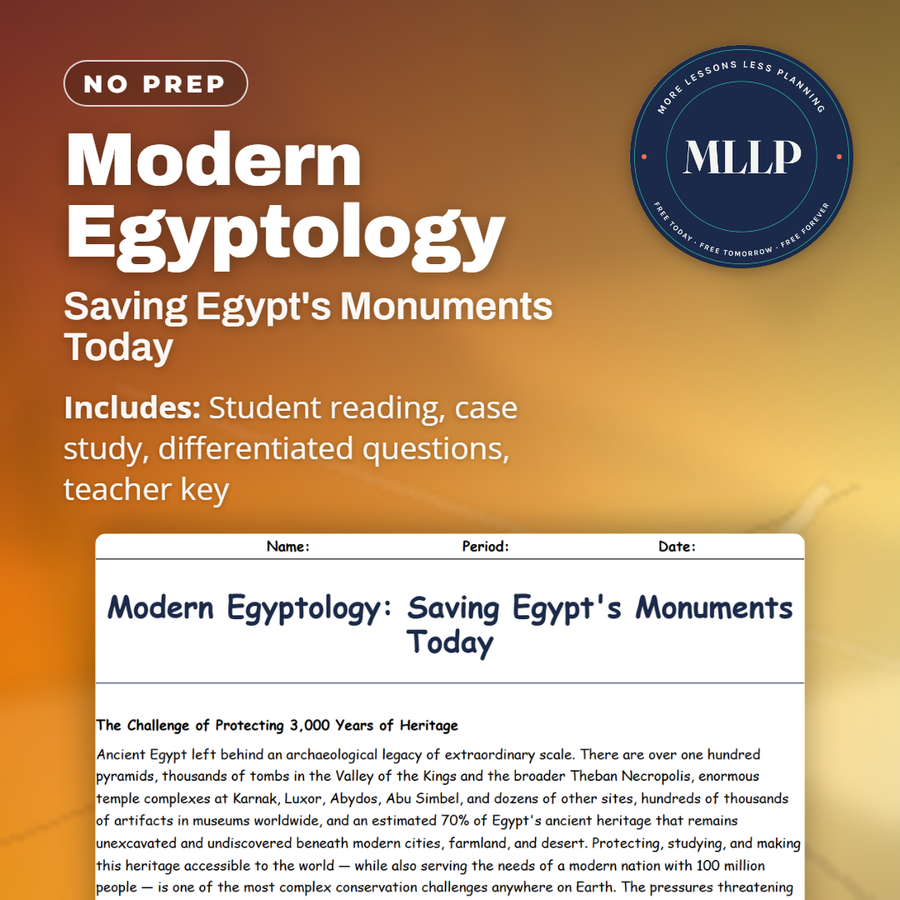
Modern Egyptology: Saving Egypt's Monuments Today
Quality reviewed September 2026
Facts verified September 21, 2026
- Subject
- Social Studies
- Grades
- Grades 9-12
- Length
- 10-page student worksheet
- Time
- About one 50-minute class period
- Great for
- Sub plans and independent work
- Includes
- Reading passage, comprehension questions + full answer key
- Format
- Print-and-go PDF
What students do
- The threats to Egypt's monuments, groundwater, salt, tourism, climate change, get sorted by how each one causes damage
- Trace the Abu Simbel rescue's 1,040 numbered blocks from the original cliff to the new hillside
- Dr. Layla Farouk's grant application argues Egyptian sites should be studied by Egyptian scholars, and students weigh her case
- Explain why the Grand Egyptian Museum counts as a political statement, not only a building project
What it covers
- Threats facing Egypt's ancient sites today, from groundwater to climate change
- The Abu Simbel rescue and how engineering saved two temples
- The debate over who leads and funds Egyptian archaeology
Start reading this worksheet
The Challenge of Protecting 3,000 Years of Heritage
Ancient Egypt left behind an archaeological legacy of extraordinary scale. There are over one hundred pyramids, thousands of tombs in the Valley of the Kings and the broader Theban Necropolis, enormous temple complexes at Karnak, Luxor, Abydos, Abu Simbel, and dozens of other sites, hundreds of thousands of artifacts in museums worldwide, and an estimated 70% of Egypt's ancient heritage that remains unexcavated and undiscovered beneath modern cities, farmland, and desert. Protecting, studying, and making this heritage accessible to the world, while also serving the needs of a modern nation with 100 million people, is one of the most complex conservation challenges anywhere on Earth. The pressures threatening Egypt's ancient sites are multiple and growing. Rising groundwater, driven partly by irrigation from the Aswan High Dam, is eroding the foundations of monuments in the Nile Valley. Salt crystallization, caused by moisture rising through ancient stone, is destroying painted surfaces from the inside. Tourism (which funds conservation but also accelerates damage through the carbon dioxide exhaled by millions of visitors and the physical wear of constant foot traffic) poses difficult management challenges. Urban development has swallowed sites across the Delta region. Climate change is raising Mediterranean sea levels, threatening coastal sites in the Delta, and increasing temperature extremes that accelerate stone deterioration.
The Abu Simbel Rescue: Engineering Meets Archaeology
The most dramatic example of monumental engineering in service of archaeological preservation was the rescue of the Abu Simbel temples in the 1960s. The two rock-cut temples at Abu Simbel, carved during the reign of Ramesses II around 1264 BCE, are among ancient Egypt's most spectacular monuments. The larger temple features four 20-meter-tall seated figures of Ramesses II carved directly into the sandstone cliff face. When Egypt built the Aswan High Dam in the 1960s (a massive infrastructure project that created Lake Nasser and transformed Egyptian agriculture), the rising waters would have permanently submerged both temples. UNESCO coordinated an international rescue operation between 1964 and 1968 that involved cutting both temples into over 1,040 carefully numbered blocks, raising them 65 meters above their original position, and reassembling them on an artificial hillside above the new lake. The precision required was extraordinary: the temples were originally oriented so that twice a year (on October 22 and February 22, corresponding to Ramesses II's coronation and birthday), sunlight penetrated the temple's 60-meter-long corridor and illuminated three of the four statues in the inner sanctuary. After reassembly, this solar alignment was preserved within one day's error. The operation cost $40 million (equivalent to hundreds of millions today) and involved engineers, archaeologists, and technical teams from dozens of countries.
The Grand Egyptian Museum: A New Chapter
For over a century, Egypt's national museum (the Egyptian Museum in Cairo's Tahrir Square, opened in 1902) served as the primary repository for the country's moveable heritage. Its collections grew faster than its space, resulting in overcrowded galleries, stored artifacts that were rarely displayed, and conditions that conservation experts considered inadequate for long-term preservation. The Grand Egyptian Museum (GEM), built near the Giza plateau and opened in stages before its official inauguration in November 2025, represents a major investment that is reshaping how Egypt presents its heritage. The GEM is the largest archaeological museum in the world, covering over 480,000 square meters. It houses the complete Tutankhamun collection (all 5,000+ objects from his tomb) displayed together for the first time since Howard Carter excavated them a century ago. The museum's design incorporates climate-controlled galleries, state-of-the-art conservation laboratories, and a purpose-built research library. Its entrance hall contains an 83-ton granite statue of Ramesses II, moved from Cairo's main train station where it had stood since the 1950s, now properly conserved in a controlled environment. The museum represents a statement of Egyptian ownership and stewardship of its own heritage at a moment when that question (who controls Egypt's past?) is increasingly contested.
Like what you read? The full reading, the case study, and every question set are in the free download below, along with the answer key.
Why this matters
Dr. Farouk's frustration in the case study is not fiction laid over real facts. The reading traces a documented pattern: for most of the nineteenth and twentieth centuries, foreign institutions held the excavation permits, led the teams, and took home the credit for Egyptian discoveries, while Egyptian scholars did the fieldwork. That history shapes who still gets funded today, and it raises a question worth asking about any field: when expertise and opportunity do not line up, who decided that, and why.
The threats section matters for a more urgent reason. Sites that survived three thousand years of sun, sand, and invasion are losing ground to groundwater, salt, and rising sea levels within a single human lifetime. Students who trace how an international team saved Abu Simbel in the 1960s get to ask whether the world would organize that kind of effort again today, for a threat that is slower and less dramatic than a rising lake but every bit as permanent in its damage.
From one teacher to another
Ancient Egypt's monuments are not finished being threatened, and this reading treats that as current news rather than ancient history. It moves from rising groundwater and salt damage to the 1960s rescue of the Abu Simbel temples, cut into over 1,040 blocks and raised 65 meters to escape the new Lake Nasser without losing their twice-a-year alignment with the sun. From there it turns to the Grand Egyptian Museum, which finally opened near Giza in November 2025 with the complete Tutankhamun collection under one roof, and to newer tools, photogrammetry, LiDAR, AI-monitored satellite images, that let archaeologists study sites without digging them up. The last section asks who gets to lead that work. The case study follows Dr. Layla Farouk, a Cairo University archaeologist rejected for funding twice while foreign-led teams with less field experience got approved, as she writes a third application that says the quiet part out loud.
What you get
Download
Where should I send the next one?
Everything here is free and it stays that way. Leave your email and I'll send you the new lessons as they go up. You can unsubscribe from any one of them.
Related resources
Ancient Egypt: Land of the Pharaohs, An Overview
Building the Pyramids: Engineering Without Modern Technology
Daily Life in Ancient Egypt: Beyond the Pharaohs
Egyptian Religion and the Afterlife
Hatshepsut: The Woman Who Became Pharaoh
Hieroglyphics and the Rosetta Stone: Cracking the Code
Every lesson on this site is free to download and use. If one of them saved you a prep period, you can chip in a few bucks toward my three kids' daycare fund. That's genuinely where tips go.