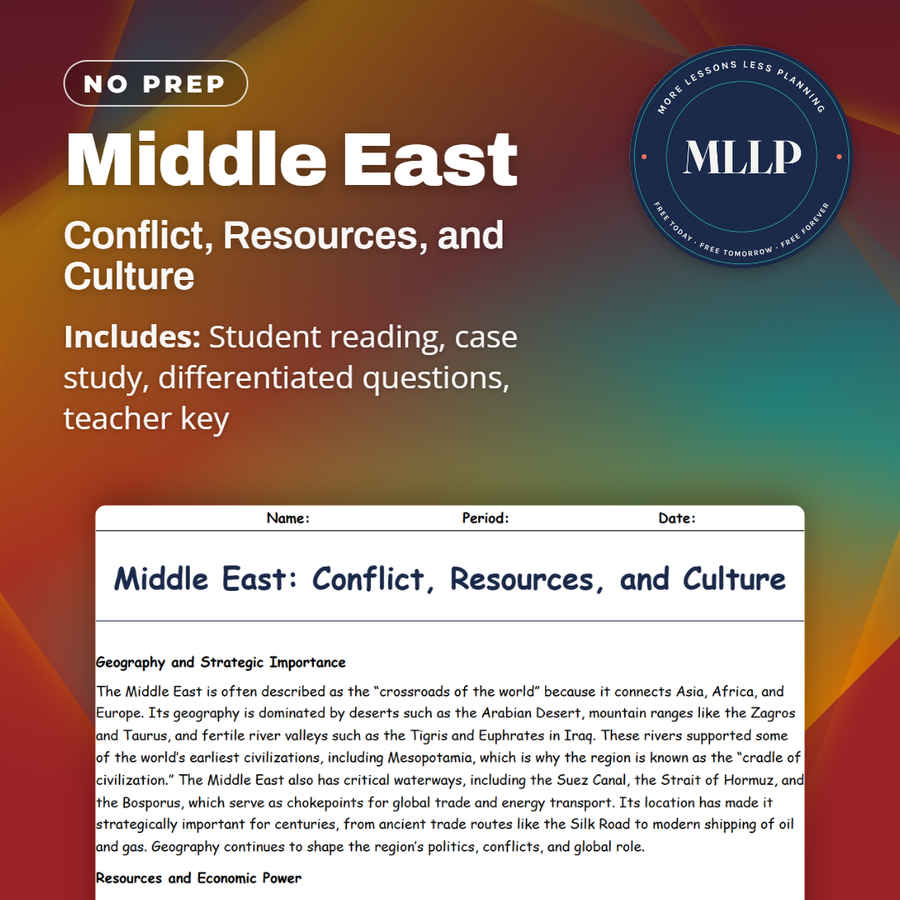
Middle East: Conflict, Resources, and Culture
Quality reviewed September 2026
Facts verified September 14, 2026
- Subject
- Social Studies
- Grades
- Grades 9-12
- Length
- 7-page student worksheet
- Time
- About one 50-minute class period
- Great for
- Sub plans and independent work
- Includes
- Reading passage, comprehension questions + full answer key
- Format
- Print-and-go PDF
What students do
- Match terms like OPEC, the Strait of Hormuz, and the Tigris and Euphrates rivers to their correct definitions
- Fill in the blank sentences on Mesopotamia, the country where the Arab Spring began, and the Suez Canal
- Answer multiple choice questions on the Strait of Hormuz and Suez Canal, major oil-producing countries, and what sparked the Arab Spring
- Write short answers on how oil shapes the region's wealth and challenges, why the Middle East is called a crossroads, and what the Arab Spring changed
What it covers
- The Middle East's geography and strategic waterways, including the Tigris and Euphrates rivers, the Strait of Hormuz, and the Suez Canal
- The region's oil wealth and economic power, including OPEC and Saudi Arabia's Vision 2030 diversification plan
- A case study on the Arab Spring, its start in Tunisia, and its spread across the region
Start reading this worksheet
Geography and Strategic Importance
The Middle East is often described as the “crossroads of the world” because it connects Asia, Africa, and Europe. Its geography is dominated by deserts such as the Arabian Desert, mountain ranges like the Zagros and Taurus, and fertile river valleys such as the Tigris and Euphrates in Iraq. These rivers supported some of the world’s earliest civilizations, including Mesopotamia, which is why the region is known as the “cradle of civilization.” The Middle East also has critical waterways, including the Suez Canal, the Strait of Hormuz, and the Bosporus, which serve as chokepoints for global trade and energy transport. Its location has made it strategically important for centuries, from ancient trade routes like the Silk Road to modern shipping of oil and gas. Geography continues to shape the region’s politics, conflicts, and global role.
Resources and Economic Power
The Middle East is best known for its oil and natural gas reserves, which supply much of the world’s energy. Countries such as Saudi Arabia, Iran, Iraq, and the United Arab Emirates are among the largest producers. Oil wealth has transformed cities like Dubai, Riyadh, and Doha, which now feature modern skylines, airports, and global business centers. The formation of OPEC (Organization of the Petroleum Exporting Countries) in 1960 gave the region collective power to influence oil prices worldwide. However, dependence on oil has created challenges. Price drops can damage economies, and many nations are now investing in diversification. Saudi Arabia’s Vision 2030, for example, seeks to expand industries like tourism, technology, and renewable energy. Meanwhile, countries without significant oil resources, such as Jordan, rely more on agriculture, tourism, and trade. The economic future of the Middle East depends on balancing resource wealth with diversification and sustainability.
Culture and Religion
The Middle East is the birthplace of three of the world’s major monotheistic religions: Judaism, Christianity, and Islam. These faiths have shaped not only the region but the entire world. Islam is the dominant religion, with sacred cities like Mecca and Medina in Saudi Arabia and Jerusalem, which is sacred to all three religions. Religious traditions deeply influence daily life, laws, and cultural practices across the region. Cultural expression in the Middle East is rich and varied. Arabic calligraphy, Persian poetry, Turkish music, and traditional foods like falafel and kebabs are internationally celebrated. At the same time, modern Middle Eastern societies are grappling with balancing tradition and modernization. Young populations push for reforms in education, technology, and gender equality, while cultural pride in ancient heritage remains strong.
Like what you read? The full reading, the case study, and every question set are in the free download below, along with the answer key.
Why this matters
The Strait of Hormuz sits in water that has been a crossroads since the Tigris and Euphrates supported Mesopotamia. The Arab Spring makes the point directly: a protest that started in Tunisia spread across the region.
The Arab Spring case study slows students down, since they lump the region into one story instead of tracing the chain reaction. Vision 2030 complicates the oil-wealth picture further, because a diversification plan only makes sense for a country thinking past its oil.
From one teacher to another
This reading covers the Middle East's geography, oil economy, and religious history in one worksheet. I like that it treats the region as a crossroads, connecting the Tigris and Euphrates rivers to modern chokepoints like the Strait of Hormuz and the Suez Canal. The case study on the Arab Spring gives students a real chain of events to trace, from a protest in Tunisia to uprisings across several countries. This pairs well with a unit on world conflict or global resources.
What you get
Download
Where should I send the next one?
Everything here is free and it stays that way. Leave your email and I'll send you the new lessons as they go up. You can unsubscribe from any one of them.
Related resources
Every lesson on this site is free to download and use. If one of them saved you a prep period, you can chip in a few bucks toward my three kids' daycare fund. That's genuinely where tips go.