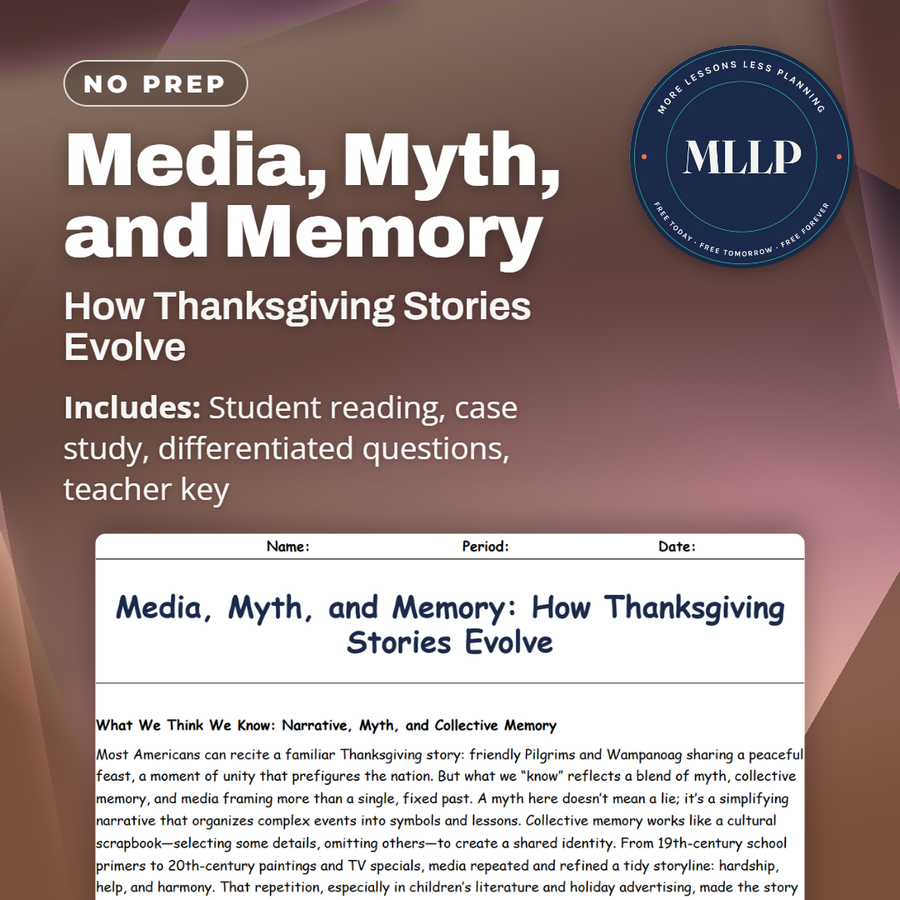
Media, Myth, and Memory: How Thanksgiving Stories Evolve
Quality reviewed September 2026
Facts verified September 9, 2026
- Subject
- Social Studies
- Grades
- Grades 9-12
- Length
- 7-page student worksheet
- Time
- About one 50-minute class period
- Great for
- Sub plans and independent work
- Includes
- Reading passage, comprehension questions + full answer key
- Format
- Print-and-go PDF
What students do
- Distinguish between myth, textbook survey, oral history, academic evidence, and media narratives
- Analyze a 1905 primer, 1973 textbook, and 2023 module to trace how storytelling changes
- Apply sourcing and corroboration skills to evaluate Thanksgiving accounts
- Design a classroom activity linking gratitude rituals to historical evidence
What it covers
- Myth, collective memory, and selective narrative
- Sources in tension (primacy, bias, who gets to author)
- Anachronism, stereotypes, and media simplification
Start reading this worksheet
What We Think We Know: Narrative, Myth, and Collective Memory
Most Americans can recite a familiar Thanksgiving story: friendly Pilgrims and Wampanoag sharing a peaceful feast, a moment of unity that prefigures the nation. But what we “know” reflects a blend of myth, collective memory, and media framing more than a single, fixed past. A myth here doesn’t mean a lie; it’s a simplifying narrative that organizes complex events into symbols and lessons. Collective memory works like a cultural scrapbook: it selects some details, omits others, and creates a shared identity. From 19th-century school primers to 20th-century paintings and TV specials, media repeated and refined a tidy storyline: hardship, help, and harmony. That repetition, especially in children’s literature and holiday advertising, made the story feel natural and timeless. Yet history is evidence-based and contested. Scholars compare primary sources, consider Indigenous oral histories, and ask who authored each account, under what power conditions, and for what audience. When we weigh these different lenses, including myth, memory, media, and scholarship, we see how narratives evolve with changing values and new sources.
Sources in Tension: Textbooks, Oral Histories, and Scholarship
Different sources answer different questions. Textbooks compress centuries into chapters; they prioritize surveyable arcs and often emphasize national cohesion. Oral histories and Indigenous perspectives highlight relationships, land use, sovereignty, and the long-term consequences of colonization: topics that don’t always fit on a cheerful holiday placemat. Historians sift letters, treaties, journals, and archaeology, noting gaps and bias (for example, who had the literacy and paper to leave records?). Meanwhile, media simplifies for broad audiences, using iconic images (buckles, long tables, feathered headdresses) even when they’re anachronistic. Over time, new evidence and social movements alter the center of gravity: where mid-century textbooks spotlighted a near-mythic feast, recent curricula attend more to diplomacy, conflict, and ecology. The point isn’t to discard tradition, but to add context: to ask how stories work, who benefits, and how we can tell them with accuracy and empathy.
Like what you read? The full reading, the case study, and every question set are in the free download below, along with the answer key.
Why this matters
Most students treat a historical story as a fixed transcript instead of something rebuilt every time it gets retold. A 1905 woodcut of a harvest feast shows smiling Pilgrims and unnamed Indians. A 1973 textbook adds disease and treaties to the same scene. A 2023 module pairs a Pilgrim letter with a Wampanoag oral history and a historian's analysis. Three versions of one meal, three stories.
The point is not that any version is a lie. It is that every version is a choice made by whoever tells it. Once students ask who authored a source and what got left out, they carry that habit into their own classroom potluck, annotating dishes with family migration and land history.
From one teacher to another
Most students arrive thinking Thanksgiving is one settled story. This worksheet opens them to how rituals and narratives evolve. The case study tracks a single scene, a harvest feast, through three versions: a 1905 woodcut showing smiling Pilgrims and unnamed Indians, a 1973 textbook sidebar adding disease and treaties, and a 2023 digital module that pairs a Pilgrim letter, a Wampanoag oral history excerpt, and a historian's analysis. Students see that each source is a piece, shaped by its time and author. The FIB and short-answer sections ask them to read images and text like critical historians: Who drew this? When and why? What's missing? Then they practice the skills in their own classroom potluck, annotating each dish with source cards about family migrations and land history. It's not "cancel" Thanksgiving; it's deepening it.
What you get
Download
Where should I send the next one?
Everything here is free and it stays that way. Leave your email and I'll send you the new lessons as they go up. You can unsubscribe from any one of them.
Related resources
Black Friday Forensics: Shoplifting, Organized Theft, and Crowd Violence
Black Friday Smart Shopper: Economics and Personal Finance in Action
Black Friday: Are the “Deals” Actually Good for Shoppers?
Black Friday’s Economic Impact: Who Gains, Who Pays, and What It Means for the Economy
Budget a Feast: Unit Prices, Deals, and Receipts
Colonial Foodways: Indigenous Knowledge and European Adaptation
Every lesson on this site is free to download and use. If one of them saved you a prep period, you can chip in a few bucks toward my three kids' daycare fund. That's genuinely where tips go.