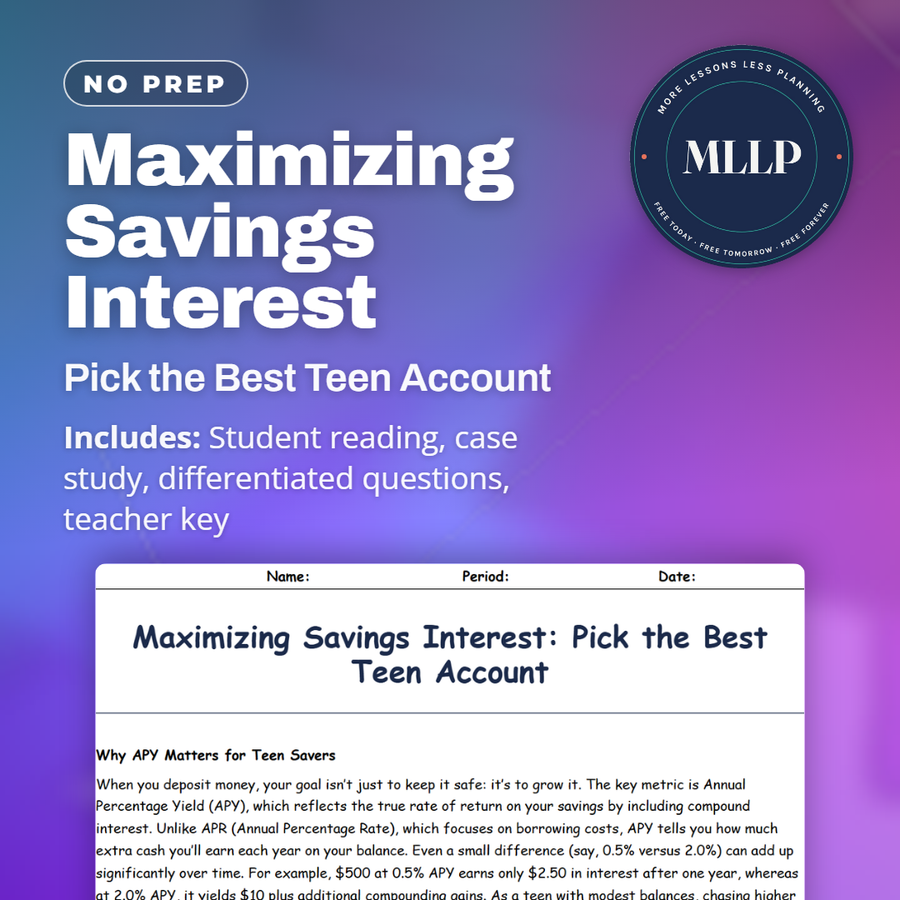
Maximizing Savings Interest: Pick the Best Teen Account
Quality reviewed September 2026
Facts verified September 24, 2026
- Subject
- Career & Life Skills
- Grades
- Grades 9-12
- Length
- 6-page student worksheet
- Time
- About one 50-minute class period
- Great for
- Sub plans and independent work
- Includes
- Reading passage, comprehension questions + full answer key
- Format
- Print-and-go PDF
What students do
- Match five features, daily compounding, no monthly fees, minimum balance, tiered rates, and push notifications, to their benefits
- Fill in the blanks on how a higher APY grows money, which compounding frequency beats the rest, and why rate-check reminders matter
- Answer multiple choice questions on how APY differs from APR, why daily compounding beats monthly, and what a tiered APY structure means
- Write short answers on why a no-fee policy matters for maximizing savings, how splitting money into three buckets supports goals, and two reasons to switch accounts
What it covers
- The difference between APY and APR, and how compound interest grows a $200 deposit to about $206.09 over a year
- A checklist for comparing accounts on minimum balance, compounding frequency, fees, and withdrawal limits
- A case study on Maya, who switched from a 1.0% to a 2.5% APY account and split her savings into three separate buckets
Start reading this worksheet
Why APY Matters for Teen Savers
When you deposit money, your goal isn’t just to keep it safe: it’s to grow it. The key metric is Annual Percentage Yield (APY), which reflects the true rate of return on your savings by including compound interest. Unlike APR (Annual Percentage Rate), which focuses on borrowing costs, APY tells you how much extra cash you’ll earn each year on your balance. Even a small difference (say, 0.5% versus 2.0%) can add up significantly over time. For example, $500 at 0.5% APY earns only $2.50 in interest after one year, whereas at 2.0% APY, it yields $10 plus additional compounding gains. As a teen with modest balances, chasing higher APYs maximizes every dollar you’ve worked to earn and helps you outpace inflation.
Compound Interest: Your Money’s Growth Engine
Compound interest means you earn interest not only on your principal (the original deposit) but also on the interest it has already accrued. Imagine you deposit $200 at 3% APY, compounded monthly. In the first month, you earn $0.50; the next month, you earn interest on $200.50, and so on. Over one year, your balance grows to about $206.09, not just $206.00 as simple interest would deliver. As your balance grows, compounding accelerates, often called the “snowball effect.” Starting early multiplies this advantage: even small weekly deposits of $10 can generate hundreds of dollars extra over four years if placed in a high-yield account.
Features to Look for in Teen Savings Accounts
Not all accounts are created equal. Beyond APY, evaluate these features: A great teen account combines a high APY with no or minimal fees and transparent terms. Daily compounding offers slightly more growth than monthly, and fee waivers (often tied to enrollment in a linked checking account) keep your returns intact. Look for apps that let you set push notifications for rate changes so you never miss a better deal.
Like what you read? The full reading, the case study, and every question set are in the free download below, along with the answer key.
Why this matters
A percentage point or two on an APY sounds small, but Maya's numbers show it more than doubled her actual earnings on the same balance, real money for a teen working babysitting and tutoring jobs. The reading's push toward quarterly rate checks is a habit any student with a savings account can start now, before their money sits in an account paying far less than a competitor down the street.
From one teacher to another
APY and APR sound alike but measure opposite things: APY reflects the true return on savings, including compound interest, while APR measures the cost of borrowing. The reading shows how compounding works, with a $200 deposit at 3% APY compounded monthly growing to about $206.09 in a year rather than a flat $206.00, then gives a checklist covering minimum balance, compounding frequency, fees, and withdrawal limits for comparing accounts. The difference a switch can make runs through the case study: Maya's original 1.0% APY account earned her only $1.50 in six months, but after moving her $300 to a 2.5% APY credit union account with no fees, she earned $3.78 in the same span and eventually split her savings into three buckets for a phone fund, college, and emergencies.
What you get
Download
Where should I send the next one?
Everything here is free and it stays that way. Leave your email and I'll send you the new lessons as they go up. You can unsubscribe from any one of them.
Related resources

Big Purchase Planning: Save for Gadgets & More
Buy Now, Pay Later: Teen’s Guide to Safe Installment Plans
Credit Reports Uncovered: Monitor & Dispute Errors
Emergency Budget Blueprint: Teens’ Step-by-Step Guide
Finance Jargon Buster: Essential Terms for Teens
Hidden Bank Fees: Slash Your Sneaky Charges
Every lesson on this site is free to download and use. If one of them saved you a prep period, you can chip in a few bucks toward my three kids' daycare fund. That's genuinely where tips go.