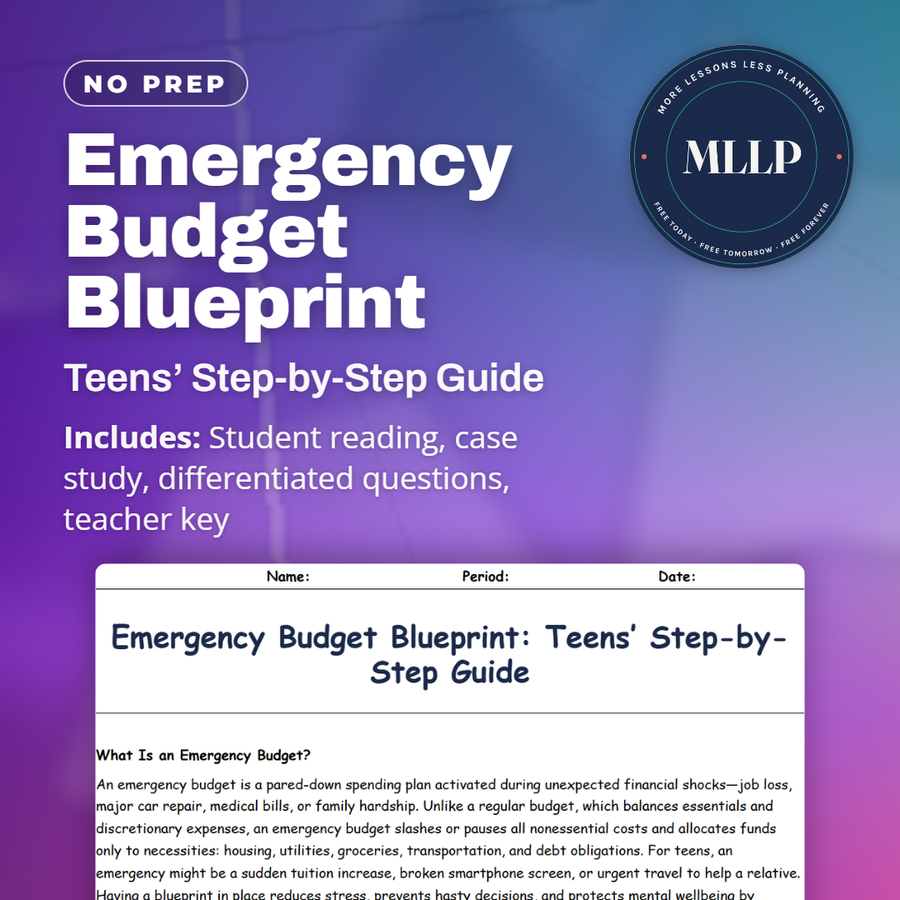
Emergency Budget Blueprint: Teens’ Step-by-Step Guide
Quality reviewed September 2026
Facts verified September 24, 2026
- Subject
- Career & Life Skills
- Grades
- Grades 9-12
- Length
- 6-page student worksheet
- Time
- About one 50-minute class period
- Great for
- Sub plans and independent work
- Includes
- Reading passage, comprehension questions + full answer key
- Format
- Print-and-go PDF
What students do
- Match five tools, emergency budget template, side hustles, expense tracker, weekly check-in, and savings cushion, to their purposes
- Fill in the blanks on pausing nonessential expenses, building a savings cushion, and checking in daily during a crisis
- Answer multiple choice questions on what an emergency budget cuts first, what a fill-in-the-blank template clarifies, and what financial resilience combines
- Write short answers on two nonessential expenses Kayla paused, why check-ins with friends help during money stress, and how to cover a $150 emergency with a side hustle
What it covers
- The difference between essentials like rent, groceries, and minimum debt payments and nonessentials like streaming and dining out
- A fill-in-the-blank template for calculating income, essential expenses, and how much to shift into savings
- A case study on Kayla, whose car transmission failed and who booked lawn-mowing and babysitting jobs to cover an $800 repair
Start reading this worksheet
What Is an Emergency Budget?
An emergency budget is a pared-down spending plan activated during unexpected financial shocks—job loss, major car repair, medical bills, or family hardship. Unlike a regular budget, which balances essentials and discretionary expenses, an emergency budget slashes or pauses all nonessential costs and allocates funds only to necessities: housing, utilities, groceries, transportation, and debt obligations. For teens, an emergency might be a sudden tuition increase, broken smartphone screen, or urgent travel to help a relative. Having a blueprint in place reduces stress, prevents hasty decisions, and protects mental wellbeing by providing clarity on exactly where every dollar goes during a crisis.
Essentials vs. Nonessentials
To build your emergency plan, list monthly expenses under two columns: Essentials and Nonessentials. Essentials include rent or allowance for room/board, phone and internet (up to the minimum plan), groceries, transportation to school/work, and minimum debt payments. Nonessentials cover streaming subscriptions, dining out, entertainment, hobby supplies, and extra apparel. Here’s an example breakdown for a typical teen: Once you identify cuts, fill in a template to calculate savings per category. For instance, pausing a $10/month streaming service frees $2.50/week.
Fill-in-the-Blank Template
Total monthly income: $__________ Sum of essential expenses: $__________ Available for nonessentials: $__________ Proposed emergency spending limit: $__________ Amount to shift to savings/emergency fund: $__________ Use these figures to set weekly targets: divide your emergency fund goal by the number of weeks you anticipate using this budget.
Like what you read? The full reading, the case study, and every question set are in the free download below, along with the answer key.
Why this matters
A surprise expense like a broken phone screen or a failed transmission can derail a student's whole budget overnight, and the reading gives them a plan to follow instead of panicking. It also connects money stress to sleep and anxiety, a real pattern for teens juggling school, work, and a sudden bill, and shows that a weekend gig can close a gap that feels impossible at first glance.
From one teacher to another
An emergency budget, as the reading describes it, is a stripped-down plan for a sudden financial shock, like a job loss or a broken phone screen, that pauses every nonessential expense and funnels money into housing, food, transportation, and debt payments. Students sort a sample teen budget into essentials and nonessentials, then fill in a blank template that calculates income, essential costs, and how much is left over to save each week. A section on side hustles shows how a temporary gig, like dog walking or tutoring, can close a cash gap, and a section on financial resilience ties budgeting to daily check-ins and small wins. Kayla's transmission failure drives the case study: she paused $120 in nonessential spending, booked three lawn jobs and two babysitting sessions in one weekend, and saved $330 toward her $800 repair by week three.
What you get
Download
Where should I send the next one?
Everything here is free and it stays that way. Leave your email and I'll send you the new lessons as they go up. You can unsubscribe from any one of them.
Related resources
Big Purchase Planning: Save for Gadgets & More
Buy Now, Pay Later: Teen’s Guide to Safe Installment Plans
Credit Reports Uncovered: Monitor & Dispute Errors
Finance Jargon Buster: Essential Terms for Teens
Hidden Bank Fees: Slash Your Sneaky Charges
Inflation Explained: Protect Teen Buying Power
Every lesson on this site is free to download and use. If one of them saved you a prep period, you can chip in a few bucks toward my three kids' daycare fund. That's genuinely where tips go.