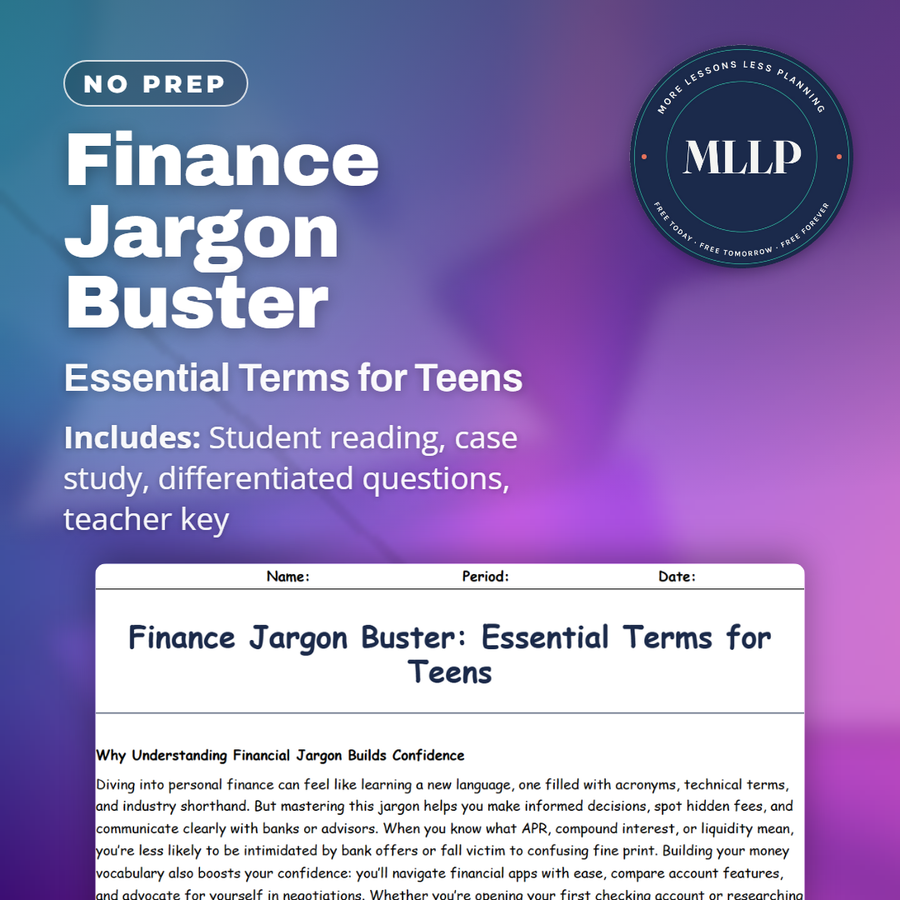
Finance Jargon Buster: Essential Terms for Teens
Quality reviewed September 2026
Facts verified September 24, 2026
- Subject
- Career & Life Skills
- Grades
- Grades 9-12
- Length
- 8-page student worksheet
- Time
- About one 50-minute class period
- Great for
- Sub plans and independent work
- Includes
- Reading passage, comprehension questions + full answer key
- Format
- Print-and-go PDF
What students do
- Match five terms, APY, principal, dividend, escrow, and index fund, to their benefits
- Fill in the blanks on compound interest, liquidity, and APR
- Answer multiple choice questions on what APR measures, how compound interest differs from simple interest, and what liquidity means
- Write short answers on why volatility matters for teen investors, how a teen could start investing with an index fund, and two ways online glossaries help
What it covers
- A 15-term glossary covering APR, APY, principal, compound interest, liquidity, dividends, escrow, collateral, and equity
- Real-world examples tying each term to teen life, like calculating compound interest on a $200 deposit
- A case study on Sophia, who built flashcards to learn the terms before negotiating a savings account deal with her banker
Start reading this worksheet
Why Understanding Financial Jargon Builds Confidence
Diving into personal finance can feel like learning a new language, one filled with acronyms, technical terms, and industry shorthand. But mastering this jargon helps you make informed decisions, spot hidden fees, and communicate clearly with banks or advisors. When you know what APR, compound interest, or liquidity mean, you’re less likely to be intimidated by bank offers or fall victim to confusing fine print. Building your money vocabulary also boosts your confidence: you’ll navigate financial apps with ease, compare account features, and advocate for yourself in negotiations. Whether you’re opening your first checking account or researching investment apps, a strong glossary of terms is your secret weapon for lifelong financial success.
Core Financial Terms
Below is a handy reference of 15 essential personal-finance terms. Study the definitions and real-world examples to see how each term applies to everyday teen life.
Building Your Money Vocabulary
Now that you have this table, practice using each term in context. For example, calculate the compound interest on $200 at 3% APY, or check your favorite brand’s volatility by tracking its stock price over a week. Use flashcards or a free glossary app (like Investopedia) to quiz yourself. Teaching these terms to a friend or family member cements your understanding and helps them, too!
Like what you read? The full reading, the case study, and every question set are in the free download below, along with the answer key.
Why this matters
Banking apps, loan offers, and investment platforms are full of terms that sound similar but mean very different things, and a student who can't tell APR from APY is more likely to sign up for a worse deal without realizing it. Sophia's story shows why this pays off beyond a quiz, since she used the vocabulary to ask her banker the right question and land a better rate.
From one teacher to another
This reading builds a 15-term glossary of personal-finance vocabulary, pairing each term with a teen-friendly example, like explaining that a 15% APR on a credit card means $15 in interest per $100 borrowed each year, or that a $100 deposit at 5% APY compounds to $105 and then $110.25 the next year. It also covers liquidity, escrow, collateral, equity, and volatility, then points students toward Investopedia, the CFPB glossary, and Khan Academy for looking up anything unfamiliar. The payoff comes in the case study, where Sophia built flashcards for all 15 terms, quizzed her brother on the bus, then used her grasp of APY and liquidity to ask her banker informed questions and negotiate a fee waiver.
What you get
Download
Where should I send the next one?
Everything here is free and it stays that way. Leave your email and I'll send you the new lessons as they go up. You can unsubscribe from any one of them.
Related resources
Big Purchase Planning: Save for Gadgets & More
Buy Now, Pay Later: Teen’s Guide to Safe Installment Plans
Credit Reports Uncovered: Monitor & Dispute Errors
Emergency Budget Blueprint: Teens’ Step-by-Step Guide
Hidden Bank Fees: Slash Your Sneaky Charges
Inflation Explained: Protect Teen Buying Power
Every lesson on this site is free to download and use. If one of them saved you a prep period, you can chip in a few bucks toward my three kids' daycare fund. That's genuinely where tips go.