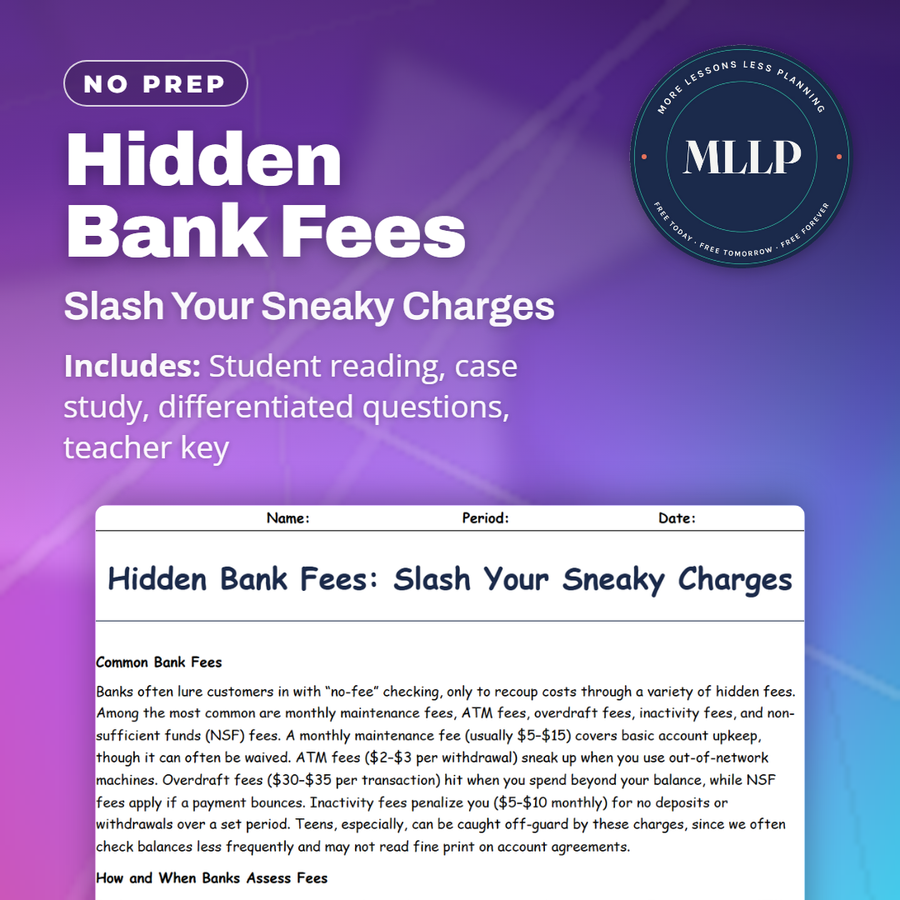
Hidden Bank Fees: Slash Your Sneaky Charges
Quality reviewed September 2026
Facts verified September 24, 2026
- Subject
- Career & Life Skills
- Grades
- Grades 9-12
- Length
- 7-page student worksheet
- Time
- About one 50-minute class period
- Great for
- Sub plans and independent work
- Includes
- Reading passage, comprehension questions + full answer key
- Format
- Print-and-go PDF
What students do
- Match five fee types, ATM fees, overdraft fees, non-sufficient funds fees, monthly maintenance fees, and inactivity fees, to their definitions
- Fill in the blanks on a separate savings account, setting up direct deposit, and reviewing monthly statements
- Answer multiple choice questions on which fee applies to out-of-network ATMs, when an overdraft fee applies, and how to avoid a monthly maintenance fee
- Write short answers on two strategies to avoid ATM and overdraft fees, how a minimum balance requirement helps, and why digital statements reduce certain fees
What it covers
- Common bank fees including monthly maintenance, ATM, overdraft, inactivity, and non-sufficient funds fees, with typical dollar ranges
- How and when banks trigger each fee, from an out-of-network withdrawal to 12 to 24 months of account inactivity
- A case study on Emma, who racked up a $45 maintenance fee, three ATM fees, and a $32 overdraft fee on an account advertised as free
Start reading this worksheet
Common Bank Fees
Banks often lure customers in with “no‐fee” checking, only to recoup costs through a variety of hidden fees. Among the most common are monthly maintenance fees, ATM fees, overdraft fees, inactivity fees, and non‐sufficient funds (NSF) fees. A monthly maintenance fee (usually $5–$15) covers basic account upkeep, though it can often be waived. ATM fees ($2–$3 per withdrawal) sneak up when you use out-of-network machines. Overdraft fees ($30–$35 per transaction) hit when you spend beyond your balance, while NSF fees apply if a payment bounces. Inactivity fees penalize you ($5–$10 monthly) for no deposits or withdrawals over a set period. Teens, especially, can be caught off-guard by these charges, since we often check balances less frequently and may not read fine print on account agreements.
How and When Banks Assess Fees
Banks use automated systems to trigger fees, often within seconds of a transaction. For example, an ATM fee is assessed the moment you confirm a withdrawal at a non-partner ATM; you’ll see it on your statement almost instantly. A monthly maintenance fee is applied on the same date each month, typically linked to your account opening or first deposit date. Overdraft fees hit whenever a debit, check, or recurring payment exceeds your available balance, even if you cover it later that day. Some banks charge multiple overdrafts per day. NSF fees function similarly but are triggered when a check or electronic payment is returned for insufficient funds. Inactivity fees begin after 12–24 months of dormancy; banks advertise “free checking,” then quietly charge you if you don’t log in or transact. Understanding these triggers helps you anticipate and avoid unnecessary charges.
Like what you read? The full reading, the case study, and every question set are in the free download below, along with the answer key.
Why this matters
An account marketed as fee-free can still cost fifty or more dollars a month once maintenance charges, ATM fees, and one overdraft stack up, and most teens check their balance too rarely to catch it early. Emma's fix, from direct deposit to a separate bill-pay account, is something any student with a part-time paycheck can copy the next time they open or review a checking account.
From one teacher to another
Five sneaky bank fees get broken down in this reading: a $5 to $15 monthly maintenance fee, a $2 to $3 out-of-network ATM fee, a $30 to $35 overdraft fee, an NSF fee for a bounced payment, and a $5 to $10 inactivity fee after 12 to 24 months of no activity. It explains exactly when each one hits, like an ATM fee posting the moment you confirm a withdrawal at a non-partner machine, and lists five strategies including minimum balances, direct deposit, e-statements, and linking a savings account. What happens without those strategies is the case study: Emma's account, advertised as fee-free, hit her with a $45 maintenance charge, three $2.50 ATM fees, and a $32 overdraft fee after a surprise parking charge, until she set up direct deposit and switched to in-network ATMs.
What you get
Download
Where should I send the next one?
Everything here is free and it stays that way. Leave your email and I'll send you the new lessons as they go up. You can unsubscribe from any one of them.
Related resources

Big Purchase Planning: Save for Gadgets & More
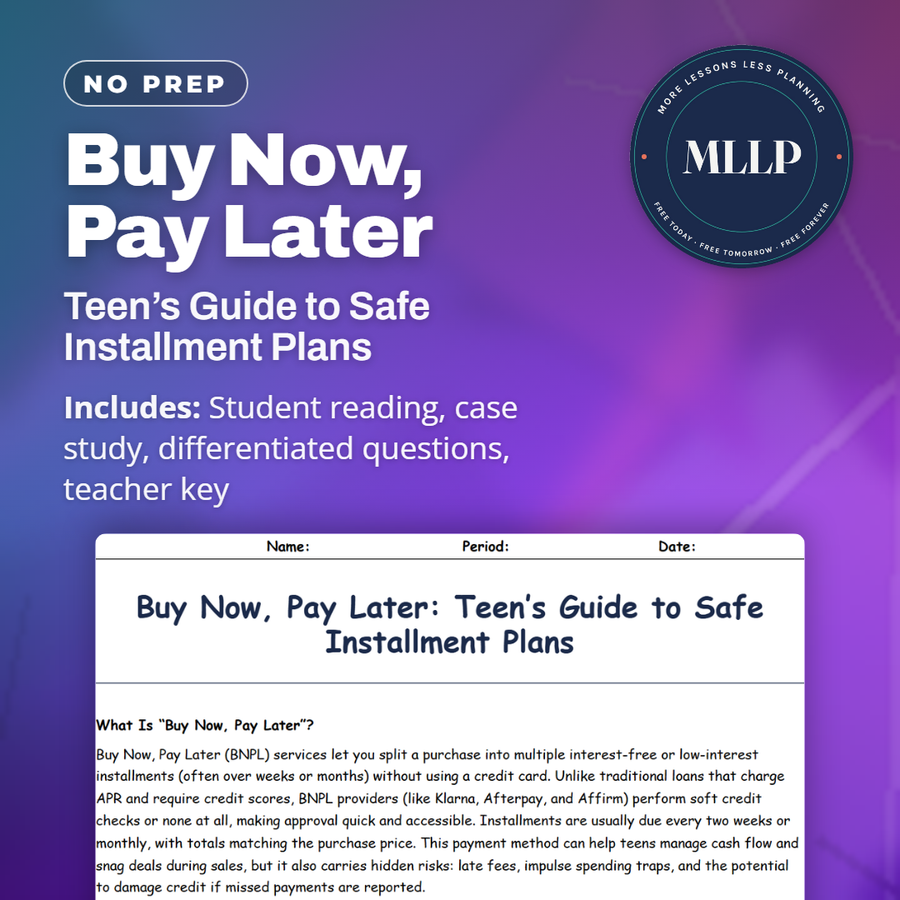
Buy Now, Pay Later: Teen’s Guide to Safe Installment Plans
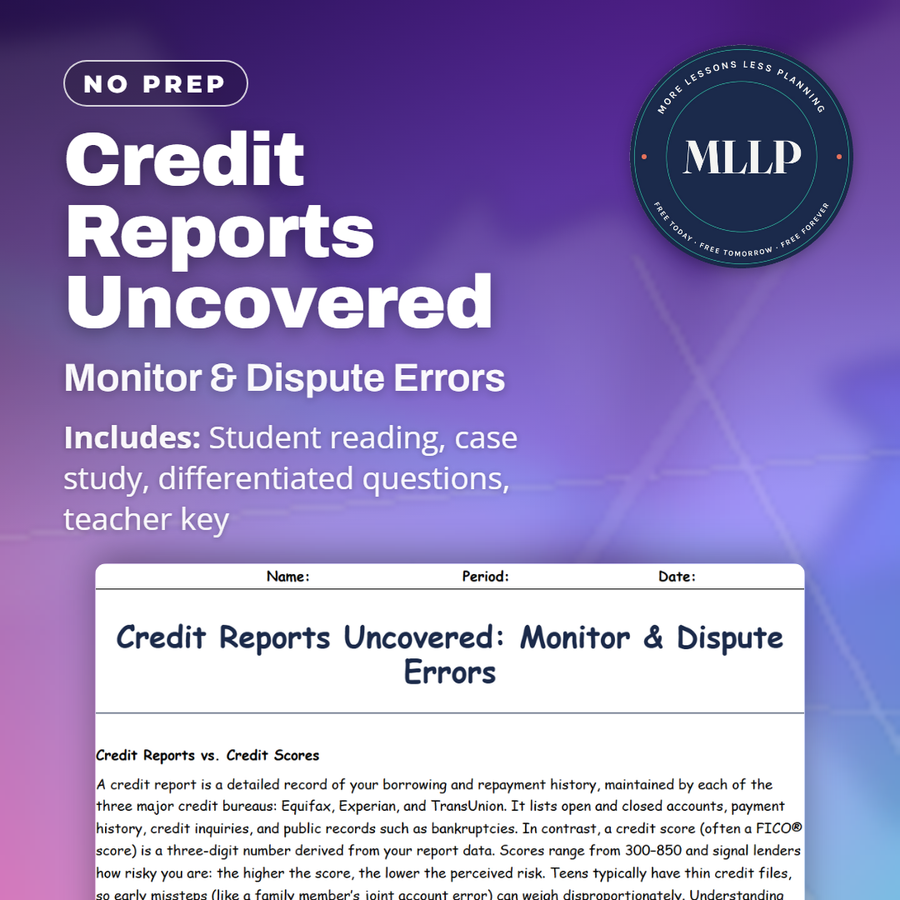
Credit Reports Uncovered: Monitor & Dispute Errors
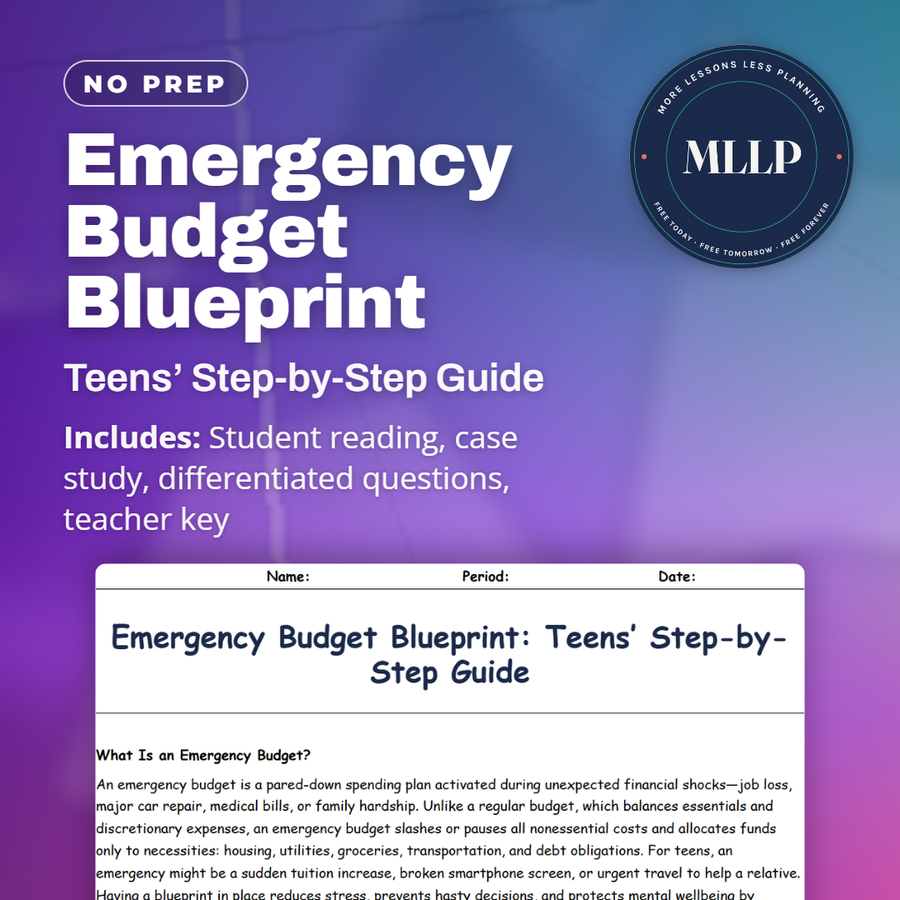
Emergency Budget Blueprint: Teens’ Step-by-Step Guide
Finance Jargon Buster: Essential Terms for Teens
Inflation Explained: Protect Teen Buying Power
Every lesson on this site is free to download and use. If one of them saved you a prep period, you can chip in a few bucks toward my three kids' daycare fund. That's genuinely where tips go.