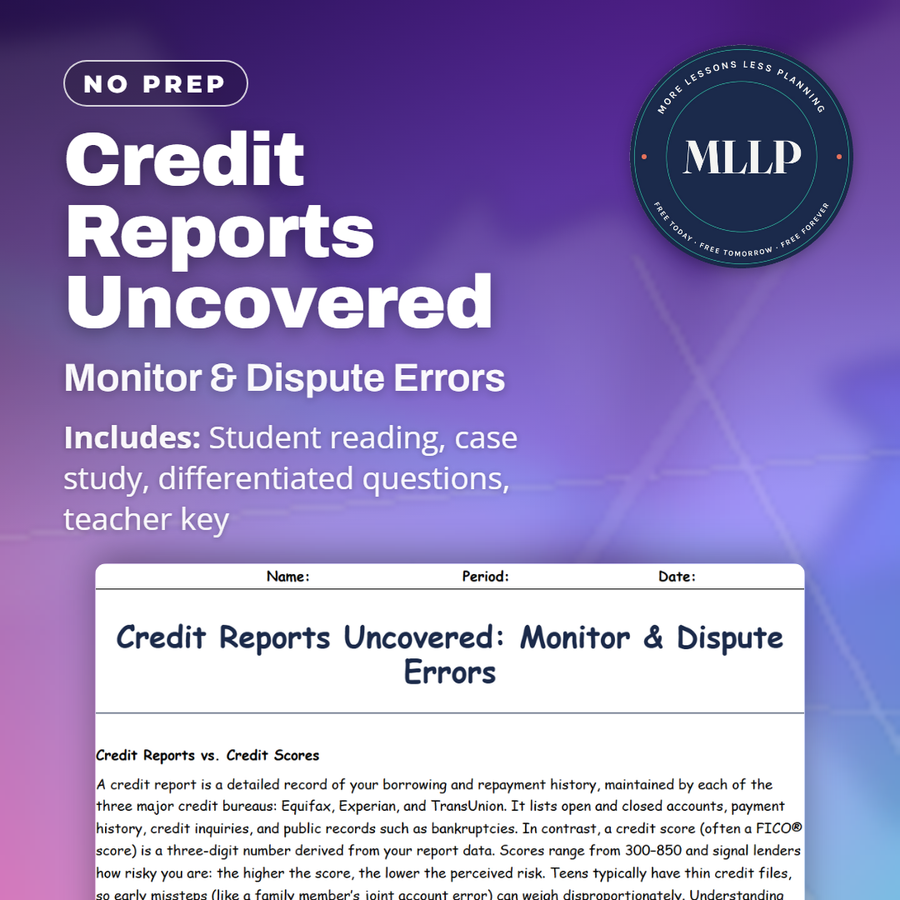
Credit Reports Uncovered: Monitor & Dispute Errors
Quality reviewed September 2026
Facts verified September 24, 2026
- Subject
- Career & Life Skills
- Grades
- Grades 9-12
- Length
- 7-page student worksheet
- Time
- About one 50-minute class period
- Great for
- Sub plans and independent work
- Includes
- Reading passage, comprehension questions + full answer key
- Format
- Print-and-go PDF
What students do
- Match five terms, AnnualCreditReport.com, fraud alert, dispute letter, credit freeze, and FICO score, to their definitions
- Fill in the blanks on the 30-day investigation window, writing a dispute letter, and how long an extended fraud alert lasts
- Answer multiple choice questions on the Fair Credit Reporting Act, what a credit freeze does, and how to spot unauthorized accounts fastest
- Write short answers on why duplicate accounts hurt a score, why certified mail matters in a dispute, and two benefits of a fraud alert
What it covers
- The difference between a credit report from Equifax, Experian, and TransUnion and a three-digit FICO score
- How to pull free annual reports and spot errors like a wrong address, a duplicate account, or an account you never opened
- A case study on Liam, who found a $1,200 auto loan on his TransUnion report that he never took out
Start reading this worksheet
Credit Reports vs. Credit Scores
A credit report is a detailed record of your borrowing and repayment history, maintained by each of the three major credit bureaus: Equifax, Experian, and TransUnion. It lists open and closed accounts, payment history, credit inquiries, and public records such as bankruptcies. In contrast, a credit score (often a FICO® score) is a three-digit number derived from your report data. Scores range from 300–850 and signal lenders how risky you are: the higher the score, the lower the perceived risk. Teens typically have thin credit files, so early missteps (like a family member’s joint account error) can weigh disproportionately. Understanding the difference helps you focus both on building positive habits (on-time payments) and on keeping your reports error-free.
Accessing Your Free Annual Reports
Under federal law, you can get one free copy of each bureau’s credit report every 12 months via AnnualCreditReport.com. When ordering, you’ll provide personal details (name, address, Social Security number) and answer security questions (e.g., past loans). After viewing your report, download and save a PDF for your records. Some states also allow more frequent free reports. Since 2023 the three bureaus have also offered free weekly online reports through the same site, so the 12-month rule is the legal floor and not a limit on how often you can look. In addition, many banks and credit-card issuers now offer free quarterly or monthly credit-score snapshots; although these aren’t the full report, they help you spot sudden dips. Use a simple table to track when you last pulled each report: By staggering your requests (one bureau every four months), you see a fresh report three times a year and cover your full credit profile once a year, without any cost.
Common Errors and Their Impact
Credit reports often contain mistakes: wrong address, duplicate accounts, outdated public records, or even accounts you never opened (a sign of identity theft). Such errors can drag your score down by 20–100 points, affecting your ability to rent apartments, qualify for low-interest loans, or even land certain jobs. For instance, a medical bill reported erroneously as a delinquent credit-card account could remain on your file for seven years unless corrected. Always scan each section (personal information, accounts, inquiries, and public records) and circle any discrepancy. Note the account name, original creditor, date opened, and balance. Keeping vigilant protects your future: as you build a history of responsible borrowing, you don’t want an old mistake to follow you into adulthood.
Like what you read? The full reading, the case study, and every question set are in the free download below, along with the answer key.
Why this matters
A thin credit file means one error, like an account opened by an identity thief, carries more weight than it would on an adult's longer history, so catching it early matters more for a teenager than it might later on. The reading also points out that free weekly reports have been available since 2023, which is worth knowing since most people still assume the once-a-year rule is the only option they have.
From one teacher to another
Students first read about the difference between a credit report, which lists every account and inquiry from Equifax, Experian, and TransUnion, and a FICO score, the three-digit number lenders calculate from that data. The reading walks through pulling a free report from AnnualCreditReport.com, then flags common errors such as a wrong address, a duplicate account, or an account opened by someone else, any of which can knock 20 to 100 points off a score. It also lays out the dispute process under the Fair Credit Reporting Act, including a sample letter format and the 30-day window bureaus have to investigate. Liam's case shows this in action: a $1,200 auto loan showed up on all three of his reports, and he cleared it with a school enrollment letter, his ID, and certified dispute letters before adding an extended fraud alert.
What you get
Download
Where should I send the next one?
Everything here is free and it stays that way. Leave your email and I'll send you the new lessons as they go up. You can unsubscribe from any one of them.
Related resources

Big Purchase Planning: Save for Gadgets & More
Buy Now, Pay Later: Teen’s Guide to Safe Installment Plans
Emergency Budget Blueprint: Teens’ Step-by-Step Guide
Finance Jargon Buster: Essential Terms for Teens
Hidden Bank Fees: Slash Your Sneaky Charges
Inflation Explained: Protect Teen Buying Power
Every lesson on this site is free to download and use. If one of them saved you a prep period, you can chip in a few bucks toward my three kids' daycare fund. That's genuinely where tips go.