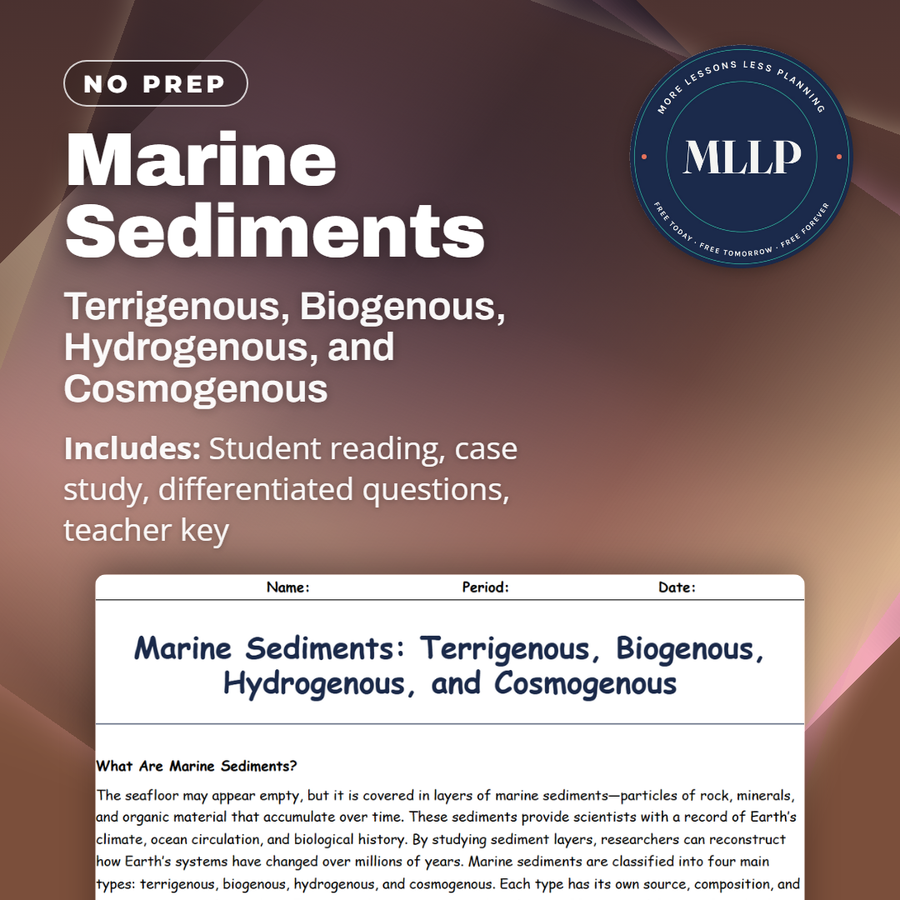
Marine Sediments: Terrigenous, Biogenous, Hydrogenous, and Cosmogenous
Quality reviewed September 2026
Facts verified September 14, 2026
- Subject
- Science
- Grades
- Grades 9-12
- Length
- 6-page student worksheet
- Time
- About one 50-minute class period
- Great for
- Sub plans and independent work
- Includes
- Reading passage, comprehension questions + full answer key
- Format
- Print-and-go PDF
What students do
- Match terms like Terrigenous, Biogenous, Hydrogenous, Cosmogenous, and White Cliffs of Dover to their correct definitions
- Fill in the blank sentences on sediments from eroded rock, plankton shells, and space dust
- Answer multiple choice questions on which sediment type comes from land erosion, which forms from plankton shells, and what manganese nodules are an example of
- Write short answers on why terrigenous sediments get finer with distance from land, what makes hydrogenous sediments economically valuable, and how biogenous sediments reveal past climates, using the case study on the White Cliffs of Dover
What it covers
- The four types of marine sediment, including terrigenous, biogenous, hydrogenous, and cosmogenous
- How sediment layers record Earth's climate, ocean circulation, and biological history
- A case study on the White Cliffs of Dover, formed from ancient biogenous plankton deposits
Start reading this worksheet
What Are Marine Sediments?
The seafloor may appear empty, but it is covered in layers of marine sediments—particles of rock, minerals, and organic material that accumulate over time. These sediments provide scientists with a record of Earth’s climate, ocean circulation, and biological history. By studying sediment layers, researchers can reconstruct how Earth’s systems have changed over millions of years. Marine sediments are classified into four main types: terrigenous, biogenous, hydrogenous, and cosmogenous. Each type has its own source, composition, and importance to marine geology. Together, they create a complex picture of how material moves from land, sea, and even space into the ocean.
Terrigenous Sediments
Terrigenous sediments come from land. They are made up of eroded rock, transported by rivers, wind, glaciers, or volcanic eruptions into the sea. The Amazon River, for example, delivers billions of tons of sediment into the Atlantic Ocean each year. These sediments cover large portions of the continental margins and abyssal plains, influencing the shape of the seafloor. Terrigenous material is usually coarse near its source but becomes finer the farther it travels. Sands and silts settle near shorelines, while clays can drift thousands of miles before settling. Terrigenous sediments are essential because they record the history of Earth’s landscapes and provide nutrients to coastal ecosystems.
Biogenous Sediments
Biogenous sediments are formed from the remains of living organisms. Microscopic plankton, such as foraminifera (with calcium carbonate shells) and radiolarians (with silica skeletons), die and fall to the seafloor, creating deposits called oozes. These oozes are important for paleoclimatology because the chemical makeup of shells records past ocean conditions. Over millions of years, biogenous sediments can form chalks, limestones, or siliceous rocks. The famous White Cliffs of Dover in England are made of ancient biogenous deposits. These sediments are key indicators of biological productivity and past environmental change.
Like what you read? The full reading, the case study, and every question set are in the free download below, along with the answer key.
Why this matters
The White Cliffs of Dover are made of chalk, and that chalk is made of plankton shells that piled up on an ancient seafloor over millions of years. That landform opens this reading's tour of the four types of marine sediment: material washed in from land, material built from plankton shells, minerals formed by chemical reactions in seawater, and dust that arrives from space.
I like starting this unit by asking what students picture at the bottom of the ocean, since most say nothing, empty space. Sediment layers prove otherwise, recording past climates and ocean circulation over time, and a cliff of chalk in England turns out to be that record written one plankton shell at a time.
From one teacher to another
Not all sand at the bottom of the ocean got there the same way, and this worksheet sorts marine sediments into four categories based on where they come from. It covers terrigenous sediment washed in from land, biogenous sediment formed from plankton shells, hydrogenous sediment formed by chemical reactions in seawater, and cosmogenous dust from space. The case study on the White Cliffs of Dover shows how biogenous sediment can build up over millions of years into a famous landform.
What you get
Download
Where should I send the next one?
Everything here is free and it stays that way. Leave your email and I'll send you the new lessons as they go up. You can unsubscribe from any one of them.
Related resources
Continental Drift and Seafloor Spreading Made Simple
Continental Margins: Active vs. Passive Boundaries
Earth’s Layers and Plate Tectonics Explained
Geological Hazards: Tsunamis, Undersea Earthquakes, and Landslides
Hydrothermal Vents and Their Ecosystems
Marine Geology and Natural Resources
Every lesson on this site is free to download and use. If one of them saved you a prep period, you can chip in a few bucks toward my three kids' daycare fund. That's genuinely where tips go.