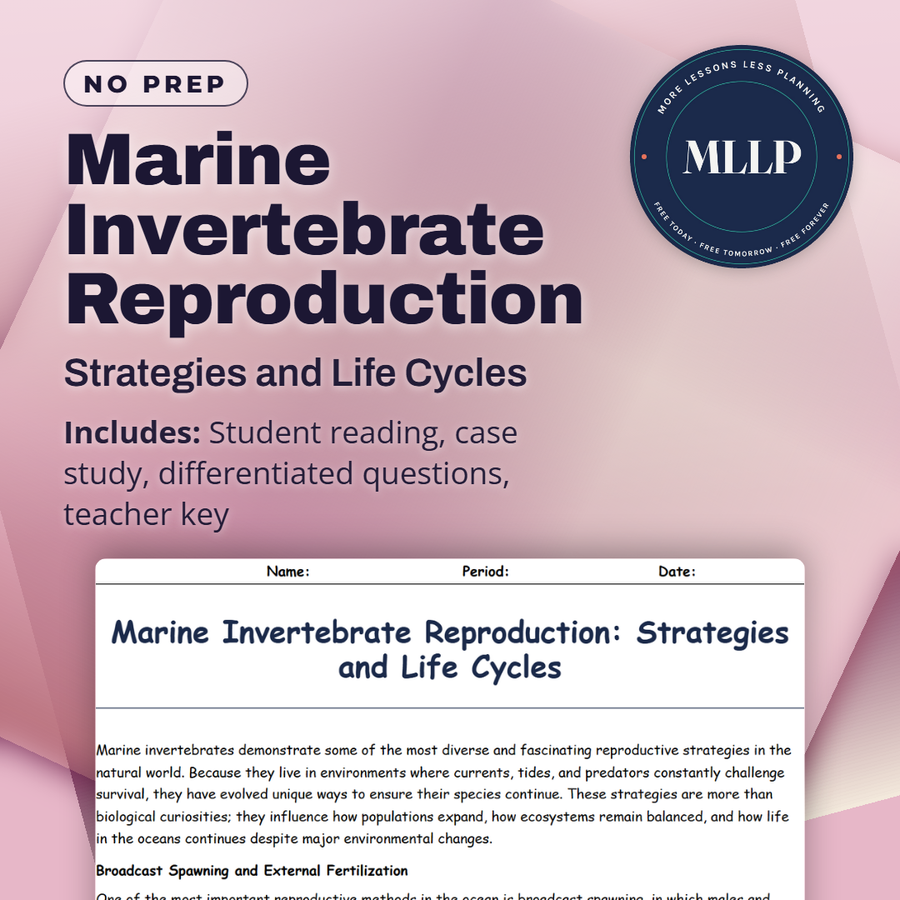
Marine Invertebrate Reproduction: Strategies and Life Cycles
Quality reviewed September 2026
Facts verified September 14, 2026
- Subject
- Science
- Grades
- Grades 9-12
- Length
- 6-page student worksheet
- Time
- About one 50-minute class period
- Great for
- Sub plans and independent work
- Includes
- Reading passage, comprehension questions + full answer key
- Format
- Print-and-go PDF
What students do
- Match terms like broadcast spawning, brooding, budding, larval stage, and external fertilization to their correct definitions
- Fill in the blank sentences on how crabs carry their eggs, how sponges reproduce asexually, and what coral spawning is timed to
- Answer multiple choice questions on broadcast spawning, the advantage of a larval stage, and which invertebrates alternate between polyp and medusa forms
- Write short answers on why releasing millions of eggs can pay off, how larval stages spread biodiversity, how broadcast spawning and brooding trade off, and why synchronized timing matters for coral spawning success
What it covers
- The range of reproductive strategies marine invertebrates use, including broadcast spawning, brooding, and budding
- How drifting larval stages help invertebrates disperse to new habitats despite the risks
- A case study on synchronized coral spawning events and the threat that warming, acidic oceans pose to them
Start reading this worksheet
Marine invertebrates demonstrate some of the most diverse and fascinating reproductive strategies in the natural world. Because they live in environments where currents, tides, and predators constantly challenge survival, they have evolved unique ways to ensure their species continue. These strategies are more than biological curiosities; they influence how populations expand, how ecosystems remain balanced, and how life in the oceans continues despite major environmental changes.
Broadcast Spawning and External Fertilization
One of the most important reproductive methods in the ocean is broadcast spawning, in which males and females release their eggs and sperm directly into the surrounding water. Fertilization then takes place externally. This strategy is especially common in corals, sea urchins, and bivalves. Since the chances of any one egg or sperm cell meeting in the vast ocean are low, many of these animals release gametes all at once and in enormous numbers. Synchronization is often guided by lunar cycles or seasonal changes in temperature. Releasing millions of eggs at once increases the odds of success, while also overwhelming predators who feed on gametes. The downside, however, is that most of the offspring will never survive to adulthood. This strategy focuses on producing quantity rather than providing protection to each individual.
Brooding and Parental Care
Not all marine invertebrates take the “quantity over quality” approach. Some species, including certain crustaceans like crabs and shrimp, use brooding strategies. In these cases, females carry their fertilized eggs either inside their bodies or attached externally until the young are ready to hatch. Brooding provides much greater protection for embryos and results in a higher survival rate, but it limits the number of offspring that can be carried at once. Other species attach eggs to rocks, seaweed, or even the ocean floor, where they remain until hatching. By offering shelter, these parents invest more energy in each individual offspring, trading off large numbers for higher chances of survival. This strategy highlights how different reproductive methods reflect the balance between energy investment and survival odds.
Like what you read? The full reading, the case study, and every question set are in the free download below, along with the answer key.
Why this matters
On a schedule timed to the full moon, thousands of coral colonies on the same reef release eggs and sperm into the water together. That synchronized spawning event opens a tour through the range of ways invertebrates reproduce, from crabs that carry their eggs to sponges that bud off new individuals asexually.
Students often think synchronized coral spawning sounds unnecessarily risky, and that is exactly the point I want them to sit with. Timing has to be nearly perfect for broadcast spawning to work at all, which is why warming and acidifying oceans threatening that synchronization is such a serious problem rather than a minor disruption.
From one teacher to another
Marine invertebrates reproduce in ways that would look strange on land, from releasing eggs and sperm straight into open water to carrying fertilized eggs until the young are ready to hatch. This worksheet lays out the tradeoffs behind broadcast spawning, brooding, budding, and drifting larval stages, showing why each strategy fits a different survival bet. The case study on coral spawning events describes how thousands of coral colonies release eggs and sperm together, often in sync with the full moon, and how warming and acidifying oceans threaten that timing. Students practice matching strategy to definition before reasoning through what climate change could do to a process that depends on precise synchronization.
What you get
Download
Where should I send the next one?
Everything here is free and it stays that way. Leave your email and I'll send you the new lessons as they go up. You can unsubscribe from any one of them.
Related resources
Adaptations for Survival: Camouflage, Shells, and Toxins
Arthropods of the Sea: Crabs, Lobsters, and Shrimp
Cnidarians: Corals, Jellyfish, and Sea Anemones
Echinoderms: Sea Stars and Sea Urchins
Exploring Marine Invertebrates: Diversity Beneath the Waves
Invertebrates in Food Webs: Ecosystem Engineers of the Sea
Every lesson on this site is free to download and use. If one of them saved you a prep period, you can chip in a few bucks toward my three kids' daycare fund. That's genuinely where tips go.