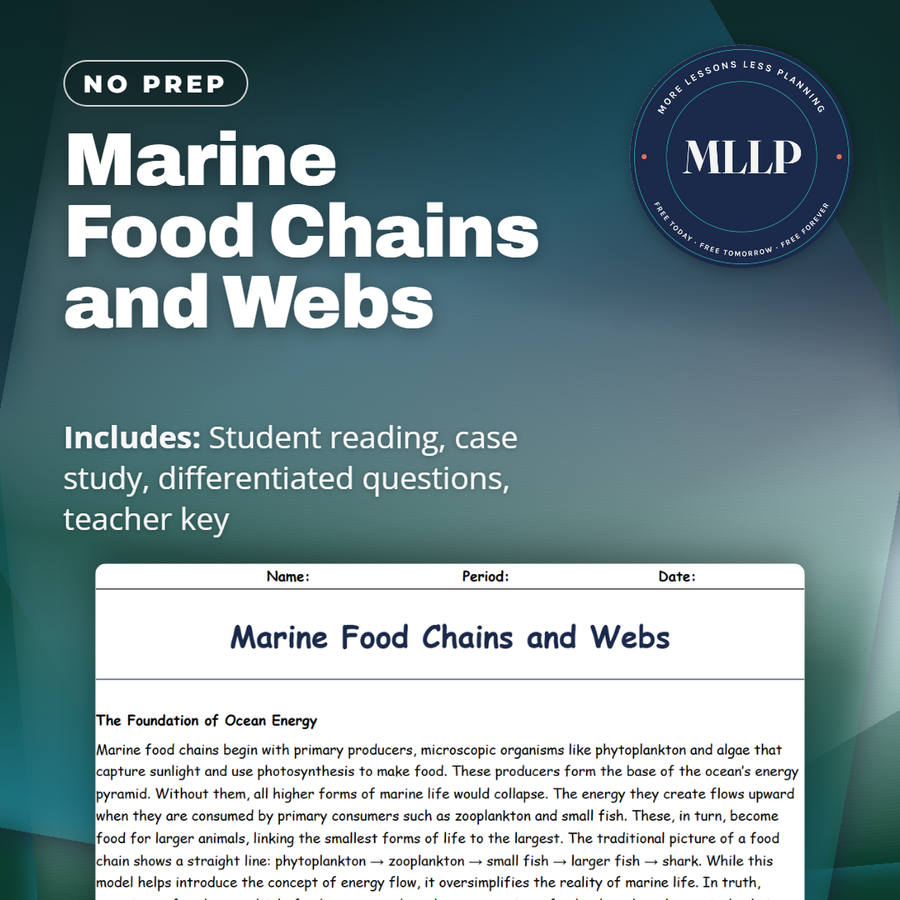
Marine Food Chains and Webs
Quality reviewed September 2026
Facts verified September 14, 2026
- Subject
- Science
- Grades
- Grades 9-12
- Length
- 6-page student worksheet
- Time
- About one 50-minute class period
- Great for
- Sub plans and independent work
- Includes
- Reading passage, comprehension questions + full answer key
- Format
- Print-and-go PDF
What students do
- Match terms like tuna, phytoplankton, zooplankton, bacteria, and small fish to their correct trophic roles
- Fill in the blank sentences on the 10% rule, food webs, and blue whales
- Answer multiple choice questions on what forms the base of marine food chains and what happens to energy at each trophic level
- Write short answers and case study questions on why food webs are more realistic than food chains and the Antarctic krill-based web
What it covers
- How energy moves from phytoplankton through consumers and decomposers in a marine food chain
- Trophic levels and the 10% rule that limits how much energy reaches top predators
- A case study on the Antarctic food web, where krill link phytoplankton to penguins, seals, and whales
Start reading this worksheet
The Foundation of Ocean Energy
Marine food chains begin with primary producers, microscopic organisms like phytoplankton and algae that capture sunlight and use photosynthesis to make food. These producers form the base of the ocean’s energy pyramid. Without them, all higher forms of marine life would collapse. The energy they create flows upward when they are consumed by primary consumers such as zooplankton and small fish. These, in turn, become food for larger animals, linking the smallest forms of life to the largest. The traditional picture of a food chain shows a straight line: phytoplankton → zooplankton → small fish → larger fish → shark. While this model helps introduce the concept of energy flow, it oversimplifies the reality of marine life. In truth, organisms often have multiple food sources and predators, creating a food web rather than a single chain. Food webs provide stability by offering different pathways for energy transfer. If one prey species declines, predators may switch to another, keeping the system balanced.
Producers, Consumers, and Decomposers
The ocean’s producers include phytoplankton, seaweeds, and some bacteria. These organisms use photosynthesis to produce organic matter, forming the first link in every chain. Consumers are divided into categories depending on their diet. Herbivores, such as manatees and parrotfish, feed on plants and algae. Carnivores like tuna and dolphins eat other animals. Omnivores, such as sea turtles, can consume both plants and animals. At the end of the cycle are decomposers, including bacteria and fungi, which recycle nutrients back into the environment by breaking down dead organisms. This division of labor ensures that no energy is wasted. Every death and every discarded fragment of organic matter fuels new growth. The recycling provided by decomposers is essential for maintaining productivity in marine systems, particularly in nutrient-poor open oceans where resources are limited.
Energy Transfer and Trophic Levels
Marine food webs are organized into trophic levels, or steps in the feeding hierarchy. The first trophic level is occupied by producers. The second level includes herbivores that feed on producers, followed by carnivores at higher levels. At each transfer, about 90% of energy is lost to heat, movement, and metabolic processes, leaving only 10% available for the next level. This 10% rule explains why ecosystems can only support a limited number of top predators. For example, it takes countless phytoplankton to support a small number of krill, which in turn sustain fewer whales. Energy loss explains why food chains rarely extend beyond four or five levels. The efficiency of this transfer also determines how much biomass an ecosystem can maintain at each level.
Like what you read? The full reading, the case study, and every question set are in the free download below, along with the answer key.
Why this matters
Energy loss is brutal at every step up a food chain: barely ten percent of what's available at one trophic level makes it to the next, which is why a chain quickly runs out of energy before it reaches a top predator. This reading uses the Antarctic food web, where krill link phytoplankton to penguins, seals, and whales, to show why a chain is really a simplified stand-in for a web.
I ask students what would happen to seals and whales if krill numbers crashed, and most can trace the collapse through the chain right away. What takes longer to land is why real ecosystems have backup paths that a simple chain hides, which is why scientists draw webs instead.
From one teacher to another
This set of readings traces how energy moves from phytoplankton up through zooplankton, small fish, and top predators in a marine food web. It walks through why real ocean communities behave more like interconnected webs than simple chains, and how the 10% rule limits how many trophic levels a system can support. The case study looks at the Antarctic food web, where krill link tiny phytoplankton blooms to penguins, seals, and blue whales.
What you get
Download
Where should I send the next one?
Everything here is free and it stays that way. Leave your email and I'll send you the new lessons as they go up. You can unsubscribe from any one of them.
Related resources
Abiotic and Biotic Factors Shaping Marine Ecosystems
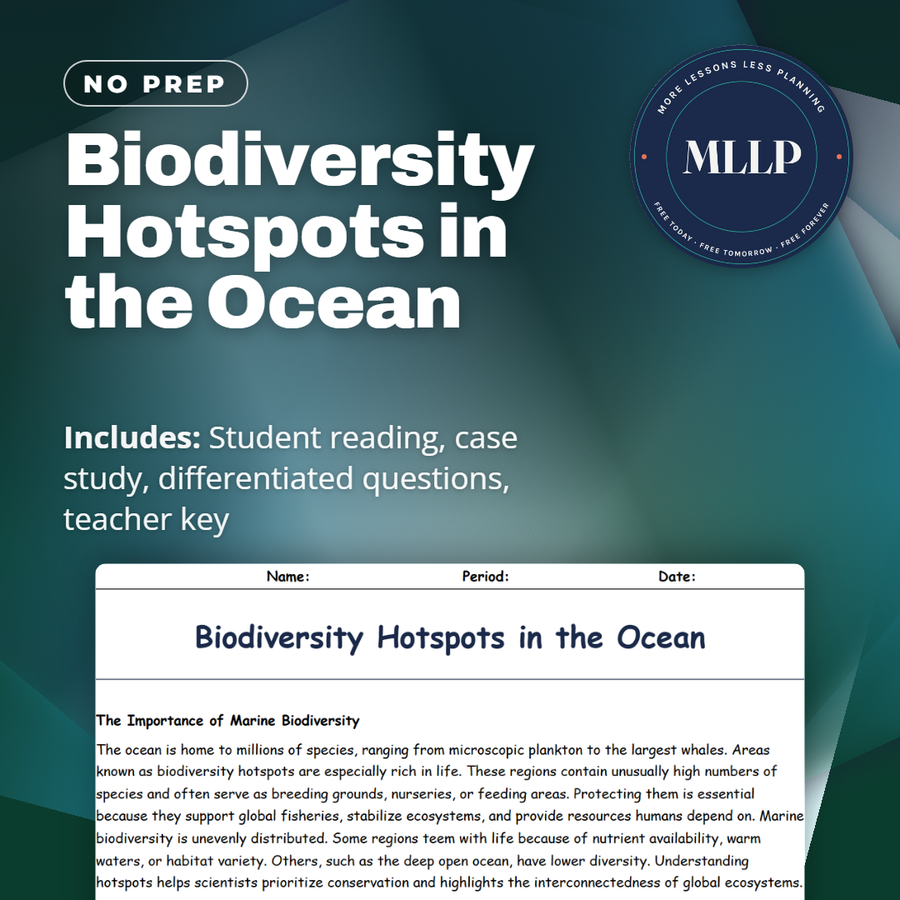
Biodiversity Hotspots in the Ocean
Ecological Niches and Competition in Marine Ecosystems
Ecosystem Principles: How Marine Life Interacts and Survives
Human Influences on Marine Ecosystems
Keystone Species and Their Role in Ecosystem Balance
Every lesson on this site is free to download and use. If one of them saved you a prep period, you can chip in a few bucks toward my three kids' daycare fund. That's genuinely where tips go.