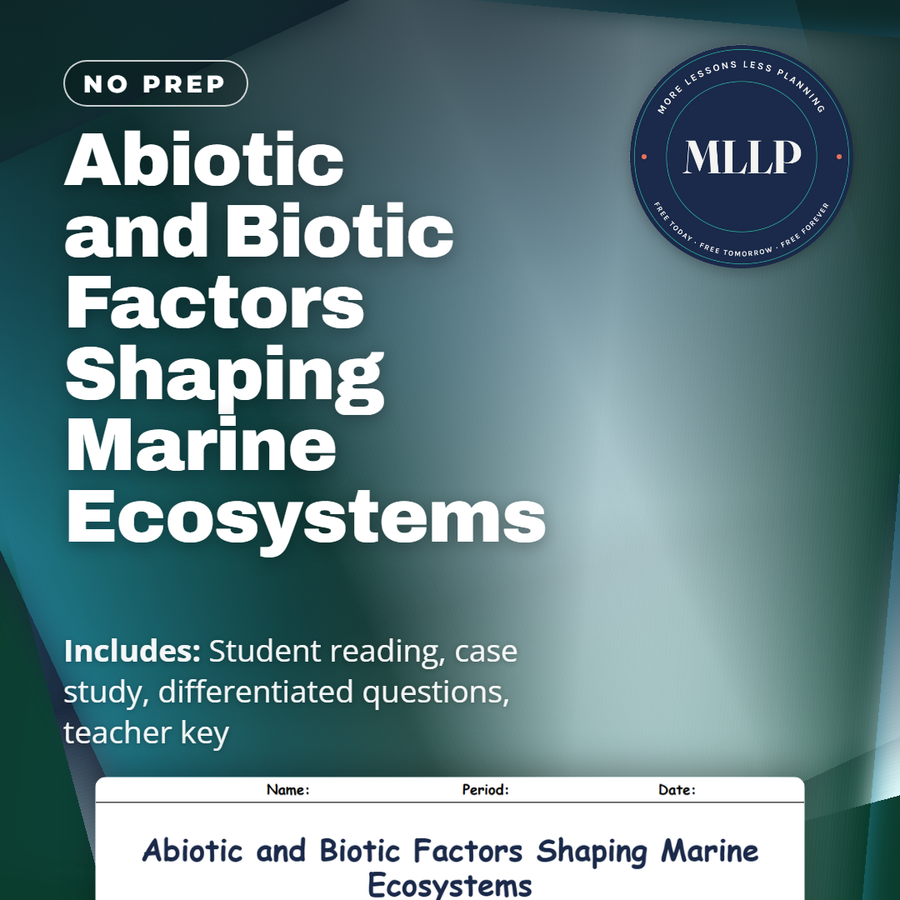
Abiotic and Biotic Factors Shaping Marine Ecosystems
Quality reviewed September 2026
Facts verified September 14, 2026
- Subject
- Science
- Grades
- Grades 9-12
- Length
- 7-page student worksheet
- Time
- About one 50-minute class period
- Great for
- Sub plans and independent work
- Includes
- Reading passage, comprehension questions + full answer key
- Format
- Print-and-go PDF
What students do
- Match terms like temperature, symbiosis, salinity, predation, and competition to their correct definitions
- Fill in the blank sentences on the photic zone, coral bleaching, and upwelling
- Answer multiple choice questions on light availability, predation, and how abiotic and biotic factors interact in ecosystems
- Write short answers and case study questions on coral bleaching, human impacts on abiotic conditions, and protecting keystone species
What it covers
- Abiotic factors like temperature, salinity, and light that shape life in the ocean
- Biotic factors like predation, competition, and symbiosis that shape marine communities
- A case study on coral bleaching and how abiotic and biotic stress combine to threaten reefs
Start reading this worksheet
Environmental Forces That Shape the Ocean
Marine ecosystems are influenced by two broad categories of factors: abiotic (non-living) and biotic (living). These elements work together to determine where organisms live, how they behave, and how communities change over time. Abiotic factors are things like temperature, salinity, light availability, pH, nutrient levels, and ocean currents. Each plays a role in shaping life in the sea. For example, water temperature affects metabolic rates in fish, and light penetration sets the boundaries for photosynthetic organisms like phytoplankton. Currents distribute nutrients, while salinity determines which organisms can thrive in estuaries versus the open ocean. Biotic factors include all living interactions. This includes competition, predation, mutualism, and the presence of keystone species. A coral reef, for example, may be stable because of the relationships among corals, algae, grazing fish, and apex predators. If one of those links is altered, the biotic balance shifts. Thus, marine life exists within an ever-changing mosaic where the abiotic “stage” sets the physical conditions, and the biotic “actors” interact within those limits.
Abiotic Factors in Depth
The abiotic environment of the ocean is not uniform. Temperature decreases with depth, light fades as water thickens, and dissolved oxygen varies with circulation patterns. Nutrient availability often controls productivity, especially nitrogen and phosphorus. These nutrients are most abundant near coastlines and areas of upwelling, where deep, nutrient-rich water rises to the surface. Regions with strong upwelling, such as the coast of Peru, often support massive fisheries because plankton growth is sustained by this nutrient delivery. Salinity—the concentration of salts—affects buoyancy, osmoregulation, and species distribution. Most marine organisms are adapted to fairly stable salinities, but in estuaries, salinity can fluctuate with tides and rainfall, demanding special adaptations. Light penetration limits photosynthesis to the upper photic zone. Beyond this zone, life depends on detritus sinking from above or on chemosynthesis around hydrothermal vents. These abiotic constraints mean life is clustered where conditions allow survival.
Biotic Factors in Depth
Biotic interactions shape the character of every marine community. Predators regulate prey populations, preventing overgrowth of certain species. Competition forces organisms to exploit resources in unique ways, helping establish ecological niches. Symbiosis produces fascinating survival strategies: cleaner fish remove parasites from larger hosts, corals and algae share resources, and parasites exploit their hosts. The presence of a keystone species can restructure whole ecosystems. For example, grazing herbivorous fish on coral reefs prevent algae from smothering corals. Similarly, sharks often regulate populations of mid-level predators, which in turn affects the abundance of species lower in the food web. Biotic forces are dynamic, sometimes reinforcing stability, sometimes producing sudden shifts when species are added, removed, or altered by human impacts.
Like what you read? The full reading, the case study, and every question set are in the free download below, along with the answer key.
Why this matters
A reef can have plenty of coral and still collapse if one grazing fish disappears from the food web. Temperature, salinity, and light set the stage here, but predation, competition, and symbiosis decide who actually survives on it, and upwelling off coasts like Peru shows the two working together by hauling nutrients up from the deep.
My students usually sort abiotic and biotic into two neat boxes and stop there. The coral bleaching case study forces them back together: warming water is abiotic, the grazing fish that would normally protect the reef are biotic, and losing either one changes the outcome for the whole system.
From one teacher to another
This worksheet looks at the two forces that shape every marine habitat: abiotic conditions like temperature and light, and biotic interactions like predation and symbiosis. Students read about how upwelling delivers nutrients along coastlines such as Peru, then work through how grazing fish and other keystone species keep reefs in balance. The case study covers coral bleaching, showing how warming water and reduced grazing fish combine to slow reef recovery.
What you get
Download
Where should I send the next one?
Everything here is free and it stays that way. Leave your email and I'll send you the new lessons as they go up. You can unsubscribe from any one of them.
Related resources
Biodiversity Hotspots in the Ocean
Ecological Niches and Competition in Marine Ecosystems
Ecosystem Principles: How Marine Life Interacts and Survives
Human Influences on Marine Ecosystems
Keystone Species and Their Role in Ecosystem Balance
Marine Food Chains and Webs
Every lesson on this site is free to download and use. If one of them saved you a prep period, you can chip in a few bucks toward my three kids' daycare fund. That's genuinely where tips go.